Department of
Biomedical Engineering
Where Engineering Meets Medicine
The Tulane Department of Biomedical Engineering has been a global leader in biomedical engineering scholarship since 1977. Our mission is to inspire and work with students as we develop and apply engineering methods to confront health science challenges. We strive for excellence in undergraduate and graduate education, meaningful and innovative research, and service dedicated to advancing the field of Biomedical Engineering.


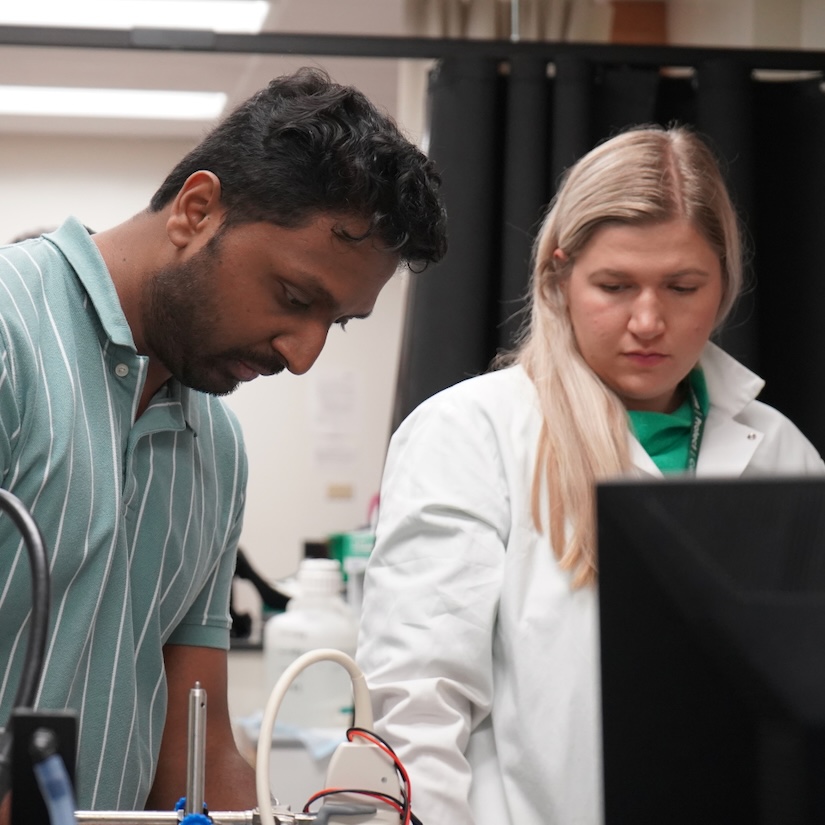
BME in the Spotlight


FAQs
Biomedical engineering applies engineering principles to problems in medicine and human health. Biomedical engineers design medical devices, develop diagnostics, model biological systems, and build the technologies that doctors and researchers use to treat patients and understand disease. The field sits at the intersection of mechanical engineering, electrical engineering, biology, anatomy, and physiology.
Tulane's Biomedical Engineering Program (established in 1977) has been continuously accredited since 1981 by the Engineering Accreditation Commission of ABET, under the commission’s General Criteria and Program Criteria for Bioengineering and Biomedical and Similarly Named Engineering Programs.
Undergraduate Program Educational Objectives:
Our undergraduate program provides students with the breadth required for participation in the interdisciplinary field of biomedical engineering and the depth required by engineers to advance the practice in our discipline. Our objective is to prepare graduates who are able to successfully pursue:
- advanced studies leading to research or professional practice in biomedical engineering
- advanced studies leading to research or professional practice in the health and medical sciences
- practice in biomedical engineering industries or related technical and professional fields
Undergraduate Student Outcomes
By the time of graduation, we expect our students to demonstrate that they have attained the following outcomes:
- an ability to identify, formulate, and solve complex engineering problems by applying principles of engineering, science, and mathematics
- an ability to apply engineering design to produce solutions that meet specified needs with consideration of public health, safety, and welfare, as well as global, cultural, social, environmental, and economic factors
- an ability to communicate effectively with a range of audiences
- an ability to recognize ethical and professional responsibilities in engineering situations and make informed judgments, which must consider the impact of engineering solutions in global, economic, environmental and societal contexts
- an ability to function effectively on a team whose members together provide leadership, create a collaborative and inclusive environment, establish goals, plan tasks, and meet objectives
- an ability to develop and conduct appropriate experimentation, analyze and interpret data, and use engineering judgment to draw conclusions
- an ability to acquire and apply new knowledge as needed, using appropriate learning strategies.
Undergraduate Program Criteria
Additionally, our program prepares our graduates with experience in:
(a) Applying principles of engineering, biology, human physiology, chemistry, calculus-based physics, mathematics (through differential equations) and statistics;
(b) Solving bio/biomedical engineering problems, including those associated with the interaction between living and non-living systems;
(c) Analyzing, modeling, designing, and realizing bio/biomedical engineering devices, systems, components, or processes; and
(d) Making measurements on and interpreting data from living systems.
Undergraduate Enrollment and Graduation Information
Undergraduate Enrollment:
2024-2025: 125
2023-2024: 105
2022-2023: 100
2021-2022: 113
BSE Degrees Earned:
2024-2025: 16
2023-2024: 21
2022-2023: 28
Yes. A master’s degree in biomedical engineering changes which jobs you can apply for on day one. Without it, a bachelor’s grad typically spends 10 to 20 years building toward roles in R&D, technical consulting, or advanced engineering. With an MS, you reach those roles one to two years after graduation. The degree does not just add knowledge. It moves you into a higher job tier immediately.
Employers sort candidates differently depending on their degree level. A BS in biomedical engineering qualifies you for entry-level lab roles, quality assurance, and manufacturing positions. An MS qualifies you for roles that require independent judgment, project leadership, and technical depth.
That tier difference shows up in hiring. Many R&D positions, regulatory affairs roles, and technical consulting jobs list an MS as a minimum requirement, not a preference. You can have five years of industry experience and still be screened out because the job requires a graduate degree.
Salary data reflects the same gap. MS graduates enter higher pay bands at the start of their careers and reach senior-level compensation faster than BS-only graduates in comparable roles.
With a master’s degree, you become eligible for a different set of roles across the biomedical sector. These include:
- R&D engineer at a medical device or biotech company
- Regulatory affairs specialist at the FDA or in industry
- Clinical applications engineer working directly with healthcare providers
- Technical consultant for healthcare technology firms
- Product development lead at a startup or established manufacturer
- Biomedical scientist at a government research agency
- Program or project manager for clinical trials or product launches
These roles are not typically accessible to BS graduates without years of demonstrated advancement. An MS compresses that timeline significantly.
A common objection to pursuing a master’s degree is that work experience can substitute for it over time. In some fields, that is true. In biomedical engineering, it largely is not.
The R&D and consulting roles that pay the most and offer the most autonomy are structured around degree tiers. Companies use degree requirements as a first filter, especially in regulated industries like medical devices and pharmaceuticals where technical credentials carry legal and compliance weight.
Spending a decade building experience without the degree means competing for senior roles against candidates who have both. The degree removes that barrier at the start of your career rather than requiring you to overcome it later.
A traditional MS in biomedical engineering prepares you to go deeper into engineering and research. That is valuable, but it points you toward a specific set of roles, primarily in labs, academia, and technical engineering positions.
The MS in Bioinnovation at Tulane is built for a different outcome. The program focuses on moving biomedical technologies from research into commercial use. You learn engineering and biology alongside entrepreneurship, regulatory strategy, and market analysis.
The program includes a built-in commercialization internship where you work directly with a startup, industry partner, or faculty-developed technology. You conduct customer discovery, market research, and a full commercialization analysis, then deliver a final report that documents your applied work. Graduates leave with a project they can point to, not just coursework.
That focus opens roles that a traditional BME master’s does not. Product development and commercialization roles at biotech companies, startup founding or early-stage team positions, technology transfer and licensing roles at universities and hospitals, and venture development within healthcare organizations are all pathways that align with what the Bioinnovation MS prepares you for.
Tulane BME graduates work across the biomedical sector. Alumni go on to roles at medical device companies, biotech startups, healthcare technology firms, consulting organizations, and research institutions. The Bioinnovation program specifically attracts students interested in the commercial side of the industry, and graduates pursue paths in product development, technology licensing, and early-stage company building.
The program draws on Tulane’s connections to the New Orleans startup ecosystem and to the Tulane Innovation Institute, which means students are working with real technologies and real commercialization challenges during the program itself.
Request information about the Tulane MS in Bioinnovation or start your application today.
Biomedical engineers work across research, development, manufacturing, and clinical environments. Day to day, the work varies depending on the sector and role. Some engineers design and test medical devices. Others analyze clinical data, develop imaging systems, or work on regulatory submissions to bring a product through approval.
Common work areas include:
- Medical device design and prototyping
- Biomechanics and rehabilitation engineering
- Imaging and diagnostic technology
- Tissue engineering and regenerative medicine
- Drug delivery systems
- Clinical instrumentation and wearable health technology
- Regulatory affairs and quality systems
- Healthcare robotics and surgical systems
Because the field spans both engineering and life sciences, biomedical engineers can move between technical, clinical, and commercial roles over the course of a career. That flexibility is one of the field’s practical advantages.
The terms are often used interchangeably, but there is a meaningful distinction. Biomedical engineering focuses specifically on applications in human health and medicine. The goal is to develop and improve technologies that directly affect patients and clinical care.
Bioengineering is broader. It includes applications in agriculture, environmental science, food production, and industrial biotechnology in addition to medicine. A bioengineer might work on crop yield optimization or biofuel production. A biomedical engineer is focused on the human body and healthcare.
Some universities use the terms differently based on departmental structure rather than a strict technical distinction. When evaluating programs, look at the curriculum and faculty research areas rather than the program name alone.
Bioinnovation refers to the development and progression of clinically relevant biomedical technologies from the lab to the marketplace. It is the process of taking a promising scientific discovery and moving it through development, regulatory approval, commercialization, and clinical use.
Most biomedical engineers are trained to work within one stage of that process, typically research or manufacturing. Bioinnovation training prepares you to understand and navigate the full lifecycle of a technology. That means knowing not just how to build something, but how to evaluate its commercial potential, meet regulatory requirements, and bring it to the people who need it.
Tulane’s MS in Bioinnovation is built around this concept. The program combines engineering and biology with entrepreneurship, finance, and regulatory strategy so graduates can work across the commercialization pipeline, not just within it.
Biomedical engineers work in a wide range of industries and organizations. Employment is not limited to hospitals or research labs. The field spans:
- Medical device manufacturers
- Pharmaceutical and biotech companies
- Healthcare technology startups
- Academic and government research institutions
- Regulatory agencies including the FDA
- Consulting firms that serve the healthcare industry
- Clinical research organizations
- Rehabilitation and prosthetics companies
- Telemedicine and digital health companies
- Defense and government agencies with biomedical programs
Job growth in biomedical engineering runs at approximately 5% annually, which is faster than average across engineering disciplines. The consistent demand reflects how central biomedical technology has become to healthcare delivery and the life sciences industry.
Contact Us
Mailing Address
Department of Biomedical Engineering
Lindy Boggs Center, Suite 500
Tulane University
New Orleans, LA 70118
Email
bmen-info@tulane.edu
Phone
504-865-5897
Fax
504-862-8779
Send Us a Message
Please use the form to send us a message about any questions you may have.
"You're seeing the real-world impact in real time."