
Seminars, News, and Events
Seminars, News, and Events
Stay connected with the Physics and Engineering Physics community at Tulane. From visiting speakers and research talks to faculty honors and department milestones, our seminars, news, and events offer a window into the ideas, discoveries, and people shaping physics and engineering physics here in New Orleans and beyond. Whether you’re a current student, a prospective applicant, a fellow scientist, or an alum, there’s always something new to explore.

Seminars
FALL 2026: Seminars are held throughout the Fall semester, normally on Mondays, 3-4pm in Boggs 239 unless specified otherwise.
Date | Speaker | Affiliation | Title |
|---|---|---|---|
Aug 24 | PEP faculty | TU / PEP | State of PEP / Overview of current research projects by PEP faculty |
Aug 31 | Prof. Rath Vannithamby | TU / PEP | Wireless Technology Evolution Towards Intelligent & Connected World of 6G |
Sep 14 | Prof. Yunfeng Shi | RPI | Atomistic Modeling of Ferroelectric Materials in Devices |
Sep 21 | Dr. Alexis Myers | NLR | From Electrons, to Molecules, to Communities |
Sep 28 | Dr. Prashant Padmanabhan | LANL | Light-Driven Phenomena in Gapless Topological Matter |
Oct 5 | Prof. Tianze Liu | Tulane / EES | New Frontiers in Geological Hydrogen Exploration Using Seismology |
Oct 12 | Prof. Denis Seletskiy | U of New Mexico | Photons Are Overrated: Bright, few-cycle quantum light and what you can do with a field |
Oct 19 | Prof. Chunli Huang | U of Kentucky | From Pencil Lead to Quantum Matter: Magnetism and Superconductivity in Stacked Graphene |
Oct 26 | Prof. Elizabeth Scott | Centre College | Measuring Energy with Circuits and Superconductors- An Introduction to Thermal Kinetic Inductance Detectors |
Nov 2 | Dr. Kyle Steffen | Tulane | Probing Gravity and Non-Inertial Effects with Polarized Neutron Interferometry |
Nov 9 | Prof. Georgi Rozenman | MIT | TBA |
Nov 16 | Prof. Mark Pedersen | UTEP | TBA |
PEP News

Tulane scientist leads study on faster charging energy storage
An award-winning Tulane University researcher has led a team in discoveries that could result in significantly faster charging electric vehicles and portable devices such as cell phones and laptops. The team, led by Michael Naguib, the Ken & Ruth Arnold Early Career Professor in Science and Engineering, engineered novel materials at the nanoscale to achieve high power and energy densities.
The new material has the potential to reduce charging times from hours to a matter of minutes.

Engineering graduate and musician values coursework and connections
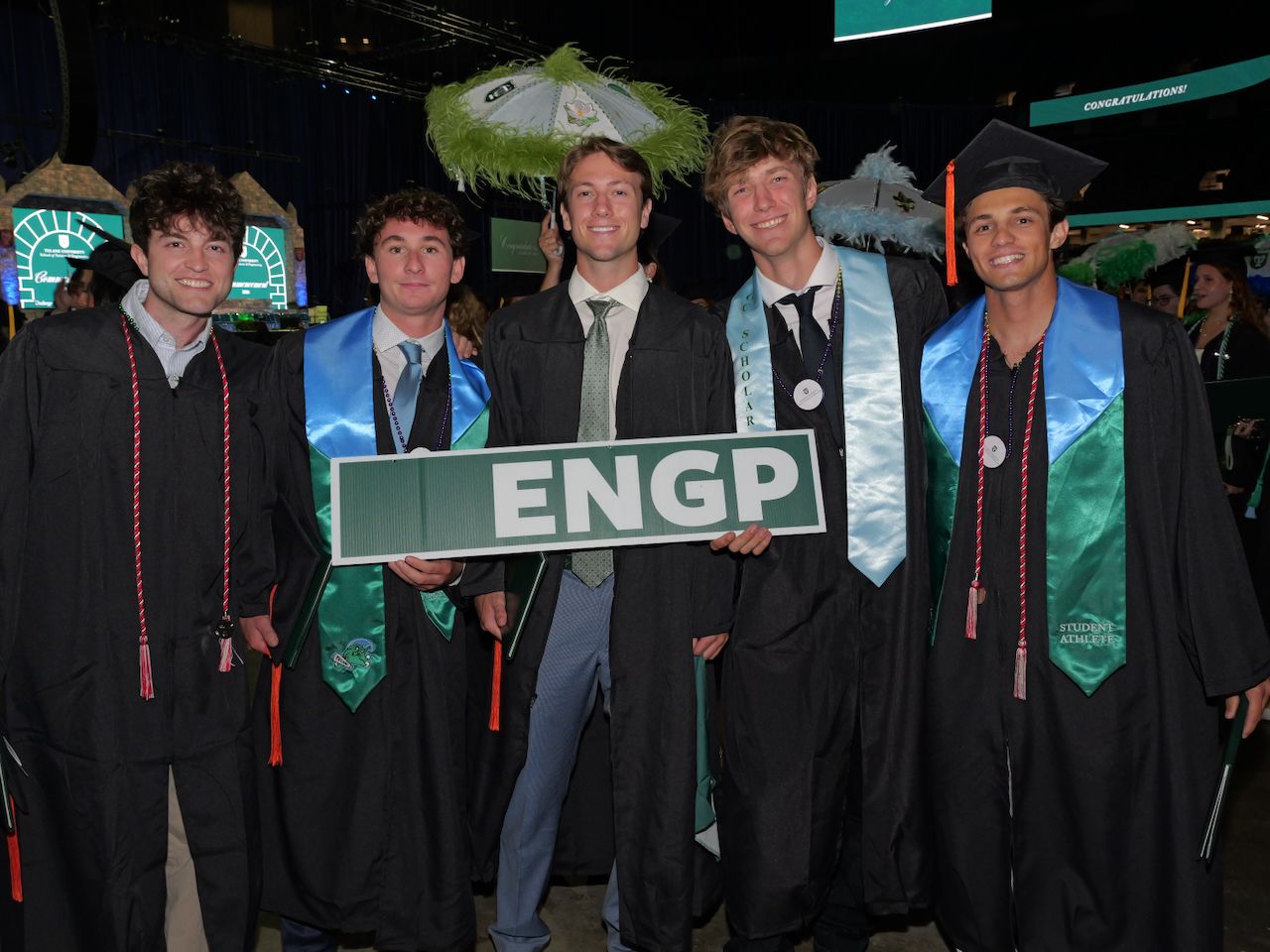
Robert Johnson, who is receiving a Bachelor of Science from the School of Science and Engineering, with a double major in engineering physics and mathematics and a minor in music, embodied the “work hard” mentality, but learned throughout his time at Tulane to enjoy the journey and connections with people along the way.

From Ecuador to the streets of New Orleans, Tulane engineering has no borders
For the past five years, the Tulane chapter of Engineers Without Borders has been working on a water-access project for Laquigo, an Ecuadorian village where residents typically get much of their water from ditches.
The group had planned to spend part of the summer of 2020 in Laquigo, working on the final plans of a 21-kilometer pipeline that would increase the water supply to Laquigo while making sure its access to water could not be cut off by other villages.

W. M. Keck Foundation grant to Tulane could spark “breakthrough” optical, wireless technologies
Tulane University’s School of Science and Engineering has been awarded a $1 million grant from the W. M. Keck Foundation to do what no physicist has ever done before: see through opaque matter using superoscillations of light in a time-domain spectroscopy lab.
That phrase might be difficult for the layperson to grasp, but its results could eventually transform a wide range of fields and technologies, from wireless communications and remote sensing to X-rays and security screenings.
