
Physics Undergraduate Major
Physics Undergraduate Major
Physics is the most fundamental science. It is the foundation for our understanding of the world around us, spanning the ultimate depths within subatomic nuclei to distances beyond the known universe. Physics provides a basis for other sciences, including chemistry, biology, astronomy, and geology. Physics discoveries, which led to technologies ranging from energy sources to quantum information and nano-communication devices to state-of-the-art medical diagnostics, have revolutionized our world and will continue to do so. The physics curriculum at Tulane provides strong analytical skills and problem-solving abilities for careers ranging from academic research to industrial development, to large government exploration, to project management, to the financial sector, to creative writing. The curriculum is unusually flexible and has successfully led to degrees with double, and even triple majors in diverse fields. The physics program also promotes and rewards creativity, stimulates intellectual development, and engages our students in lifelong learning.
The mission of the Physics program is to provide outstanding opportunities for learning and research in physics and teaching of the highest quality and impact, addressing needs and challenges of the 21st century. The program is designed to assist our students in developing deep understanding via powerful problem-solving skills, preparing them for a very broad range of opportunities.

What You'll Learn
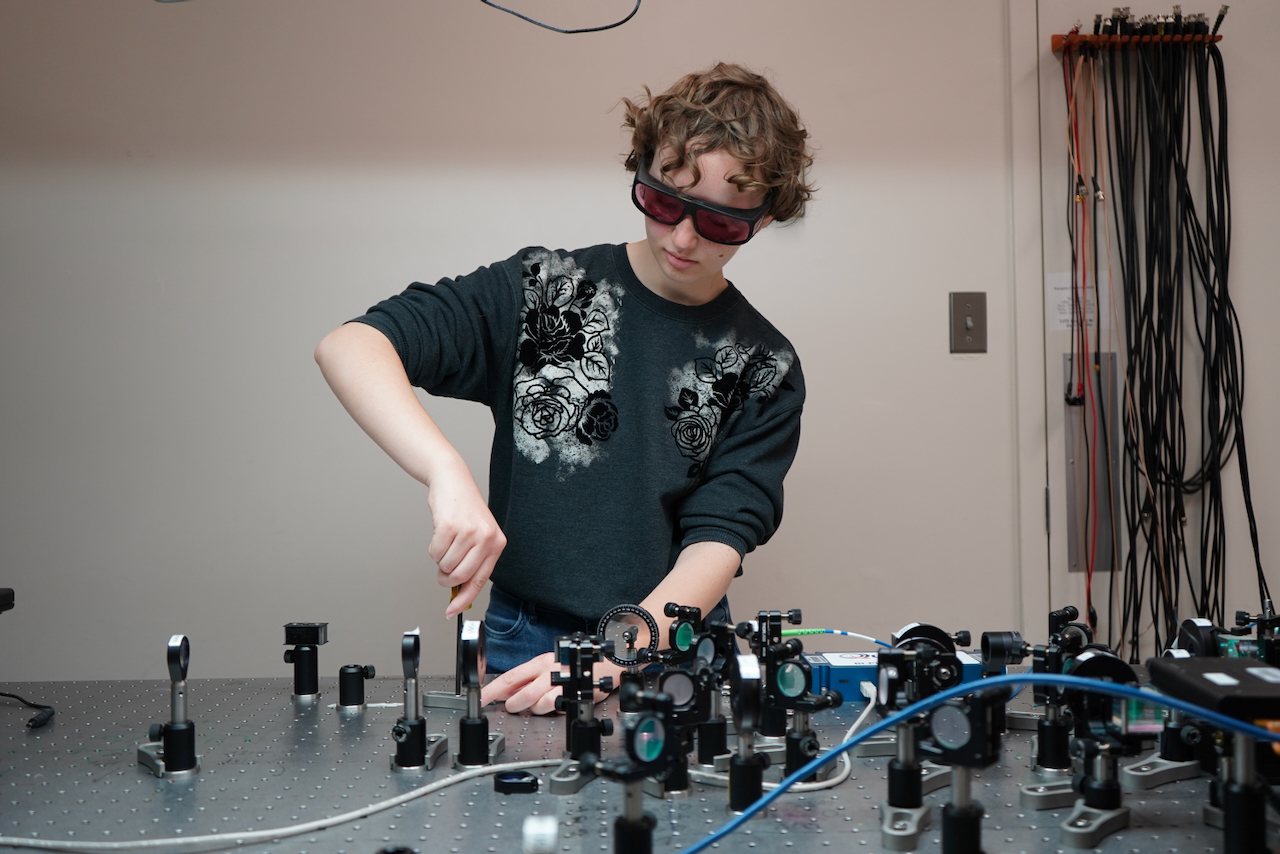
Graduates of the Physics program at Tulane University will come away with the ability to apply knowledge of physics, mathematics, other sciences, and engineering, along with the skills to design and conduct experiments and analyze and interpret data. They'll be equipped to function on multi-disciplinary teams, identify, formulate, and solve problems, and communicate effectively, all grounded in an understanding of professional and ethical responsibility and a recognition of the need for lifelong learning. On the technical side, graduates will develop competence in advanced mathematics — including multivariate calculus, differential equations, and numerical techniques — alongside contemporary analytical and experimental techniques, computational tools, and a high-level programming language. Combined with a depth of knowledge in calculus-based physics at an advanced level and an awareness of contemporary issues, this gives graduates a well-rounded foundation for a wide range of physics-related careers.
Career Outlook
A Physics degree from Tulane builds strong analytical skills and problem-solving abilities for careers ranging from academic research, to industrial development, to large government exploration, to project management, to the financial sector, to creative writing. The curriculum's flexibility supports double and even triple majors, and also prepares students for professional study in medicine, patent law, business, or engineering, and for careers in environmental science, mathematical or computer modeling, science writing, or science and public policy — giving graduates an unusually wide range of directions to take the degree.
The intention of Tulane’s physics major program is to encourage students to continue on to graduate education in Physics and related disciplines or to pursue cross-disciplinary preparation in physics for medical or other professional schools. Dual majors are encouraged. Students pursuing a career in physics are advised to follow the “Pre-graduate Training” sequence.
Meet Our Faculty
The Department of Physics maintains a wide range of research interests among its faculty in both theoretical and experimental fields, giving majors direct access to research happening at the edge of the discipline. Undergraduates are welcome to reach out to faculty listed as Principal Investigators to inquire about joining a research group, making faculty mentorship a real, accessible part of the undergraduate experience rather than something reserved for graduate students.
Curriculum Requirements
The minimum requirements are nine courses in Physics (1310 and above), including Physics 1310, 1320, 2350, and 2360, and 3530 (Advanced Laboratory), four in Mathematics, and an additional approved five elective courses in Mathematics, Physics, Chemistry, Computer Science, or Engineering, and Colloquium 3800. The five electives must be at the two thousand level or above, with the exception of CHEM 1070+1075, CHEM 1080+1085, CMPS 1100, CMPS 1500, and CMPS 1600. One of the electives must be a computational course, offered in PEP or another SSE department. Students should always confirm with the Major Advisor that all their electives are acceptable. All courses or electives counting towards the requirements must be at least three credits (except Colloquium 3800, which does not count as one of the nine courses in Physics).
Of the nine required Physics courses, two upper-level courses must be chosen from 3740 (Classical Mechanics), 3630 (Electromagnetic Theory), 4230 (Thermal Physics), 4470 (Intro. Quantum Mechanics), and 3010 (Theoretical Physics).
At least four courses in mathematics (totaling at least 13 credit hours) are required. No more than two of the four mathematics courses may be at the 1000 level.
The minimum GPA for degree certification, counting all courses pertaining to Physics, Mathematics, and approved Science and Engineering electives, is 2.50.
Research
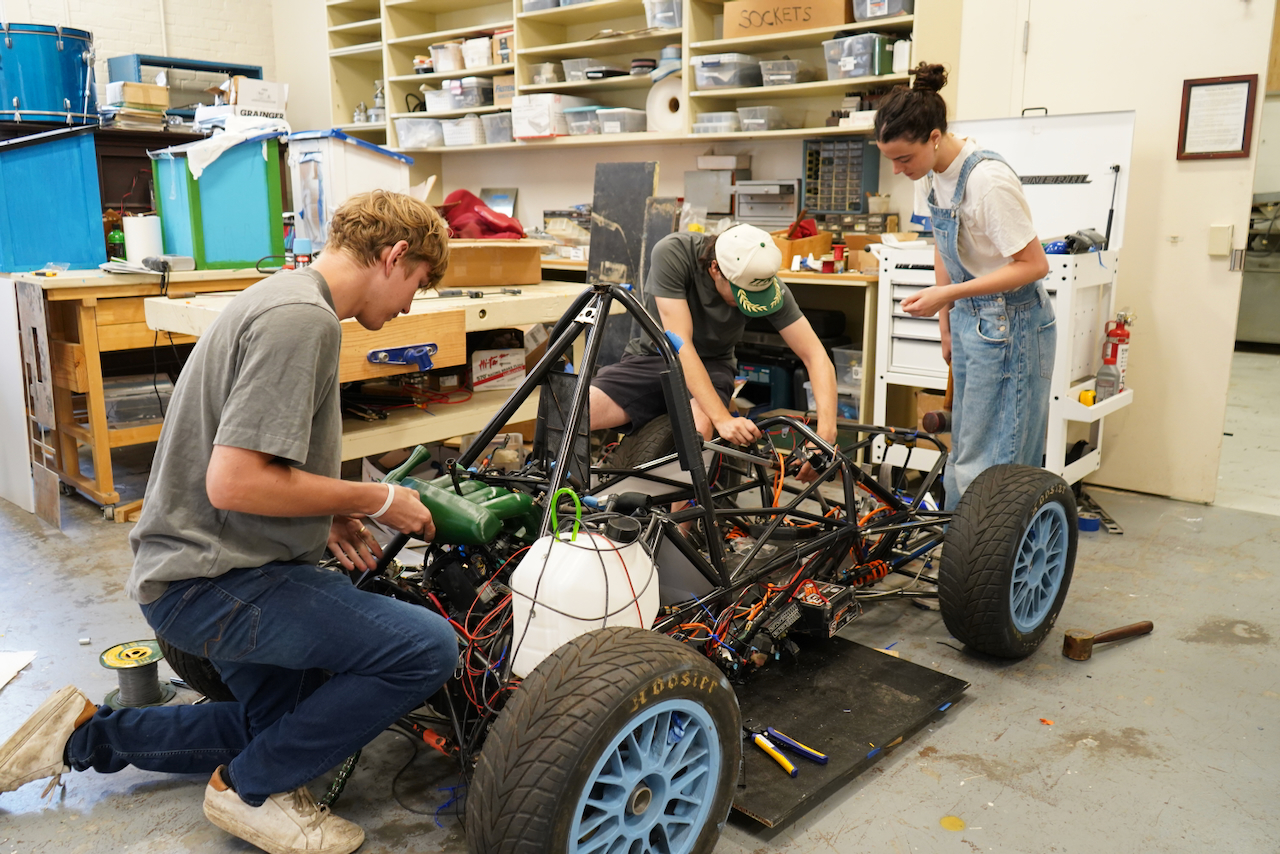
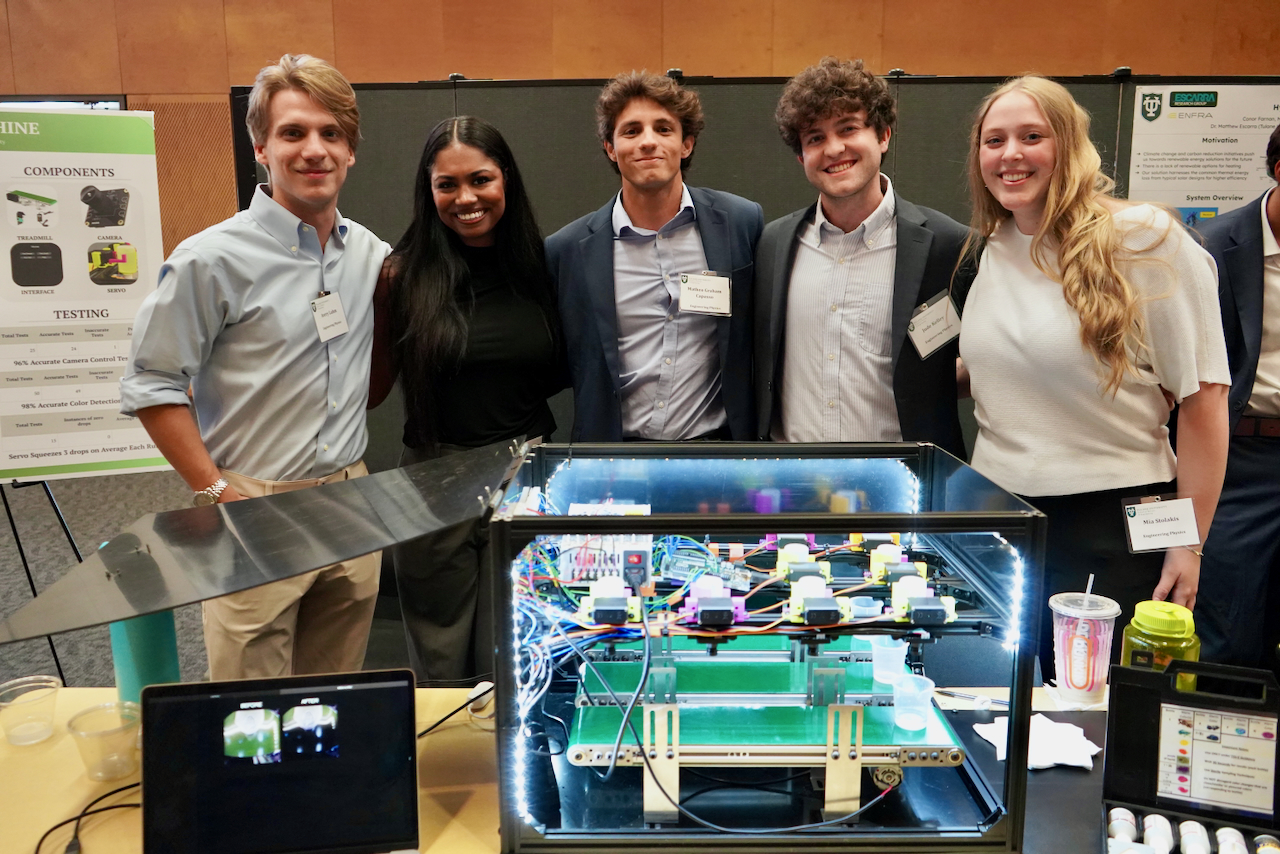
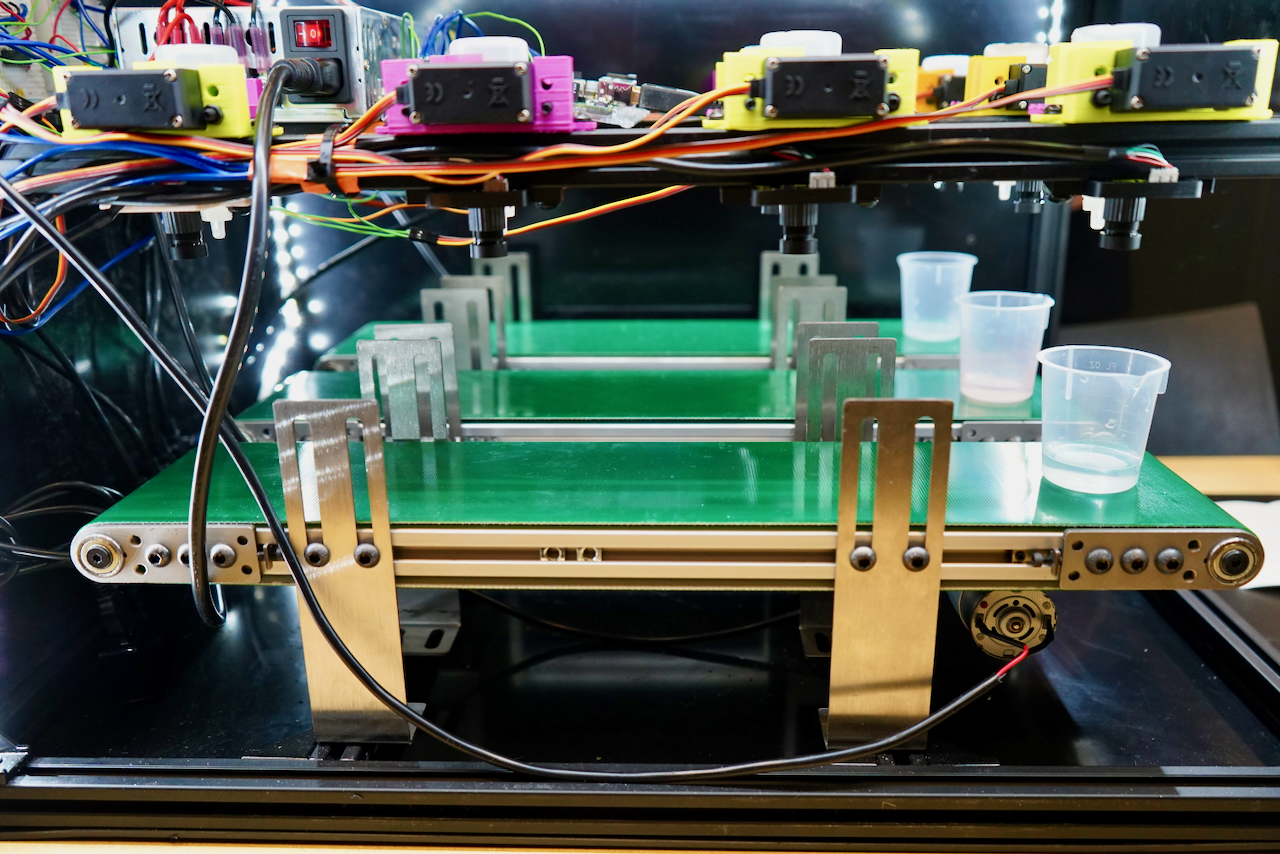
The Department of Physics maintains a wide range of research interests among its faculty in both theoretical and experimental fields, giving undergraduates exposure to research happening across the full spectrum of the discipline. Students interested in getting involved are encouraged to reach out directly to faculty members listed as Principal Investigators on active research programs and projects, making it possible to join a lab and start contributing to real physics research well before graduate school.

Learn more about the admissions process or apply now!
Find full tuition information and the financial aid process.
Get to know what makes this place a launchpad for the next generation of scientists and engineers.
FAQs
Physics is the most fundamental science, providing the foundation for understanding everything from the depths of subatomic nuclei to the farthest reaches of the known universe, and underpinning fields like chemistry, biology, astronomy, and geology. Its discoveries have driven technologies ranging from energy sources to quantum information and modern medical diagnostics, and continue to shape the world today.
Physics is crucial to understanding the world around us, the world inside us, and the world beyond us. It is the most basic and fundamental science. Physics challenges our imaginations with concepts like relativity and string theory, and it leads to great discoveries, like computers and lasers, that change our lives.
Physics encompasses the study of the universe from the largest galaxies to the smallest subatomic particles. Moreover, it's the basis of many other sciences, including chemistry, oceanography, seismology, and astronomy. All are easily accessible with a bachelor's degree in physics.
The importance of physics isn't limited to the “hard sciences.” Increasingly, physicists are turning their talents to molecular biology, biochemistry, and biology itself. Even medicine has a niche for physicists, and since medical physicists are hard to come by, they are much in demand.
Physics also undergirds many new technologies. Cell phones, the Internet, and MRIs are only a few examples of the physics-based technological developments that have revolutionized our world. Many theoretical and experimental physicists work as engineers, and many electrical and mechanical engineers have physics degrees.
A physics education equips a person to work in many different and interesting places—in industrial and government labs, on college campuses, and in the astronaut corps. In addition, many physics grads leave the lab behind and work at newspapers and magazines, in government, and even on Wall Street—places where their problem-solving abilities and analytical skills are great assets.
So—physics is interesting, relevant, and it can prepare you for great jobs in a wide variety of places. Shouldn't you take a physics course?
—Reprinted with permission from the American Physical Society
1. The student fills out the Major/Minor declaration form (linked below) and contacts the appropriate faculty advisor to arrange a meeting:
- Physics major or minor: Prof. Wayne Reed
- Engineering Physics major (without a minor/certificate or if undecided about optional minor/certificate): Prof. Ahmad Majed
- Engineering Physics major with Electrical Engineering minor: Prof. Ryan Gelfand
- Engineering Physics major with Mechanical Engineering minor: Prof. Matt Barrios
- Engineering Physics major with Materials Engineering minor: Prof. Doug Chrisey
- Engineering Physics major with Computational Engineering certificate: Prof. Jianwei Sun
Notes for filling out the form: The degree pursued is BS for a Physics major or BSE for the Engineering Physics major. Students declaring a certificate should enter "ENGP + ___ Certificate" in the "primary major" field.
2. After meeting the student, the faculty advisor signs the form and forwards it to Prof. Jerry Shakov, Associate Chair, for his signature.
3. Prof. Shakov forwards the form to the student's NTC advisor or returns it to the student (in cases where additional signatures from another department are needed).
Students who are interested in obtaining transfer credits should first obtain the transfer credit request form from their academic advisor. They should then attach a detailed course description and/or syllabus to the form for departmental approval. Syllabi are preferred for most courses and are required for introductory physics courses (e.g., algebra-based or calculus-based Physics I and II).
The forms should be returned to April Sanchez in the Physics & Engineering Physics office in 2001 Percival Stern Hall. The office is open from 8:00 AM until 4:00 PM Monday through Friday, excluding all university holidays. Once forms are approved and signed by Dr. Jiang Wei, students will be contacted to retrieve their forms and return them to Academic Advising.
All forms must be submitted and receive approval prior to taking courses at another institution.
Special note for online coursework: A lecture course that was delivered online may be considered for transfer credit, but any laboratory component must be completed in person to receive credit. For this purpose, a student may take the 1-credit lab section separately to complete the requirements for a laboratory science course that was taken elsewhere online. However, for introductory physics courses (e.g., algebra-based or calculus-based Physics I and II), the lecture and corresponding in-person lab must be taken concurrently to qualify for transfer credit.
The student who intends to continue graduate work in physics should complete at least 32 credits in physics including 1310, 1320, 2350, 2360, 3630, 3740, 4230, 4470, and 4650. Students are encouraged to undertake a research project and write a senior honors thesis under the supervision of a physics faculty member. Recommended mathematics courses include 3050, 3090, 4060, 4210, and 4300. Courses in scientific computing, e.g., PHYS 3170 or MATH 3310 are also recommended.
Note: This is only a suggested schedule and students should not feel compelled in any way to model their course of studies on this example. Many other options and alternatives are possible, especially when including a double major. Chemistry, for example, is not a requirement for the B.S. in Physics. The illustration of certain courses in certain semesters below does not guarantee they will be offered in the suggested semester. Many physics courses at the 3000 level and above are given only once every two years. Students should keep abreast of actual course offerings as they are published by the Registrar.
1st Year:
Fall
PHYS 1310: General Physics I + lab (4)
MATH 1210: Calculus I (4)
ENGL 1010: Writing (4) [unless exempt]
CHEM 1070+1075: General Chemistry I + lab (4)
TIDES Course (1)
Spring
PHYS 1320: General Physics II + lab (4)
CHEM 1080+1085: General Chemistry II + lab (4)
MATH 1220: Calculus II (4)
Foreign Language or elective(s)
2nd Year:
Fall
PHYS 2350: Modern Physics I (3)
MATH 2210: Calculus III (4)
PHYS 4230: Thermal Physics (3)
Foreign Language or elective(s)
Public Service Course, e.g., Introduction to Physics Pedagogy (1)
Spring
PHYS 2360: Modern Physics II (3)
PHYS 3170: Computational Physics and Engineering (3)
MATH 2240: Applied Mathematics (4)
Cultural Knowledge Elective 1 (3)
Elective(s)
3rd Year:
Fall
PHYS 3010: Theoretical Physics (3)
PHYS 3630: Electromagnetic Theory I (3)
PHYS 3700: Electronic Properties of Materials (3)
PHYS 3800: Colloquium (1)
Cultural Knowledge Elective 2 (3)
Elective(s)
Spring
PHYS 3530: Advanced Laboratory (3)
PHYS 3600: Nanoscience & Technology (3)
PHYS 4650: Optics (3)
Elective(s)
4th Year:
Fall
PHYS 3740: Classical Mechanics (3)
PHYS 3150: Intro to Neutron Science (3)
PHYS 4470: Quantum Mechanics (3)
Elective(s)
Spring
Elective(s)
Mission Statement
The mission of the Physics program is to provide outstanding opportunities for learning and research in physics and teaching of the highest quality and impact, addressing needs and challenges of the 21st century. The program is designed to assist our students in developing deep understanding via powerful problem-solving skills, preparing them for a very broad range of opportunities.
Program Objectives
The Physics program aims to educate students to become professionals with in-depth knowledge and skills in science and mathematics to understand physical systems; to research, design, and solve problems in physics and related disciplines; and to provide the foundation for graduate study and lifelong learning. Our objective is to prepare graduates to be able to successfully pursue:
- Advanced studies leading to research and/or professional careers in physical science;
- Careers in related technical and professional fields in industry or government.
Program Outcomes
Graduates of the Physics program at Tulane University will attain:
- an ability to apply knowledge of physics, mathematics, other sciences, and engineering;
- an ability to design and conduct experiments, as well as to analyze and interpret data;
- an ability to function on multi-disciplinary teams;
- an ability to identify, formulate, and solve problems;
- an understanding of professional and ethical responsibility;
- an ability to communicate effectively;
- a recognition of the need for, and an ability to engage in life-long learning;
- a knowledge of contemporary issues;
- an ability to apply advanced mathematics through multivariate calculus, differential equations, and/or numerical techniques;
- a knowledge of contemporary analytical and experimental techniques;
- a competence in the use of computational tools and in the use of a high-level programming language;
- a depth of knowledge in calculus-based physics at an advanced level.
Our physics curriculum places emphasis on:
- Physics
- Mathematics
- Computer Science and Engineering
- Problem Solving
- Science and Scientific Principles
- Research
- Communications
- Multi-disciplinary Teamwork
- Continuous Learning
- Leadership
- Ethics
- Preparation for Advanced Degrees in a Broad Variety of Fields
The basic physics requirements are flexible and accommodate degrees with majors in multiple and diverse fields. Students planning to continue on to graduate school should take more than the minimum courses required.