
Research
Research
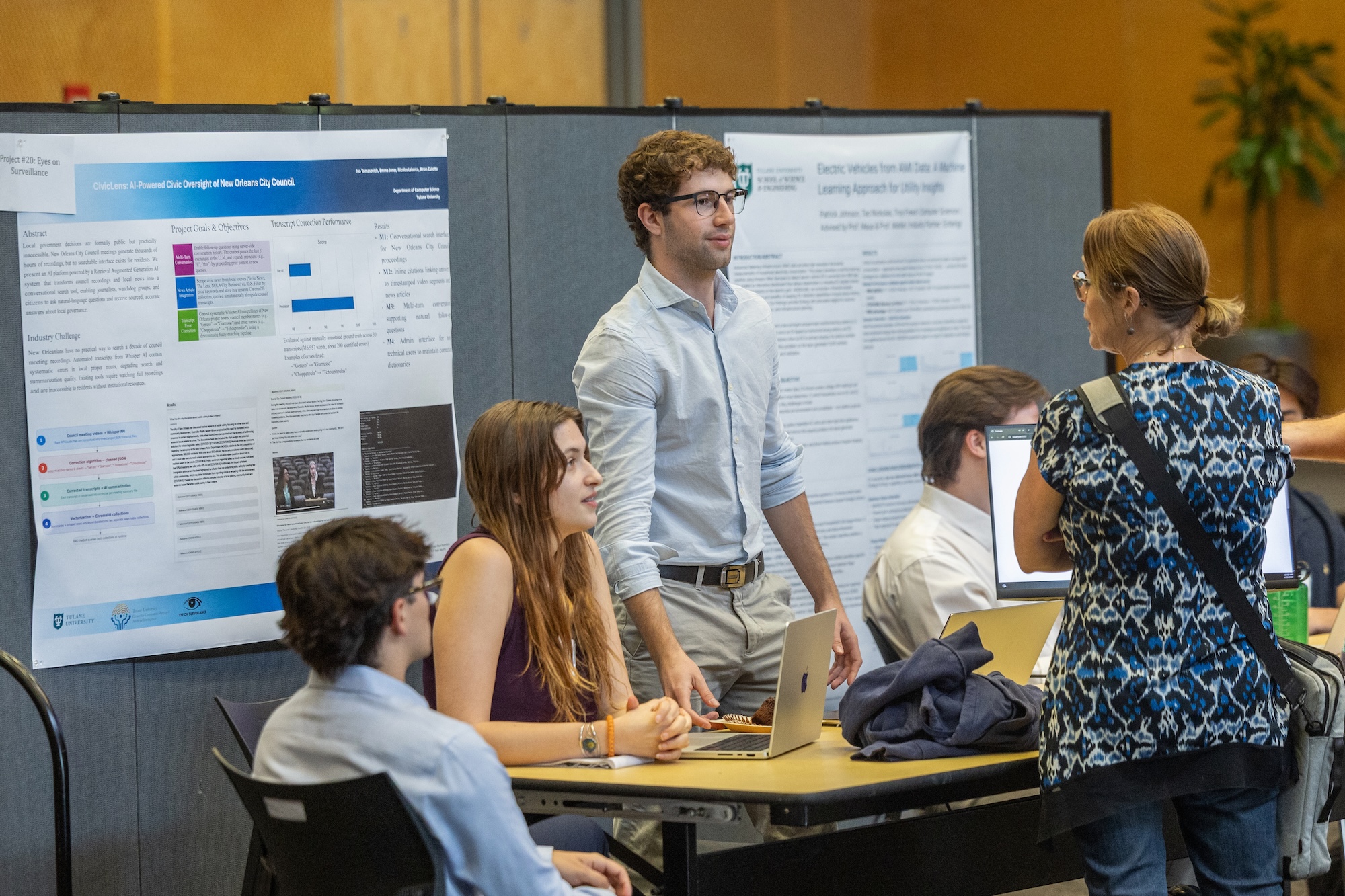
Research in the Department of Computer Science spans the breadth of the field and its connections to other disciplines. Faculty advance work in algorithms, artificial intelligence, machine learning, natural language processing, computer vision, computational biology, privacy and security, networking, data science, and scientific visualization, among other areas. Supported by agencies including NSF, NIH, DARPA, and DoD, this work is recognized nationally and internationally and is increasingly applied to real-world challenges in science, health, and society. Students take part alongside faculty, gaining hands-on experience at the leading edge of computing.
Research Areas

Artificial Intelligence and Machine Learning
Research in this area focuses on the development of algorithms that allow computers to learn from data and make decisions. Topics include deep learning, reinforcement learning, natural language processing, computer vision, and multi-agent systems.

Social network analysis, natural language processing, data science, machine learning.

Computer vision and machine learning, with a focus on developing scalable algorithms to learn robust representations from large-scale data.

Machine Learning: adversarial machine learning, deep learning, privacy and security, optimization, nonlinear dimensionality reduction.

Artificial Intelligence, Data Science, Decision Making, Preferences.

Game Development, Computational Narrative, Artificial Intelligence for Games.

AI Security and Safety, Reinforcement Learning, Networks.
Computational Biology
This research area focuses on designing computational techniques for biological data. It covers topics such as protein structure comparison and high-throughput sequencing.

Protein Structure Comparison and Analysis Techniques, Protein Energy Functions and Minimization Protocols.

Design and analysis of algorithms with guarantees on running time and solution quality, applied to experimental and biological phenomena.
Human-Computer Interaction and Visualization
Research in this area explores the design and evaluation of interactive systems that involve human users. It includes topics like scientific visualization, human-AI interaction, and accessible computing.

Visualization and human-AI interaction with a focus on explainable, human-in-the-loop analysis methods.

Accessible Computing, Human-Computer Interaction (HCI), and Computational Social Science.
Large data processing, scientific visualization, computer graphics, scalable algorithms, and energy minimization.
Software Engineering and Systems
This area focuses on the development and security of software systems, computer architecture, distributed systems, and computer networks.

Software and Systems Security.

Computer architecture, big data analytics, distributed systems, deep learning accelerators, and applications.

Software Engineering, Programming Languages, Data Science.

Systems programming, network and software security, distributed systems.

Software Engineering, Quantum Computing, Heterogeneous Computing, Big Data
AI Security and Safety, Reinforcement Learning, Networks.
Theory, Algorithms, and Computational Geometry
This research area covers theoretical aspects of algorithms, computational complexity, computational geometry, and combinatorial optimization.

Quantum computation/information, combinatorial designs, optimization.
Design and analysis of algorithms with guarantees on running time and solution quality, applied to experimental and biological phenomena.

Algorithms and computational geometry, with a focus on shape matching algorithms and interdisciplinary applications.



Awards
Awards
HCC: Designing Civic AI to Connect Residents, Communities, and Local Governments
SHF: SHARP: Achieving Scalable Blockchain Sharding via Software and Hardware Optimizations
CAREER: Toward Interpretable AI: Modeling and Adapting Data-Driven Semantic Prototypes
SHF: Small: Fault Localization for Deep Learning
Interpretable AI-Driven Multi-Modal MRI for Brain Imaging Analysis
ARPA-H: Machine-learning Assisted Gigantic-Image Cancer Margin Scanner
DOE: Efficient and Accessible Interactive Visual Analytics of Exascale Scientific Data
NSF: Hardware-Assisted Detection of Memory Disclosure Attacks
NSF: Fair Recommendation Through Social Choice
NSF: Mechanisms and Algorithms for Improving Peer Selection
NSF: A Unified Framework for Geometric and Topological Signature-Based Shape Comparison
I-ARPA: METROPOL (Modeling and Encoding TRajectories Of Patterns Of Life)