
EENS Faculty Spotlight Daniel A. Friess, Ph.D.
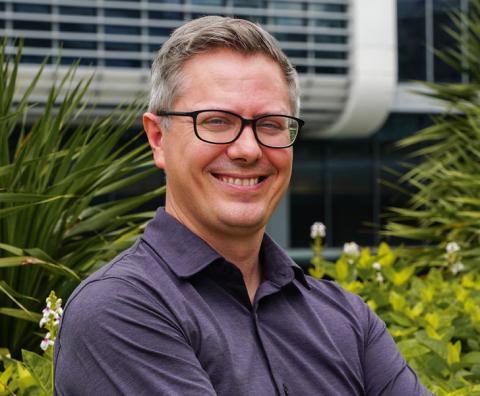
I joined the Department of Earth and Environmental Sciences in early 2023 as the Cochran Family Professor of Earth and Environmental Sciences. Here, I convene the Mangrove Lab – a group of graduate students, undergraduates and researchers dedicated to understanding coastal wetland ecosystems, and the communities who depend on them. We focus particularly on mangrove forests – intertidal forested ecosystems found across the tropics, sub-tropics and warm temperate regions, that have experienced significant loss due to human activities and are projected to be heavily impacted by climate change in the future.
I’m originally from the United Kingdom, and while its way too cold for mangroves there, I’ve long been interested in wetlands and the coast. It was a high school field trip to the Jurassic Coast of southern England that really opened my eyes to the dynamic world of coastal processes and landforms. My PhD at the University of Cambridge investigated hydrodynamic, geomorphological and ecological dynamics of salt marsh restoration. Quickly realizing that the east coast of England in January is too cold and wet for research, I moved across the world and spent 14 years at the National University of Singapore, where we studied mangrove forests across Southeast Asia, South Asia, East Africa and the Pacific.
Our work is concerned with the conservation and restoration of mangroves: why are they important to people? How are they impacted by human and natural stressors? How can we best conserve and restore them, particularly in human-modified landscapes? To answer these questions we often use the lens of “blue carbon”; an international policy term that highlights the exceptional ability of many coastal ecosystems to sequester carbon from the atmosphere and store it at high densities in their waterlogged soils. Their role in the coastal carbon cycle has attracted huge recent interest from governments, nonprofits and the corporate sector, as one tool in our climate change mitigation toolbox.

We use a range of multidisciplinary techniques to investigate blue carbon. A lot of our work involves landscape- to global-scale remote sensing and spatial modeling, to help us understand spatial and temporal patterns in mangrove dynamics, and the drivers of their loss. Spatial modeling also helps us to scope out viable locations globally for potential blue carbon credit projects, or where conservation and restoration may be most successful. We also use policy analyses and social science techniques, to understand the current state of mangrove forests, and human constraints and opportunities for their protection. But nothing beats being covered in mud in the field, whether monitoring geomorphic dynamics in mangroves through our long-term network of Surface Elevation Tables, or measuring trees and soils for their organic carbon stocks and greenhouse gas fluxes.
While we continue to work on mangroves globally and in Southeast Asia, moving to Tulane has been a great opportunity to pivot our research to the Americas. Mangroves here are very different structurally and biophysically compared to their counterparts in the Asian wet tropics. Mangroves in our region face very different human and natural pressures, have different species composition and growth forms, and exist across a wider climatic gradient, from arid-zone mangroves in Baja California Sur in Mexico, to mangroves at the very limit of their cold temperature tolerance along the US Gulf Coast. Only by working across such diverse coastal settings can we get a true understanding of the world’s mangrove forests, and the processes shaping them. Moving to Louisiana has also been a fun opportunity to return to salt marsh research, and to expand our work into the complex mosaic of tidal freshwater ecosystems in the Mississippi Delta and beyond. We are excited to take our concepts and experiences from mangroves and apply them to these lesser researched ecosystems.
Today, our research group works on a range of topics related to mangroves and other coastal wetlands. Dr. Zhen Zhang is a remote sensing scientist interested in global scale mangrove dynamics, such as their deforestation and degradation, and their response to regional-scale ENSO signals. Dr. Lukas Lamb-Wotton leads several projects, including measuring carbon fluxes in expanding mangrove areas on the Mississippi Delta, and their sensitivity and recovery to extreme events such as Louisiana’s heavy snowfall event in 2025. Dr. Gabriela Reyes is using a mixed-methods approach to investigate conflicts and opportunities between blue carbon and community mangrove use in Puerto Rico. PhD student Zoë Shribman is spending months in the field investigating blue carbon dynamics in natural and restored mangroves in Baja California Sur, while our most recent PhD student Damir Creecy has varied research interests around restoration ecology in the Gulf Coast. Undergraduates in our lab continue to do impactful Honors research in places as varied as Louisiana, Ecuador and Singapore, and we continually train undergraduate research assistants in lab, field and remote sensing techniques.
While our research is broad and multidisciplinary, all our projects have one thing in common – a desire to produce research with real world application. We have extensive global collaborations through the International Blue Carbon Initiative Scientific Working Group, The Global Mangrove Alliance, and the IUCN Mangrove Specialist Group, and most of our research is in collaboration with varied stakeholders. Whether it’s working with a national government to get blue carbon into their next National Greenhouse Gas Inventory, providing data for nonprofits and women’s community cooperatives undertaking restoration projects in Baja California Sur, investigating the potential for blue carbon credit projects with our corporate partners, or initiating our own community-based mangrove restoration project. Ultimately, we want our work to help contribute to better conservation and restoration outcomes for coastal ecosystems.
Everyone in the Mangrove Lab, and the broader Earth and Environmental Sciences department are always happy to share our research and ideas with you, please drop by any time!