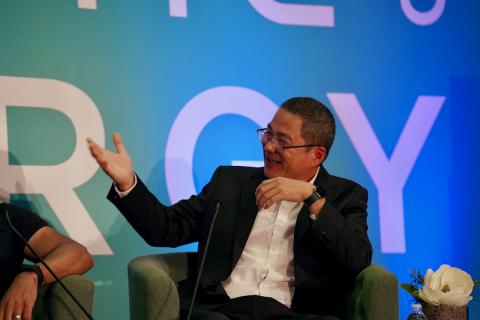
From AI to Critical Minerals, SSE Faculty Take on Energy’s Biggest Challenges


From discovering new superconductors to recovering critical minerals and preparing communities for disasters, faculty from Tulane’s School of Science and Engineering brought a range of expertise to the Tulane Energy Forum. Across the multi-day event, they explored how research and engineering can help meet growing energy needs while improving efficiency and resilience.
For Jianwei Sun and Daniel Strauss, that work includes combining physics, artificial intelligence and experimental chemistry to accelerate the discovery of superconductors. These materials carry electrical current without resistance, but many require extremely cold temperatures to function.
“And if we can make one such superconductor that operates at room temperature, then we don’t need any sort of cooling whatsoever,” Strauss said. “It could enable data centers and processors that give off significantly less heat, using a lot less energy.”
Finding promising materials takes time, however, with researchers synthesizing samples before examining their structures and testing their properties. Strauss described experiments that require heating materials to approximately 1,800 degrees Fahrenheit.
“Even just to heat something up that hot takes about a day, and we have to let it react, cool down, characterize, understand exactly what we made, and then test the properties,” he said. “It can take weeks.”
AI could help researchers narrow that search. Sun described incorporating physical understanding, including electron spin and magnetic information, into models designed to predict superconducting behavior more accurately.
“If we can use AI to help us decide which are the most promising materials, I think we can greatly increase the pace of discovery,” Strauss said. The team hopes to connect those improved predictions with the discovery of new superconductors in the laboratory.
The materials needed for advanced technologies also depend on reliable supply chains. In a discussion moderated by SSE Dean Hridesh Rajan, Cindy Ebinger explained that securing raw materials and developing the capacity to process them present separate challenges.
“Over the past 30 odd years, I’ve done research in Africa and South America, and I watched to see the raw materials coming out of the ground, going on ships, and again moving to these processing facilities,” Ebinger said. She characterized the resulting supply-chain challenge as a “double bottleneck.”
Ebinger highlighted mine waste, discarded batteries and electronic waste as potential sources of valuable minerals. Recovering those resources could help diversify supplies while reducing environmental risks associated with accumulated waste.
“It’s happening. There are many companies, and it’s a really big business,” Ebinger said of mineral recovery from mine waste. She also emphasized the need to prepare students for a field increasingly shaped by remote sensing, robotics and AI.
Rajan reinforced that connection to student opportunity at the close of the session. He encouraged students interested in critical minerals to speak with panelists about the experience and preparation needed to enter the field.
Matt Escarra brought another dimension to the energy conversation, moderating a session on AI and semiconductors. He emphasized that understanding AI’s energy demands requires looking beyond large data centers.
“We focus a lot on massive, centralized compute when we think about energy, but there’s this parallel push towards efficient edge computing,” Escarra said. He noted that “the energy life cycle starts where the data is collected, not just where the inference happens.”
Rath Vannithamby drew on his experience developing successive generations of wireless technology to discuss how engineers could improve AI’s energy efficiency. His recommendations included reducing the energy required for useful work, putting idle systems into sleep modes and designing devices and infrastructure together.
“The third thing is, we need to look at the system as a whole,” Vannithamby said. He also cautioned that efficiency gains would continue to face pressure from expanding use: “But the thing is, when we improve everything, the demand is going to keep coming too.”
For Ibrahim Demir, connecting systems is also central to Louisiana’s disaster resilience. He described how shared data infrastructure, AI and a live digital twin could help communities monitor conditions, anticipate impacts and make better-informed decisions.
“In the last stage, these systems can also talk together through agentic AI, making the data, knowledge, and models accessible at any level, from a city to a parish to a large watershed, and at the state level, connecting all the dots,” Demir said. His proposed approach would bring together information relevant to water, energy, transportation and public health.
Demir emphasized that those capabilities must translate into practical help for communities. The goal is to equip local decision-makers with information “so that they can act in a timely manner to reduce their damage,” connecting advances in computing with the needs of Louisiana residents and infrastructure.
Together, these discussions highlighted how SSE faculty are addressing energy challenges at every scale, from the materials inside new technologies to the infrastructure supporting Louisiana communities. Explore research at Tulane’s School of Science and Engineering to learn more about the people, projects and partnerships moving this work forward.