
Dean's Message
From the desk of Dean Hridesh Rajan:
Sunday, May 17, 2026
New Orleans, LA
Dear Friends and Colleagues of SSE,
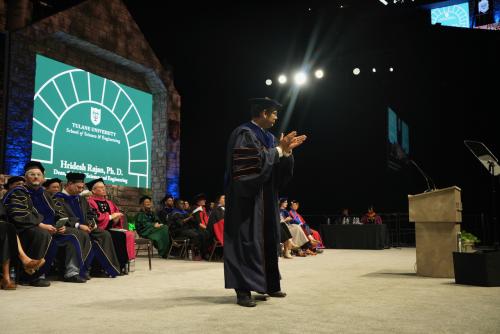
Last night, after two exciting days in the Superdome, first watching another class of SSE graduates cross our school stage on Friday and then joining thousands of Tulanians for the unified commencement ceremony on Saturday, I came home, sat down at my desk, and found myself thinking about each of you. Every name we read this weekend, every photograph snapped by a tired and proud parent in the seats, every cap thrown into that famous arch under the Superdome lights, was a future member of the family that you already belong to, and I wanted you to hear directly from me, while the regalia is still on the chair and the chant of "Roll Wave" is still in my ears, what the last two years have looked like inside the school you helped build. You are the reason our school is described, increasingly and accurately, as a school on the rise. Thank you. Before anything else, simply, thank you.
Two days of commencement is a useful vantage point for taking stock, and I want to use it. I am about to finish my second year as your Dean. Two years is a short span in the life of a typical science and engineering school, but in the life of our young school it is close to ten percent of our entire history, and in the time of our students it is roughly four thousand person-years, so it is worth taking stock with you carefully rather than quickly. I will try to do that here, organized around the three groups of people who make our school what it is, namely our students, our faculty, and our staff, and the structural work we have done together to support them.
Let me begin with our students, because they are why everything else exists, and because what they did this year is the part of the story I most want our alumni community to know. Our students continue to win at the highest national levels, and I am thinking, as one example among many, of Auto Breaux and Trishita Paul, who were named 2026 Goldwater Scholars this spring, with Breaux a junior in physics and mathematics and Paul a sophomore in biomedical engineering with a minor in public health, both of them already deep into the kind of research that turns into a scientific career. Ten of our students and recent alumni were awarded National Science Foundation Graduate Research Fellowships or Honorable Mentions this year, a recognition that funds the most promising young scientists in the country at the earliest stage of their graduate careers, and a leading indicator of the STEM pipeline Tulane is feeding. Our students continue to take on real-world problems with science and engineering for better lives, and I am thinking of the team that designed a new inhaler for patients with chronic lung disease, of the students who built a Formula-style race car from the ground up as their capstone, of the team that reimagined a low-cost device for foot drop, and of the team rethinking infant safety beyond the simple alarm. Our students continue to reach beyond Earth and beyond our city, with undergraduates running an origins-of-life experiment in microgravity supported by NASA, with another team helping pioneer lunar cement also with NASA, and with a third pitching fungi as a food source for the International Space Station. Closer to home, students from finance, engineering, theater, and AI partnered with New Orleans nonprofits to turn coursework into community change, two of our undergraduates launched a student-built internship program called FUSE that connects Tulane STEM talent with start-ups, and our Engineers Without Borders chapter continued its long work in Ghana, building water systems that families will rely on for decades. I could keep going for another page, and the only reason I will not is that the monthly SSE newsletter does exactly that, every month, and I would rather you subscribe to it than read it once from me.
Let me turn to our faculty, where the news across these two years is, candidly, among the strongest the school has ever produced. I want to start with the part of our faculty's work that alumni often remember most vividly, which is teaching, because the Tulane teachers who changed your life are still very much among us, and the Suzanne and Stephen Weiss Award for Excellence in Undergraduate Teaching is the university's highest recognition of that craft. In both years of my deanship, SSE has won that award: Professor Katie Russell received the 2026 Weiss Award last night for fostering a community of collaborative learners and for helping students develop professional skills alongside their technical ones, and Professor Katherine Raymond received the 2025 Weiss Award the year before. These two recognitions sit inside a long Tulane tradition that alumni will recognize, from Jeff Agnew (2020 Weiss) and Professor Carrie Wyland (2024 Weiss) to Professor Ricardo Cortez (2024 President's Award for Graduate and Professional Teaching), back through Professor D. Jelagat Cheruiyot (2023), Professors Donata Henry and Michael Moore (2019), Professor Beth Wee (2017), Professor Scott Grayson (2014), and many others whom many of you took classes from and still talk about today. If a teacher at Tulane mattered to you, there is an excellent chance their name is on that list.
On the research side, the headlines are equally strong. Professor Cynthia Ebinger was elected to the National Academy of Sciences and to the American Academy of Arts and Sciences within weeks of one another, which is the kind of recognition that a faculty member earns over a lifetime of work and that a school is privileged to celebrate even once. Professor YiPing Chen was named a Fellow of the American Association for the Advancement of Science, another national honor that recognizes sustained scientific distinction. Four of our colleagues were named Senior Members of the National Academy of Inventors this winter, which is a recognition of sustained, translatable, real-world impact, and it places SSE among the schools whose research is making its way out of the lab and into the world. Our researchers are setting agendas in their fields, with a Tulane-led team producing a parameter-free route to predict electron and phonon interactions in complex materials, with another Tulane researcher proposing smarter hardware sharing as a way to reduce the so-called quantum queue, and with a Tulane professor securing a prestigious NIH award to study family mental health. Our researchers are also showing up on the national cultural stage, with a Tulane AI professor sharing a stage with the inventor of the World Wide Web at the New Orleans Book Festival, which is a reminder that the public conversation about science is itself part of our work. Behind these visible recognitions sits a much larger story, which is that we have hired over two dozen new faculty colleagues in these two years and are actively searching for several more, and these are extraordinary teachers and researchers who are already shaping the classrooms, laboratories, and national conversations that your degree is part of.
Let me turn to our staff, because alumni do not always see them, and because the school does not work without them. In these two years, building thoughtfully on the foundation laid by colleagues who came before, we have invested more deeply in the school-level functions that hold the student experience together, including a department administrator and an operations manager now in place in each of our departments to free our chairs and faculty to focus on teaching and research; a strengthened approach to facilities, instrumentation, and laboratory safety; an information technology effort built for the computational research that now sits at the center of so much modern science; the beginnings of a professional master's program infrastructure that runs from lead generation through graduation, designed to fund the faculty lines that teach our undergraduates; a first SSE-level career services function, anchored by the first SSE-wide career fair we held in September 2025; school-wide undergraduate research infrastructure under the banner of Undergraduate Research for All; a marketing and communications team that produces the monthly SSE newsletter many of you read; and an events team that quietly makes board meetings, awards ceremonies, admitted-student weekends, and undergraduate research symposia look effortless when they are anything but. These investments are the reason a senior in May meets a recruiter in September, that an undergraduate research project pulls a student into the lab in the first place, and that a story about a Tulane student appears in your inbox each month. None of it happens without the staff who hold it up.
Behind the people, the curriculum has moved as well, in ways that I know matter to many of you specifically. In these two years, Computer Science has returned as a standalone major, Civil Engineering has returned as a BSE in Water and Environment, Mechanical and Electrical Engineering are coming back as BSE programs, an AI minor is now available to our quantitative majors, an AI literacy credential for every Tulane student is in development, and 4+1 pathways are now available across nearly every major in the school, which saves our students a year of tuition and a year of lost wages at the start of their careers. The research enterprise is moving in parallel through our 1,000 Days plan, which organizes our growing research portfolio around six faculty task forces working on the questions that will define our students' careers in health, energy, climate, space, and AI, each one carrying undergraduate research opportunities inside it. The student body is responding: our incoming SSE Class of 2030 numbers 737 students, up meaningfully from 662 in the Class of 2029, and our undergraduate retention sits at 92 to 93 percent, which is well above national averages. Students choose Tulane STEM, and they stay, because the experience works.
Looking out at the next twelve months, our priorities are clear and they will not surprise you, because they follow directly from the work above. We will continue to deepen undergraduate student success through AI, careers, and undergraduate research. We will stabilize the school-level infrastructure we have strengthened together, so that it serves us reliably for the long run. We will continue to build the laboratories, curricular pathways, and faculty pipelines for Civil, Mechanical, and Electrical Engineering so that the reinstated programs are not just announced but truly excellent. And we will continue to grow our research enterprise through the next phase of the 1,000 Days plan, turning task force ideas into center-scale grants and into more undergraduate research seats inside each one.
A short word about asks, because I would rather be direct than coy. Our school needs you, and there are specific ways you can help that take very little time and move us a great deal. Send us a current student who reminds you of yourself at twenty. Open a door at your company for a Tulane senior looking for her first job. Tell the family at your kid's soccer game that their daughter belongs at SSE. Send me a note when something good happens in your life that we should celebrate, and another note when you see something we could do better. And, when you can, support the giving that funds scholarships and laboratories and the next chapter of this school, because every dollar in this community works harder than it would anywhere else. My door is open, and my inbox is open.
Two years. Two days of graduation. Two graduating classes. Roughly four thousand person-years of student time honored. Auto and Trishita as Goldwater Scholars. Ten NSF Graduate Research Fellowships and Honorable Mentions. Cynthia Ebinger as a member of the National Academy of Sciences. YiPing Chen as a Fellow of the American Association for the Advancement of Science. Four new Senior Members of the National Academy of Inventors. Katie Russell and Katherine Raymond as back-to-back Weiss Award winners for SSE. A reinstated set of engineering majors and a standalone Computer Science. A growing incoming class. A school on the rise. And on the morning after, the same simple sentence I most wanted to write: we are grateful you are part of this, and we are even more grateful for what we are going to build together next.
Roll Wave! See you soon, hopefully this homecoming if not sooner.
Warmly,

Hridesh Rajan, PhD
Dean, Tulane University School of Science and Engineering
P.S. While I will continue to provide periodic updates on the school’s activities, I invite you to connect with me on LinkedIn for more frequent updates: https://linkedin.com/in/hrideshrajan.