
From California to Tulane, online computer science student brings AI education to life

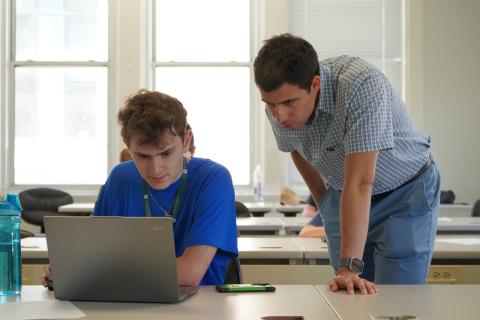
High school teacher Robinne Ponty is using Tulane’s online Master of Science in Computer Science program to explore how artificial intelligence can strengthen learning while keeping students firmly in control.
For 10 years, Robinne Ponty has helped high school students in Southern California make sense of physics, astronomy and the fundamentals of scientific discovery. Now, as he completes Tulane University’s online Master of Science in Computer Science, he is exploring another question that is rapidly reshaping classrooms everywhere: How should educators prepare students to understand and use artificial intelligence?
This summer, that question brought Ponty more than 1,800 miles from his classroom at STEAM Legacy High School in South Gate, California, to Tulane’s uptown campus. From July 13–17, he worked alongside Aaron Maus, senior professor of practice in computer science, in CMPS 1010: AI Systems, a two-week course offered to high school students through the Tulane Science Scholars Program. Ponty continued participating by Zoom during the second week as students developed, refined and prepared to present AI tools of their own.
The experience brought together the different parts of Ponty’s professional journey. He came to Tulane as a graduate student advancing his knowledge of computer science, contributed as an experienced high school educator and left with new ideas and teaching materials he could bring back to his students in California.
“I’ve enjoyed it,” Ponty said. “It’s a lot of work. We’re still preparing lessons and still talking about what we’re doing next.”
That work began years before he arrived in New Orleans. Ponty graduated from the University of California, Irvine, in 2015 with a degree in mechanical engineering. While there, he took several computer programming courses after hearing that computer science would become increasingly important across industries. His first encounters with programming were challenging, but they planted an interest that remained with him as his career took an unexpected turn.
Engineering opportunities were limited when Ponty graduated, and people around him encouraged him to consider teaching. Schools saw value in his engineering background and knowledge of physics, and the classroom proved to be a natural fit. Over the following decade, he taught physics, AP Physics, astronomy and an introductory course that helps freshmen learn how to observe, design experiments and document scientific results.
Even as he established himself as an educator, Ponty continued looking for a way to develop the computer science foundation he had begun building in college. Many of the graduate programs he considered required an undergraduate degree in mathematics or computer science, making it difficult to enter the field without first earning another bachelor’s degree.
Tulane offered a different path. Its online computer science program provided the flexibility Ponty needed to continue teaching full time in California while taking graduate courses. A bridge course designed for students entering the program without a traditional computer science background helped him develop the foundation he needed before advancing through the graduate curriculum.
“Tulane perhaps had the only flexibility that I could find, and it was pretty prestigious already,” Ponty said. “You had an online program that was willing to work with my schedule.”
The 30-credit program can be completed at a student’s own pace, an important consideration for working professionals like Ponty. After taking six credits during his first semester, an experience he jokingly described as “a journey,” he adjusted his pace and continued progressing through the curriculum. At the time of his summer visit, he had only two courses remaining.
Although Ponty attended his Tulane classes remotely, he found faculty members readily available when he needed help. Professors remained online after class to work through difficult material and offered consistent office hours, providing the support he needed as he moved into increasingly advanced subjects.
His coursework produced its share of late-night challenges and breakthroughs. In a data science course, Ponty and a classmate completed a major project that required them to analyze stock data, organize it into a comprehensible form and draw conclusions from the results. In an artificial intelligence course, he programmed an AI-driven Pac-Man agent and spent hours trying to understand why it was not performing optimally. At approximately 1 a.m., he reversed an inequality in his code and watched the agent suddenly pass every test.
Another breakthrough came in computational geometry, when he completed an extra-credit project involving a quadtree, an algorithm used to efficiently organize and search large amounts of data. Together, those experiences strengthened Ponty’s technical abilities while showing him how persistence and experimentation can turn frustration into understanding.
The program also prompted him to consider how his growing computer science knowledge could benefit his own students. Ponty approached Tulane’s computer science faculty about completing an independent study focused on developing computer science materials for high school education in the age of AI. The idea eventually reached Maus, who had already taught Ponty in two courses and was preparing to lead the AI Systems course through the Tulane Science Scholars Program.
Ponty initially expected to contribute to the course remotely. When Maus described the opportunity, however, Ponty asked whether he could travel to New Orleans and participate in person. His visit became a formal component of his summer independent study, allowing him to present and evaluate lessons that he plans to incorporate into his own high school computer science curriculum.
“Having Robinne here, we split the class,” Maus said. “I knew what AI systems material I wanted to cover, and he introduced key ideas in a very interactive way. He brought in his high school experience to get the students engaged and warmed up. It was really wonderful.”
Maus adapted concepts previously taught to Tulane undergraduates for the accelerated two-week course. He and Ponty discussed the central theme of each lesson, and Ponty developed activities that connected the technical material to ideas high school students could recognize. In one interactive demonstration, Ponty used a Markov model to illustrate how large language models probabilistically generate successive words in a response.
For Max, a Tulane Science Scholars Program student from San Diego who entered the course without previous experience in Python or coding, having Ponty in the room made the challenging material feel more manageable.
“He made the lessons really interactive,” Max said. “He was a really big help around the classroom. Peter and I both had some coding errors, and he would come over and help us. Overall, he was a huge help in the classroom.”
Peter, another California student, saw Ponty’s ability to connect computer science to broader, more familiar subjects as one of his greatest strengths.
“His lessons were really interesting because he would connect something to a broader topic and then narrow it down to how it was implemented in coding,” Peter said. “It made it feel more familiar than just a bunch of random words and numbers on the screen.”
Nick, a student at Isidore Newman School in New Orleans, remembered an activity in which Ponty used chess strategy to explain probability. Because Nick plays chess, the analogy gave him a familiar way to visualize an unfamiliar computational concept.
“When someone doesn’t have a clue what they’re doing in the beginning, finding common ground to explain something can really help,” Nick said.
Those connections helped students move quickly from introductory Python lessons to developing their own AI systems. Max and Peter created a roommate-matching tool designed to evaluate open-ended responses from incoming college students. Rather than matching potential roommates primarily through demographic information or a series of checkboxes, their system considered how students described their interests, habits and preferences.
Nick and Noah, a student from Arizona, developed a chatbot intended to help patients better understand information they receive about chemotherapy. They designed the tool to explain or reiterate complex information while making clear that it could not provide medical advice or replace guidance from a physician.
The students entered the course with little or no experience using AI development tools. With guidance from Maus and Ponty, they learned how to break complex problems into smaller components, use AI tools to assist with coding and evaluate the resulting output. During the second week, Ponty joined the class by Zoom as the students brought those components together into functioning systems.
Their experience also reinforced one of the course’s most important lessons: AI still requires informed human oversight.
“We need to steer away from this idea of completely replacing human authority and autonomy,” Nick said. “You still need the experts to look over everything. We’re not there to replace human effort and expertise. We’re there to be an assistance.”
That principle closely reflects the philosophy Ponty hopes to bring back to his own high school. While educators have understandable concerns about students submitting AI-generated work, he does not believe attempting to ban the technology offers a sustainable solution. Instead, he wants students to understand what AI can do, recognize when its answers are unreliable and continue thinking critically even when the technology makes certain tasks easier.
“It’s less about pure coding and more about understanding,” Ponty said. “These tools are available to you, and you can do a lot with them. But ultimately, you’re the one in control. It’s your buddy. It’s not exactly in the driver’s seat.”
The Tulane Science Scholars Program students saw both sides of that equation. AI tools helped them understand new concepts and assemble code more quickly than they could have on their own, but the tools also made small errors, overcomplicated instructions and sometimes struggled to combine individually correct components into a working system.
For Ponty, learning to identify those weaknesses is just as important as learning to use the technology itself. AI may make coding and other technical skills accessible to more people, he said, but that accessibility raises expectations for the creativity, judgment and higher-level thinking people bring to their work.
“AI is a revolution in how we think,” Ponty said. “It’s very different, it’s very new, and where it’s going to fit into our society has not been defined yet, especially with education.”
Ponty’s experience demonstrates how Tulane’s online Master of Science in Computer Science can extend the university’s educational impact far beyond its physical campus. The knowledge and teaching materials developed through his graduate studies reached high school students from Louisiana and other states through the Tulane Science Scholars Program and will continue reaching students when he returns to his classroom in California.
“We are incredibly proud to see how our students are translating their graduate education into immediate community impact,” said Lu Peng, interim chair of Tulane’s Department of Computer Science. “Ponty’s journey perfectly reflects the reach of Tulane’s online MS in Computer Science, which is designed to make high-level technical skills accessible to working professionals regardless of their undergraduate background. This commitment extends beyond our graduate programs through our focus on responsible AI education and our efforts to inspire and prepare the next generation of students through high school outreach.”
As he approaches the completion of his Tulane degree, Ponty is preparing for a new school year with deeper technical knowledge, classroom-tested materials and firsthand evidence that high school students are ready to engage seriously with AI. His Tulane education may have taken place primarily online, but its influence now extends into classrooms on both sides of the country, connecting graduate education, high school outreach and a new generation learning how to shape the technology that will help define its future.
