
Ishita Pal Helps Tulane Students Find Their Way into Research
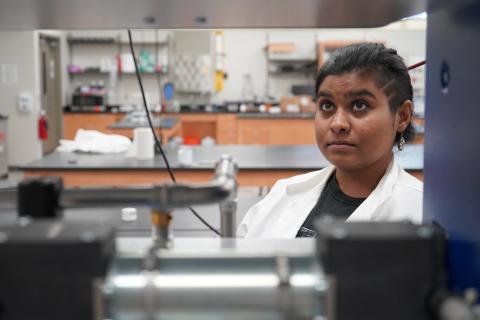
Before helping Tulane undergraduates navigate the world of research, Dr. Ishita Pal followed scientific questions from deep within the Earth to the origins of the solar system.
She subjected rocks to extreme pressures and temperatures to better understand planetary interiors. She used lasers to study microscopic particles of stardust preserved inside meteorites. More recently, she examined isotopes in Louisiana pine trees to explore how scientists might reconstruct rainfall patterns from fossilized wood.
Now, as undergraduate research coordinator for the Tulane University School of Science and Engineering, Dr. Pal is applying that broad experience to a different kind of challenge: helping students find their own entry points into research.
“My mission is to connect and provide resources for undergraduate students for their research initiatives,” Dr. Pal said. “They are motivated, and they’re looking for opportunities.”
Dr. Pal sees her role as a bridge between students who want to participate in research and the faculty members, laboratories, and programs that can help them begin. Her work will include connecting students with opportunities while helping them develop the practical skills needed to succeed once they enter a research environment.
Those skills can range from writing proposals and seeking funding to understanding laboratory expectations, approaching a faculty member, and learning how to transform an initial question into a manageable project.
"We are delighted to have Dr. Pal join SSE as an Undergraduate Research Coordinator. We conducted a national search for this position. Dr. Pal was selected because of her impressive research background and her outstanding mentoring experiences supporting student research,” said Laurie O’Brien, Associate Dean for Undergraduate Programs.
For students encountering research for the first time, even knowing where to begin can be a significant obstacle. Opportunities already exist throughout SSE, including departmental programs, grants, faculty laboratories and peer-support networks, but those resources are not always found in one place or communicated in the same way.
One of Dr. Pal’s priorities is to bring that information together and make it easier for students to explore. She is reviewing existing resources, learning how undergraduate research operates across departments and identifying ways to create a more centralized and accessible source of information.
“There are already existing resources,” Dr. Pal said, pointing to programs offered through undergraduate offices, departmental pathways and a student research ambassador group that provides peer mentoring. Her goal is to help students more easily understand how those pieces connect and which opportunities might fit their interests.
Dr. Pal also recognizes that expanding undergraduate research requires supporting the faculty members who serve as mentors. Laboratory capacity is limited, and meaningful mentorship requires more than simply giving a student an assignment.
“You have to fully guide them,” Dr. Pal said.
That understanding comes from a research career that has repeatedly taken her into new fields and unfamiliar environments. A native of India, she studied geology and physics before pursuing work in geochemistry and geophysics. Her early research included experimental petrology, in which scientists expose rocks and minerals to intense pressures and temperatures to investigate how materials behave beneath Earth’s surface and within other planetary bodies.
She later pivoted from studying Earth to studying the cosmos.
During her doctoral research, Dr. Pal entered the field of laboratory astrophysics and worked at Lawrence Livermore National Laboratory in California. There, she studied tiny particles found inside meteorites whose chemical compositions differ dramatically from materials formed within the solar system.
These presolar grains, commonly described as stardust, formed around ancient stars before becoming part of the material from which the solar system developed. By analyzing their chemical signatures with lasers, Dr. Pal investigated processes occurring inside stars and supernovas.
“I studied those microscopic particles, looked at their chemical composition, and tried to understand what happens inside supernovas and stars that died way before our Sun formed,” Dr. Pal said. “I was studying the cosmos in a lab on Earth!”
Her research later returned to Louisiana and to questions much closer to home. Using isotopic techniques, Dr. Pal studied pine trees to determine how their chemical records could reflect the amount of rainfall they received during their lifetimes. The work could help scientists use fossil trees to better understand precipitation in past environments, particularly in the hot, humid conditions where many fossils formed.
That varied path gives Dr. Pal a personal understanding of how research skills can travel across disciplines. It also informs her plans to help students recognize that they do not need to have their entire academic or professional path mapped out before getting started.
Dr. Pal will teach courses focused on research career development and hands-on projects. Students will learn skills such as finding opportunities, approaching professors, thinking critically, and developing research proposals. A project-based course would give students an opportunity to apply those lessons through guided research experiences.
She will also help connect students through events such as the Research and Ideas Symposium, scheduled for Nov. 10. The symposium will give undergraduate researchers an opportunity to present their work and participate in a poster competition spanning seven categories. It is expected to be part of a broader week of research programming that includes talks, peer mentoring and opportunities for students to interact with researchers across the university.
“Dr. Pal has an ambitious vision for undergraduate research in SSE. Her position will involve connecting students with existing resources as well as creating new programming to support the undergraduate research mission,” said O’Brien.
Ultimately, Dr. Pal wants students to see research not as something reserved for experienced scientists working on intimidating problems, but as a process they can learn one step at a time. Major discoveries and advanced equipment can inspire students, but smaller, more approachable experiences can be just as important in convincing them that they belong.
“Sometimes when we see something simple, it’s like, ‘OK, this is doable for me,’” Dr. Pal said. “It can be the gateway.”