
Tulane physicist Jianwei Sun named American Physical Society Fellow
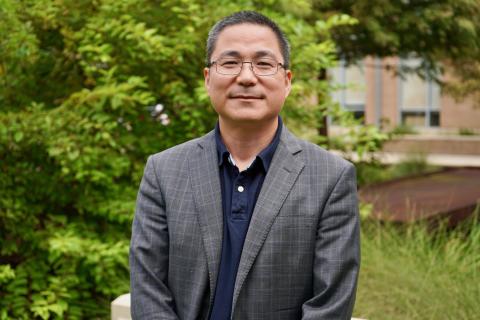
Tulane University physicist Jianwei Sun, whose computational research is helping scientists predict the properties of complex materials and accelerate the search for new discoveries, has been named a fellow of the American Physical Society, one of the field’s most selective honors.
Sun, professor of physics and engineering physics at Tulane University School of Science and Engineering, was selected by the APS Division of Computational Physics for developing the SCAN density functional, a method used to calculate the behavior of electrons in materials and molecules, and for demonstrating its ability to computationally predict the structure, bonding energetics, magnetism and band gaps of a wide range of materials.
“The naming of Jianwei Sun as a fellow of the American Physical Society adds to the growing acclaim he has been receiving as one of the most impactful and influential leaders in his field,” Tulane University President Michael A. Fitts said. “It is also another testament to the vital contributions Tulane researchers continue to make through interdisciplinary advancements and discoveries that are helping to drive the future.”
Sun’s work focuses on using computational methods to understand and predict the properties of materials. He is leading a Tulane team recently selected for the federal Genesis Mission, a multiagency initiative aimed at using artificial intelligence to accelerate scientific discovery. The Tulane project that is part of the Genesis Mission is using AI and quantum-mechanical simulations to speed the search for higher-temperature superconductors — materials that can transmit electricity without energy loss and could enable advances in energy, medicine, quantum computing and other technologies.