
Master's Degree in Electrical Engineering
The Master's of Science (MS) degree in Electrical Engineering (EE) includes a flexible curriculum that can be tailored to fit many potential career paths within electrical engineering and beyond. A graduate advisor will work with you to plan a course of study that fits your interests.
The primary objective of this master’s program is to train highly skilled electrical engineers with expertise in the fundamental and applied aspects of their area of choice. Students in this degree program will focus on gaining theoretical and experimental knowledge while fostering critical thinking and problem-solving abilities in a multidisciplinary context. Graduates will be well-prepared for careers in both academia and industry across nearly all sectors of our modern society.
ApplyRequest InformationDepartment of Physics and Engineering Physics
4+1 Accelerated Master's Program
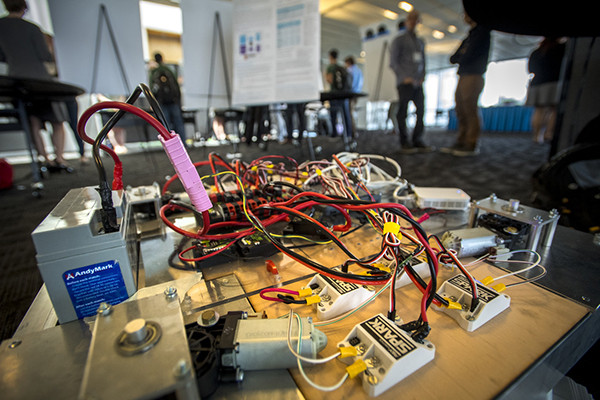
Current Tulane undergraduate students can earn this M.S. degree with just one additional year of study. This accelerated program allows you to count graduate-level courses toward both your B.S. and M.S. degrees, providing a fast track to an advanced credential.

What You'll Learn
Upon completion of this program, graduates will be able to describe fundamental principles of quantum mechanics, solid state physics, and electromagnetism and their relevance to modern electrical engineering, as well as hone mathematical, analytical, and coding knowledge in the context of technology domains influenced by electrical engineering. Graduates will design, with quantitative modeling, electronic and optoelectronic devices, computing systems, integrated circuits, controllers, and other EE platforms that require use of the full engineering design process. They will conduct independent research and learning, utilizing lifelong learning skills to investigate cutting-edge technologies and communicate findings to their peers, with thesis-track students conducting original research that contributes new ideas to the field. Finally, graduates will work effectively in multidisciplinary teams, collaborating with diverse colleagues to bring expertise from their background and experience to solve complex engineering challenges in course-based projects, hands-on labs, research groups, and other program components.
Research
Research is central to the Electrical Engineering MS program, with opportunities to investigate cutting-edge technologies. Students in the thesis track conduct original research in one or more of the program's focus areas—Quantum, Electronics, and Photonics (QEP) or Signals and Computing Systems (SCS)—contributing new ideas and solutions to the field. All students engage in research through coursework, hands-on laboratory work, and collaborative projects that apply theoretical knowledge to real-world engineering challenges. Faculty research spans emerging technologies including quantum computing, semiconductor device design, photonic integrated circuits, machine learning systems, and advanced controls, providing students with opportunities to work on problems at the forefront of technological innovation. Through research and project-based learning, you'll develop the investigative skills and technical expertise essential for leadership roles in academia and industry.
Meet Our Faculty
Our electrical engineering faculty are accomplished researchers and educators with expertise spanning quantum mechanics, electronics, photonics, signals processing, computing systems, controls, and communications. Faculty members are actively engaged in cutting-edge research addressing emerging technologies in quantum computing, semiconductor devices, photonic integrated circuits, and advanced computing systems. They are committed to fostering critical thinking and problem-solving abilities in a multidisciplinary context, providing personalized mentorship as you design your course of study and research direction. Whether through coursework, hands-on labs, or thesis research, our faculty create an environment where you'll develop both theoretical understanding and practical expertise while contributing to innovations that shape the future of technology.
Curriculum Requirements
A graduating master’s student in Electrical Engineering at Tulane University will have a solid foundation of knowledge, both theoretical and applied, and skills, such as computational and lab skills, relevant to their chosen focus area in Electrical Engineering. The Tulane MS in EE provides flexibility so that students can pursue their interests within this broad field while guiding students towards two primary focus areas: Quantum, Electronics, and Photonics (QEP) and Signals and Computing Systems (SCS). Students may choose one of two paths:
1. Non-Thesis Route: This is the default route and requires the students to complete 30 credits of coursework from the approved curriculum.
2. Thesis Route: A student may opt for the thesis route if they find a faculty member who agrees to supervise their thesis. The thesis route requires the students to complete 24 credits of coursework from the approved curriculum and a 6-credit research thesis supervised by a Tulane SSE faculty member. The thesis must be based on original research and must be approved by a committee consisting of at least three members, including the research supervisor and at least one other full-time member of the SSE faculty. One member may be from another Tulane school or other appropriate outside institution. Approval of the research topic and committee from the Electrical Engineering Graduate Advisor and consent from all committee members are required before embarking on the thesis.


Career Benefits and Pathways
Graduates of this program will be prepared for leadership roles in a variety of industries including quantum computing and quantum communication companies, semiconductor manufacturing and R&D, optoelectronics and photonic systems companies, energy and materials-oriented industries, healthcare device and systems industries, defense and intelligence industries, space technology companies, and telecommunication and networking companies. Additional opportunities exist in companies that utilize extensive data streams for optimization and decision-making, companies employing advanced controls systems such as vehicles, aerospace, and robotics, research institutions and universities, and many other fields impacted by electrical engineering.
Learn more about the admissions process or apply now!
Find full tuition information and the financial aid process.
Get to know what makes this place a launchpad for the next generation of scientists and engineers.
FAQs
Electrical engineering is the discipline that applies principles of electricity, magnetism, and electromagnetism to design, develop, and optimize devices, systems, and technologies that power modern society. It encompasses diverse areas including power systems, electronics, communications, computing, controls, and emerging fields like quantum computing and photonics, addressing challenges in energy, healthcare, defense, computing, and countless other sectors.
Quantum, Electronics, and Photonics (QEP)
This focus area centers on quantum, electronic, and photonic fundamentals and technologies. There is currently a strong need for more skilled workers in each of these three target areas, and the rapid pace of technological advancement in these industries necessitates further education and skill development to stay competitive. Emerging technologies such as quantum computing, semiconductor devices, and photonic integrated circuits are reshaping industries and opening new frontiers in applying physics principles to benefit humanity. The QEP thrust will provide a comprehensive understanding of quantum mechanics, the design and operation of electronic devices, and the principles of photonics—all of which are critical for the future of technology in communication, computing, energy systems, defense, and healthcare.
Signals and Computing Systems (SCS)
This focus area centers on signals and computing systems, which sits at the intersection of computing, signals and information processing, controls, networking, communications, and the hardware/software interface. This thrust has a strong dependence on optimization, machine learning, and artificial intelligence. This SCS focus area interfaces with nearly all areas of technology development and is an area of ongoing growth and demand for trained engineers.
No undergraduate major is specified for admission. Applicants must have completed at least 24 credit hours in science and engineering (3.0 GPA or higher). Adequate background coursework in mathematics, physical science, computer science, and core aspects of electrical engineering is required. For example, for students interested in the QEP focus area, courses in modern physics, optics, or electromagnetic theory are appropriate, along with at least four semesters of math and at least one undergraduate electrical engineering course (such as circuits or electronics). For the SCS focus area, courses demonstrating programming proficiency are required, in areas such as algorithms and systems, along with at least four semesters of math (discrete math preferred) and one electrical engineering course (such as digital logic or signals & systems). Provisional admission with required remedial coursework is possible. Students who have not taken the appropriate introductory coursework will be allowed to take such courses at Tulane without credit towards the graduate degree to make up for this deficiency. Applicants may also demonstrate proficiency in the introductory material by passing the Fundamentals of Engineering (FE) exam in electrical and computer engineering. Students must submit a transcript, a personal statement (which should include a statement about which EE area they would like to focus on), at least one letter of recommendation, and proof of proficiency in English (undergraduate degree from a program in which English was the language of instruction, or TOEFL, IELTS, or equivalent standardized score). Applicants should select “Quantum, Electronics, and Photonics Focus Area”, “Signals and Computing Systems Focus Area”, or “Custom Focus Area” in Slate at the time of application.
Students admitted to graduate programs are admitted specifically into either the terminal MS or a PhD program. A student admitted to the EE MS program should not assume admission to a PhD program. A separate application is required for admission to any PhD program for a student to be eligible to work toward the PhD degree. If accepted, coursework from the Master’s program can be applied towards the PhD degree, subject to approval by the department overseeing the PhD.
We accept students from many foreign countries, including China and India.
The GRE General Exam is required for all applicants. The GRE Physics subject exam is strongly recommended, but not required, for applicants to the Physics Ph.D. Program. The TOEFL exam is required for all applicants who are non-native English speakers.
We have no minimum required GRE scores. We do have a minimum TOEFL score of 80. The test scores are used, along with other indicators such as GPA and recommendation letters, to make relative comparisons of applicants. We look for a complete picture in the application to find the students who we think will fit in best in our department. Test scores are just one part of that picture.
Every applicant is automatically considered for a TA, RA, or fellowship. Most admitted students are offered a TA position. Fellowships are available for exceptional applicants in the Physics program. RA positions may also be available in some research groups.
We usually receive over 100 qualified applications. Approximately 20% are offered admission.
Our staff is not able to provide individual advice or review your qualifications, other than through the admissions process. We encourage you to submit an application and assure you that every application will receive full consideration in due time.
We can accept unofficial TOEFL and GRE scores, such as photocopies of ETS score reports, at the time of your application. We will use the unofficial scores to make the admission decisions. However, if you are admitted and decide to enroll at Tulane, you will need to submit the official ETS scores.
All graduate students are required to carry health insurance, either through the Tulane plan or privately. In the Tulane plan, the student is responsible for paying a 50% portion of their health insurance, which is about $669 per semester. The School of Science and Engineering subsidizes the other 50% of the health insurance premium.
Please see the Research section of our website for a description of the research groups in our department.
Graduate students in the department receive financial assistance through teaching assistantships, research assistantships, tuition scholarships, University loans, and Louisiana Board of Regents Fellowships.
Research assistantships are provided by a student's faculty research advisor and are available at the advisor's discretion. Stipend amounts and durations are decided by the advisor, although the research assistantship is normally accompanied by a tuition waiver.
A small number of summer teaching assistantships are normally available, and are usually reserved for students with special circumstances.
Contact Us
Ilianna H. Kwaske, Ph.D.
Associate Dean for MS Programs & Professional Education
ikwaske@tulane.edu
Sarah Berry
Director of MS and Certificate Programs
smccarty@tulane.edu
Rosie Chavez
Director of Graduate Programs
rchavez@tulane.edu
Dr. Ryan Glasser, Graduate Admissions Director (Physics), rglasser@tulane.edu
Dr. Diyar Talbayev, Graduate Advisor (Physics), rglasser@tulane.edu
Dr. Michael Naguib, Graduate Admissions Director (Materials Physics and Engineering), naguib@tulane.edu
Dr. Douglas Chrisey, Graduate Advisor (Materials Physics and Engineering), dchrisey@tulane.edu