
Mechanical Engineering Undergraduate Minor
The Mechanical Engineering Minor complements various STEM and non-STEM majors at Tulane by offering a condensed exploration of mechanical systems. It includes the fundamental courses Statics, Dynamics, and Thermodynamics, providing essential knowledge in the field while allowing further exploration via electives. This minor enhances career prospects across industries including aerospace, renewable energy, and manufacturing, preparing students for diverse engineering challenges.
ApplyDepartment of Physics and Engineering PhysicsMore Undergraduate Programs
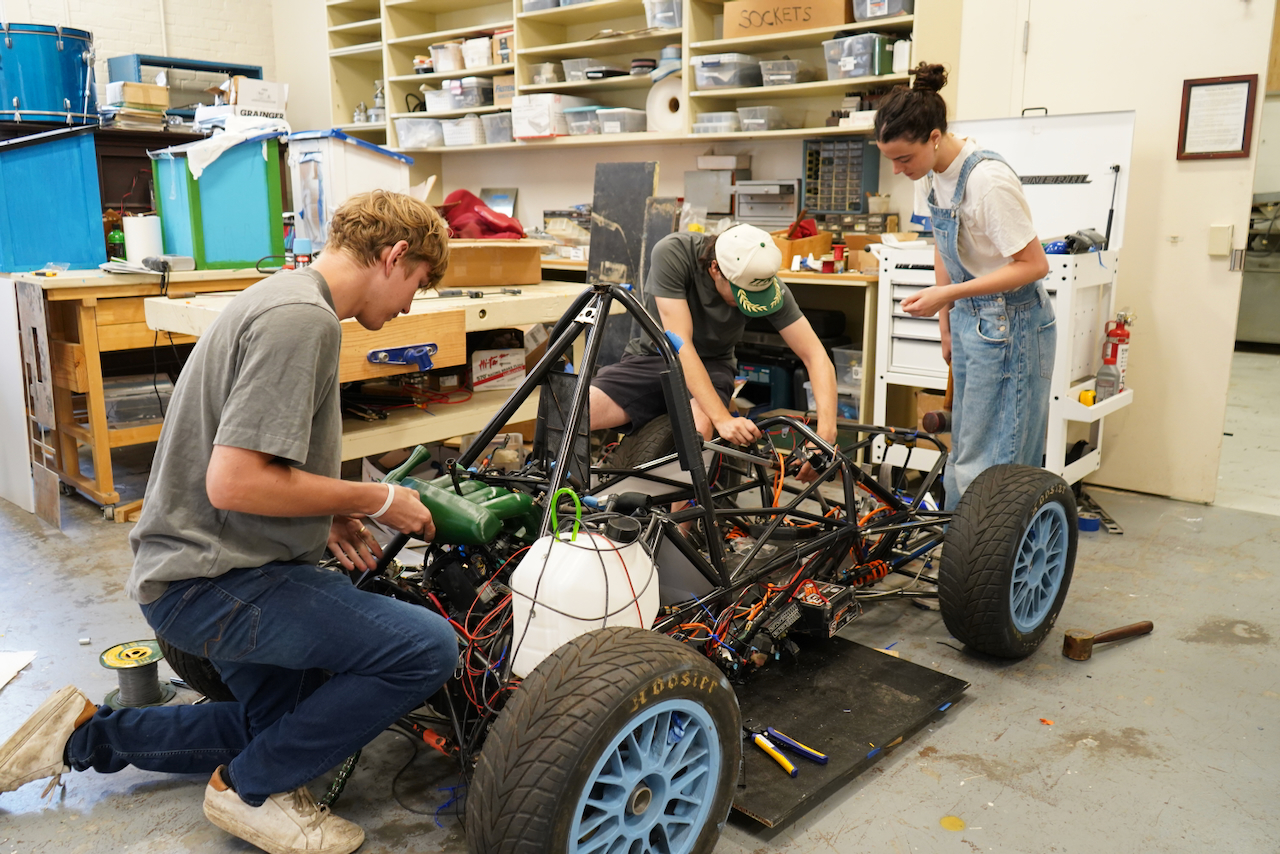

Curriculum Requirements
The minor requires prerequisites in Calculus I, II, and III, General Physics I, and General Chemistry I with lab, followed by 9 credit hours of required coursework in statics, engineering dynamics, and thermodynamics, plus three electives (9 credit hours) chosen from a wide list spanning mechanics of materials, fluid transport, materials science, control theory, and more. At least three courses (9 credits) counting toward the minor must not overlap with a student's major.
FAQs
For students outside the core engineering majors, this minor is a direct route into how physical and mechanical systems actually work — statics, dynamics, and thermodynamics form the backbone, with room to specialize through electives in areas like materials, fluids, or controls. That combination translates into real career traction in industries like aerospace, renewable energy, and manufacturing, where employers value candidates who can think like engineers even if that's not their primary degree.
1. The student fills out the Major/Minor declaration form (linked below) and contacts the appropriate faculty advisor to arrange a meeting:
- Physics major or minor: Prof. Wayne Reed
- Engineering Physics major (without a minor/certificate or if undecided about optional minor/certificate): Prof. Anoop Rajappan
- Engineering Physics major with Electrical Engineering minor or certificate: Prof. Ryan Gelfand
- Engineering Physics major with Mechanical Engineering minor or certificate: Prof. Matt Barrios
- Engineering Physics major with Materials Engineering minor or certificate: Prof. Doug Chrisey
- Engineering Physics major with Computational Engineering certificate: Prof. Jianwei Sun
Notes for filling out the form: The degree pursued is BS for a Physics major or BSE for the Engineering Physics major. Students declaring a certificate should enter "ENGP + ___ Certificate" in the "primary major" field.
2. After meeting the student, the faculty advisor signs the form and forwards to Prof. Jerry Shakov, Associate Chair, for his signature.
3. Prof. Shakov forwards the form to the student's NTC advisor or returns to the student (in those cases where additional signatures from another department are needed).
Students who are interested in obtaining transfer credits should first obtain the transfer credit request form from their academic advisor. They should then attach a detailed course description and/or a syllabus to the form for departmental approval. Syllabi are preferred for most courses, and they are required for introductory physics courses (e.g. algebra-based or calculus-based Physics I and II).
The forms should be returned to April Sanchez in the Physics & Engineering Physics office in 2001 Percival Stern Hall. The office is open from 8:30 AM until 4:30 PM Monday through Friday, excluding all university holidays. Once forms are approved and signed by Dr. Jiang Wei, students will be contacted to retrieve their forms and return them to Academic Advising.
All forms must be submitted and receive approval prior to taking courses at another institution.
Special note for online coursework: A lecture course that was delivered online may be considered for transfer credit, but any laboratory component must be in-person to receive credit. For this purpose, a student may take the 1-credit lab section separately to complete the requirements for a laboratory science course that was taken elsewhere online.