From New Orleans to the Rainforest: Tulane Students Build Scalable Environmental Sensor Network
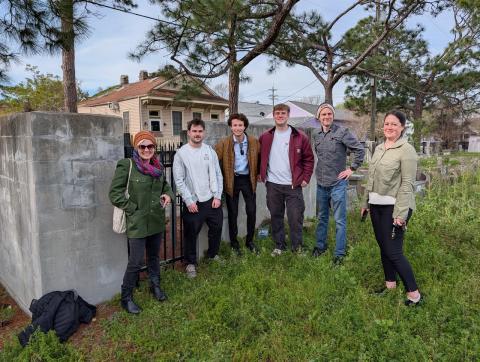
In a city where water shapes everything from infrastructure to risk, understanding what is happening beneath the surface has never been more important. Across several New Orleans cemeteries, a network of sensors is now collecting real-time data on soil moisture, temperature, and environmental conditions, with implications that extend far beyond the city.
What makes this effort stand out is not just the technology. It is how it has evolved, and where it is headed.
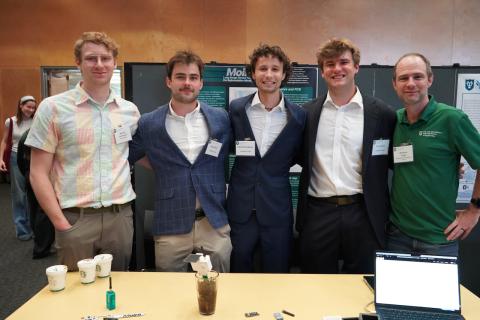
The system was designed, built, and deployed by Tulane University students in computer science and engineering, building on a multi-year capstone effort developed by earlier teams. Rather than starting from scratch, this year’s group, starring Lakeland Galinson, Chris Yarbro, Josh Allison, focused on advancing the project, significantly improving the hardware, software, and overall performance to move it closer to a fully deployable system already operating beyond the classroom.
At its core, the project tackles one of the most difficult challenges in student-driven innovation: scale.
“One of the biggest challenges our senior capstone students face is scaling up, going from a prototype that works in a small demo on campus to something that can operate at a large scale, unattended and far away,” said Matthew Toups, Professor of Practice in Computer Science and the project’s faculty advisor.
That challenge is exactly why New Orleans matters. Building on Computer Science Capstone Service Learning, run in partnership with Tulane’s Center for Community Engaged Artificial Intelligence (CEAI), SSE’s AI4All Initiatives, and the City of New Orleans ITI Office, an idea took shape. “The City ITI Office has been a great partner for our service learning over the years, getting our students involved with real data and real problems, from potholes to tree monitoring,” said Nicholas Mattei, Associate Professor of Computer Science.
“The City of New Orleans has been the perfect partner in this effort,” Toups said. “Our team can get experience testing in an environment similar to what we will face in the Andean rainforest: varying moisture levels, varying sunlight levels, varying radio reception. Once we know our sensor system can survive outdoors in New Orleans, we’ll feel more confident that it can also survive the tropical Andes.”
That framing shifts the story. New Orleans is not just where the system is deployed. It is where the system is proven.
Sensors placed across cemeteries and near campus are already capturing real-world environmental variability, including rainfall-driven spikes in soil moisture and changing light conditions throughout the day. That variability forces the system to adapt in ways that controlled lab environments cannot replicate, accelerating its path toward reliability at scale.
The foundation for that progress was laid years earlier.
“Originally we built three sensors together in the span of a couple of weeks in our dorm and at the MakerSpace,” said Bennett Hermanoff, a member of the project’s first capstone team. “To see that original idea develop into something that can actually be deployed in the city is amazing and speaks volumes to the work ethic of the students continuing to innovate on this idea.”
What began as a focused effort around flooding has steadily expanded into a broader environmental monitoring platform.
“When the idea first came to us for a mesh network of sensors, there was a focus on flooding,” said Maddie Wisinski, also from the original team. “Through yearlong, in-depth development, that idea was expanded upon for additional capabilities and experimented with.”
That evolution has also sharpened the project’s potential impact.
“Getting them out into the city, where it frequently and inevitably floods, is ingenious,” Wisinski said. “Devices that can detect flooding among other infrastructural issues are devices that can save lives, and that’s really the potential these devices have, not just in New Orleans.”
Today’s system reflects that expanded vision.
Each sensor node measures soil moisture, temperature, humidity, and light conditions, transmitting that data through a decentralized mesh network that allows devices to communicate across long distances. The system feeds into a live dashboard, where users can monitor environmental changes over time and begin to identify patterns that inform decision-making.
For city stakeholders, that could mean more targeted responses to flooding, overgrowth, or drainage issues in fragile spaces like historic cemeteries.
“The way these sensors are becoming applicable for the city is in places like cemeteries,” said Lakeland Galinson. “They’re historic, they’re fragile, and resources are limited. If we can use data to show where attention is needed, whether it’s overgrowth or flooding, that can help guide how those resources are used.”
“If a moisture sensor is reading extremely high, you know there’s likely standing water or flooding,” added Josh Alison. “That’s the kind of information that could actually help with prevention or response.”
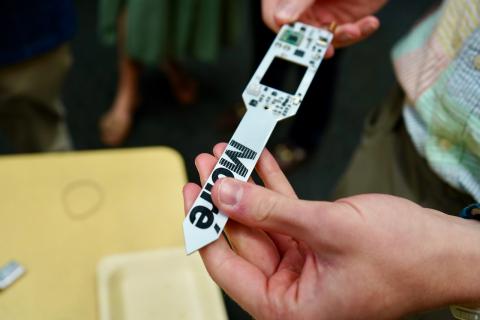
Under the hood, the system has undergone major technical advancements. The team redesigned the hardware using custom printed circuit boards that integrate temperature, humidity, and soil moisture sensors into a single unit, while transitioning to a more power-efficient architecture that enables long-term deployment.
Those improvements, combined with solar integration and optimized sleep cycles, allow the sensors to operate for extended periods with minimal maintenance, even in environments with inconsistent sunlight.
Just as important is the system’s affordability.
While comparable commercial solutions can cost thousands per unit, these sensors can be built for roughly $30 to $50. That dramatically lowers the barrier to scaling deployments across large areas or resource-constrained environments.
“It’s not just our network,” said Chris Yarbro, who led much of the software and firmware development. “Anyone with a compatible device can help extend it. That’s how you scale.”
That scalability is what opens the door to the project’s next phase.
Through collaboration with Jordan Karubian and the Tulane Environmental Initiative for Research and Action (TIERA), the team is exploring how the same system could be deployed in rainforest restoration sites in Ecuador.
“There’s going to be an immediate application,” Karubian said. “At the scale we’re working, this is really amenable.”
In those environments, researchers are working to understand how forests recover over time, tracking fine-scale changes in temperature, humidity, and ecological conditions. That kind of work depends on continuous, reliable data collection across challenging terrain.
“You want data you can publish,” Karubian said. “That means calibration, consistency, and the ability to measure changes over time.”
The Tulane system is designed to meet that need.
By combining environmental sensor data with biological observations, researchers could gain new insight into how restoration strategies influence ecosystem recovery, from plant growth to animal behavior.
For students, the impact of seeing their work move from concept to real-world application has been immediate.
“Being able to do this in New Orleans and actually see something you built deployed, it’s really meaningful,” Yarbro said. “We started with something we thought would help the environment, and now we’re seeing that it actually can.”
The project also reflects a broader model within Tulane’s capstone experience, where student teams build on the work of those before them, refining and expanding ideas into systems with real-world application.
“We’re not environmental scientists,” Galinson said. “But if someone tells us what data they need, we can build the system to make it happen.”
That mindset has taken the project from a dorm room prototype to a system already operating in the city, with the potential to expand across ecosystems and continents.
The project earned Best Project in Computer Science at this year’s Engineering Design Capstone Expo and was recognized at a Tulane Engineering Forum reception, where students connected with faculty, industry leaders, and partners supporting the next phase of development.
What began as a class project is now something more.
A platform. A proof point. And a glimpse of how student-driven innovation can move from campus to city to the world.
Science and Engineering for Better Lives.