From the Diamond to Discovery
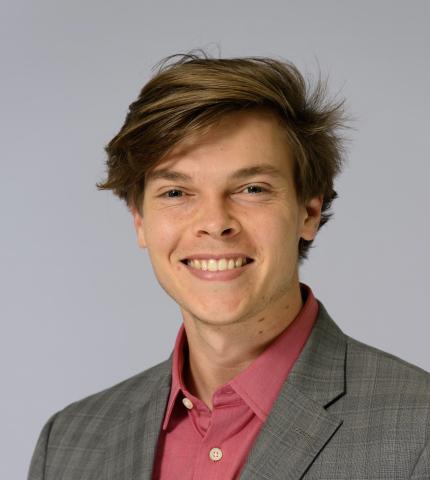
Marc Théberge originally came to Tulane University to play baseball. A shoulder injury in his first year changed that. What followed was a path that took him from the School of Science and Engineering to the National Institutes of Health, and eventually to a doctoral program that spans two continents.
Today, Théberge is pursuing his PhD through the NIH Oxford-Cambridge Scholars Program, dividing his time between the NIH Vaccine Research Center in Bethesda, Maryland, and collaborators at Cambridge University in the United Kingdom. His research focuses on understanding how certain HIV-infected cells manage to persist in people who are receiving antiretroviral therapy, and what drives that persistence in the first place.
When Théberge arrived as a Cell and Molecular Biology major, his enthusiasm for the subject took time to develop. The early coursework did not immediately grab him. That shifted, he says, in his junior and senior years, when the coursework began to bring the discipline to life.
The course he points to most directly as preparing him for a scientific career was his senior year immunology class taught by Dr. Robert Dotson, a professor in the Cell and Molecular Biology department. It was structured differently from most of what he had taken before, built around reading scientific papers, classroom discussion, and a student presentation.
"I really enjoyed my senior year immunology class, which was the capstone course," Théberge said. “I think that immunology class was really good for me and prepared me to go on and be a scientist.”
Many faculty members made an impression that extended beyond the course material. For example, Dr. Sara Clark, a professor in Tulane's Neuroscience department, encouraged Théberge to consider graduate school at a moment when he was still undecided.
"After I had taken a few of her courses, she mentioned to me that I should consider graduate school when I was on the fence about it," he said. “Other professors shared that sentiment. I had similar conversations with Dr. Stryder Meadows, Dr. Jonathan Fadok, Dr. Elizabeth Abboud, and Dr. Preston Marx.” That encouragement, coming at the right time from those who had seen his potential, helped set the course for what followed.
After graduating in 2021, Théberge joined the Vaccine Research Center as a postbaccalaureate trainee. The environment was different from what he had experienced as an undergraduate, more focused on engineering and method development than on biology in the traditional sense. The group he joined, the Virus Persistence and Dynamics Section, was working on new approaches to detect and study the HIV-infected cells that persist in people receiving antiretroviral therapy.
The clinical problem behind the research is significant. Antiretroviral drugs allow people living with HIV to live long, healthy lives. But the infection is never fully eliminated. A small number of infected cells remain, rare and difficult to study. The method the Virus Persistence and Dynamics Section developed, in collaboration with researchers in California, made it possible to detect those cells and examine their characteristics alongside uninfected cells from the same people. The study was published in Nature.
What they found challenged some assumptions in the field.
"There was thinking for a long time that those persisting infected cells were going to be very similar to uninfected cells, and they were, but we actually found some key differences," Théberge said. "It was a good proof of concept that these cells were different and that, perhaps in the future, we'd be able to come up with therapies to target those differences and eliminate the infected cells."
That work became the launching point for his doctoral research, which takes the question a step further. Rather than describing what persistent infected cells look like, Théberge is now focused on understanding how they come to exist.
"There must be something about the infection of a given cell that drives different outcomes. With most virus infections that we think of, a cell gets infected, it produces new virus particles, and then it dies. But there are cells that can get infected with HIV and not die. They can last for many years," he says.
The NIH Oxford-Cambridge Scholars Program gave him a way to pursue that question while staying connected to the Vaccine Research Center lab where he had done his postbaccalaureate work. He spent two years at Cambridge initiating a collaborative project, then returned to continue his research at the NIH.
"I wanted to stay in the environment of the Vaccine Research Center," he explained. "And this program allowed me to do that."
Alongside his research, Théberge found his way back to baseball. After being cut from the Tulane roster during his sophomore year, he did not pick up the sport again for many years. When he went to Cambridge for his PhD, he discovered the university had a team, and the community he found there pulled him back in.
"I met this great group of people and just loved being around them, and that really pulled me back into the game," he said. He served as captain for the 2024-25 season, and the team most recently won a silver medal at the 2026 British Universities and Colleges Sport National Championship.
He reflects on the years he spent away from the sport, and what returning to it has meant during his PhD.
"It was a mistake for me to be away from baseball for four or five years," he said. "Coming back to it made me realize how much I missed it. Staying connected in some way to communities and a sport that I really cared about is very important, and I was missing that for a long time."
Looking ahead, Théberge's goal is to become an independent researcher and to keep working on HIV. He sees a cure as a possibility within his lifetime and wants to be part of the work that gets there.
"To see a cure for HIV in my lifetime would be special," he said. "And to be a part of that is something that I can now tie myself to in my career."
Still, the thread running through his story leads back to New Orleans, to professors who pushed him toward graduate school, and to a capstone immunology course that taught him what it means to think like a scientist.