The Art of Translation: Jill Love’s Journey From the Lab to the Stage
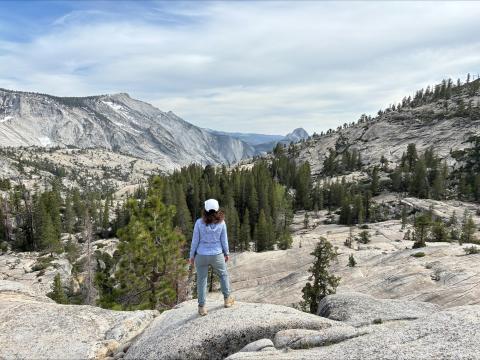
High in the rugged peaks of Sierra Nevada rests the Mimulus laciniatus—the cutleaf monkeyflower. To a casual hiker, these flowers are merely a part of the scenery; to Jill Love, Ph.D. in Tulane University’s Ferris Lab, they are a living puzzle. Her research sits at the intersection of evolutionary ecology and climate change, exploring a fundamental question: how do plants survive in a world where the rules are constantly shifting?
Jill’s work is a technical marathon. She uses reciprocal transplant experiments, quantitative genetics, and population genomics to study how these flowers adapt to different elevations. Specifically, she looks at phenotypic plasticity- the ability of a single genotype to produce different physical traits in response to its environment. It is a complex dance of biology that determines whether a species will thrive or fade as the climate warms.
However, Jill’s greatest challenge wasn’t found in a lab or on a mountainside; it was found on a stage.
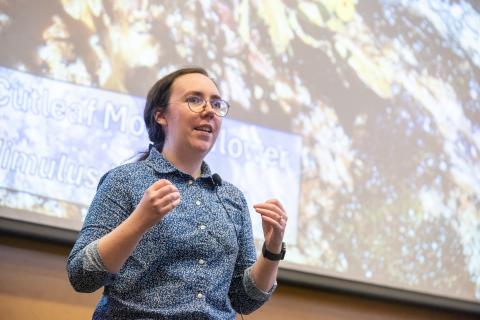
The Three Minute Thesis (3MT) competition at Tulane University asks graduate students to do the nearly impossible: distill years of dense, jargon-heavy research into a single three-minute presentation with only one static slide. Jill took the technical "alphabet soup" of her dissertation and translated it for a broad audience. She focused on the heart of her field experiments in California, illustrating how a plant's flexibility can either be a lifeline or a hurdle in the race to adapt.
Her ability to bridge the gap between "scientist" and "storyteller" resonated. Jill won the university-wide competition, earning the honor of representing Tulane at the Southern Regional 3MT. Competing against winners from across the South, she refined her voice even further. While she didn't take home the regional trophy, the experience solidified her belief that science is only as impactful as it is accessible.
Beyond the greenhouse and the podium, Jill’s mission is rooted in people. As a mentor to undergraduate researchers and an inclusivity liaison within the Department of Ecology and Evolutionary Biology, she is committed to broadening participation in STEM. From leading K-12 outreach initiatives to guiding the next generation of biologists, Jill Love is proving that whether you are a monkeyflower in the mountains or a student in the lab, the key to the future is the ability to adapt, connect, and grow.