
Beyond the Alarm: Tulane Biomedical Engineering Students Rethink Infant Safety
In the middle of the night, most infant monitoring devices do one thing when something goes wrong. They sound an alarm.
For parents, that moment is filled with panic. For the baby, nothing changes.
A team of Tulane University biomedical engineering students set out to rethink that approach entirely.
Their goal was not to build another monitor, but to design a system that responds in real time. Instead of simply detecting when an infant’s breathing or oxygen levels drop, their capstone project takes action.
“We wanted to move beyond just notifying parents,” said Mariana Pirela. “There are a lot of products that wake you up, but they don’t actually help the baby in that moment. We wanted to take a more active approach.”
The result is a smart swaddle system designed to reduce the risk of sudden infant death syndrome by gently stimulating an infant’s breathing response when it matters most.
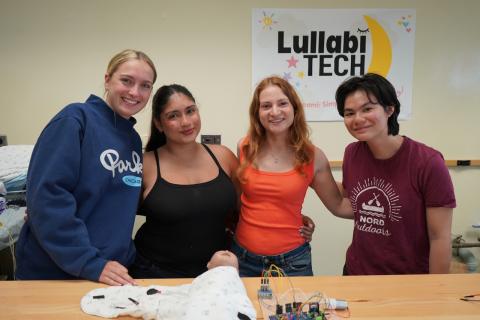
Developed by Pirela, Emelia Cooperberg, Gigi Kinner, and Indy Ward, the project brings together physiology, engineering, and user-centered design to address one of the most difficult challenges in infant health.
At the core of the system is a concept known as stochastic resonance. In simple terms, it uses low-level, randomized vibrations to stabilize biological systems. Prior research has shown that these subtle mechanical signals can reduce episodes of apnea and help regulate breathing patterns in infants.
Instead of relying on electrical stimulation, the team engineered a pneumatic solution. Small air-filled pouches embedded in the swaddle rapidly shift pressure, creating a soft vibration effect across the infant’s body.
“It doesn’t feel like inflating or deflating,” the team explained. “It just feels like a vibration.”
That distinction was critical. Safety and comfort drove nearly every design decision.
“All of the electronics are kept away from the baby,” said Emelia Cooperberg. “Parents we spoke to were very clear about that. So everything on the baby itself is just airflow through tubing. That also makes the swaddle fully washable.”
The system operates in two ways. A pulse oximeter attached at the ankle continuously monitors heart rate and oxygen levels, triggering the device when readings fall below safe thresholds. At the same time, the swaddle delivers low-level, randomized vibrations throughout the night, an approach supported by prior research showing that stochastic resonance can help stabilize infant breathing patterns.
The idea builds on emerging research suggesting that some infants may lack or underutilize key neurological responses to low oxygen levels during sleep. In those cases, external stimulation can act as a substitute signal, encouraging the body to resume normal breathing patterns.
“It’s almost like a nudge,” said Gigi Kinner. “A way to help the body respond when it otherwise might not.”
For the team, the inspiration was personal. Pirela began exploring the problem after seeing the anxiety surrounding infant monitoring devices within her own family.
“My sister had a baby last year,” she said. “She used one of the popular monitoring systems, and it would go off all the time. A lot of false alarms, a lot of stress. We started asking, what if instead of just alerting you, the device could actually help?”
That question shaped the direction of the entire project.
To test their system, the team is working with infant simulation technology at Tulane’s medical training facilities. Using advanced robotic mannequins capable of mimicking physiological changes, they plan to evaluate whether their device responds appropriately when vital signs drop.
“We can simulate real scenarios and see if the system activates the way we expect,” said Indy Ward. “That’s a big step in validating what we’ve built.”
Early testing has also included self-experimentation, with students using breath-holding exercises to trigger the system and confirm its responsiveness.
Beyond functionality, the team is already thinking about scalability and real-world use. The current prototype uses off-the-shelf components, including an Arduino Nano microcontroller, pumps, and solenoid valves. Future iterations could integrate the system into a compact, sealed unit for broader use.
“There’s definitely a path to making this smaller and more refined,” the team noted. “That’s part of what we’re learning through this process.”
For this team, the goal is not just to demonstrate a working prototype, but to show what is possible when engineering is driven by empathy, urgency, and lived experience.
It is a shift from passive monitoring to active intervention. And it reflects a broader mindset taking shape across Tulane’s School of Science and Engineering, where students are not just building devices, but rethinking how those devices can make a difference when it matters most.