
Building Islands, Building Impact Along the Mississippi River
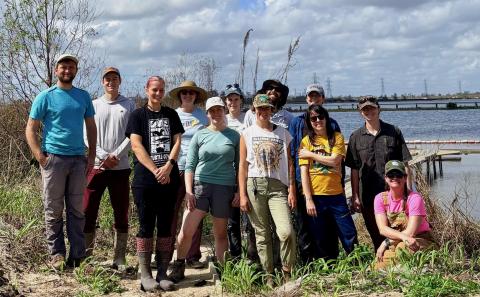
On a recent morning in the wetlands just east of New Orleans, a group of Tulane researchers and students stepped onto a mound of newly built land carrying trays of native plants. Before following the plan to install the landscape, the group took time to gaze at the islands popping out of the vast open water and discuss a brief history of the site. A year ago, none of this existed.
The islands are part of an ongoing project led by researchers at Tulane University in Ecology and Evolutionary Biology and Chemical and Biomolecular Engineering, working alongside community partners like Glass Half Full to explore new approaches to coastal restoration. What began as two small islands near the shoreline has grown into a four-island system; each pair designed to test how different materials support plant life over time.
Typically, local wetlands are rebuilt using pumped sand dredged from the Mississippi River which no longer floods and deposits sand naturally. Here, we introduce the concept of adding recycled glass to the mix, from bottles and jars diverted from the landfill that are crushed back into sand.
There are two sets of experimental islands, each with one built entirely of dredged river sand, and one built using half river sand and half recycled glass sand crushed by Glass Half Full. “The goal is to compare the development of habitat on the islands with glass versus without,” commented Bek Markel. The first pair of islands, built and planted last year, has already begun to change. Planted species have taken hold, and others have arrived on their own, carried by wind and water, so that the islands are starting to behave less like constructed spaces and more like living systems.
Now, with two additional islands complete, the project has expanded to restore more land and create more robust data about how plants grow in glass sand environments.
The idea has started to gain attention beyond the project itself. The team’s research highlighted in Science News suggests that recycled glass sand mixes may support plant growth as effectively as natural sediment, raising the possibility that it could play a role in future coastal restoration efforts. “Pilot studies in the Tulane greenhouse showed the ability of 7 wetland species and 3 dune species to grow in coarse glass sand and mixes with natural sand in a controlled setting, suggesting that we should expand into the field,” commented Bek Markel. Out in the bayou, those questions are being tested in real time. “These opportunities to explore connecting recycling and maintaining wetlands are hopeful for a city like New Orleans, and can be a blueprint for other coastal cities facing erosion,” said Bek Markel.
Students, community members, and researchers moved across the islands with trays of both swamp and marsh species, working in small groups to get plants into the ground. Bek Markel, a scientist who helped organize the effort, walked through planting techniques as the group worked, demonstrating how to place each plant to give it the best chance to take hold. Nearby, Ph.D. student Elizabeth MacDougal carried flats of vegetation across the sand, while others worked along the edges of the island, filling in gaps as they went.
The work was hands-on and collaborative, with less emphasis on instruction and more on doing, as everyone learned by working directly in the environment they were studying.
For Sunshine Van Bael and the team, the goal is not just to build islands, but to understand what happens after they are in place. How the plants take hold, how the materials hold up, and how the system changes over time are questions that will only be answered gradually, as water levels shift and new species move in. “Our lab is especially interested in the bacteria and fungi that live in the soil and the roots of plants,” said Van Bael, “we hope to find funds in the future for long term monitoring of these roots, to understand how use of glass impacts them.”
For the students and researchers, though, the impact is more immediate. They are not just studying environmental systems in a classroom, they are working inside them, making decisions, solving problems, and seeing the results take shape in front of them. Elizabeth MacDougal commented, “It is so rewarding to do this research, in part because many of the students I have taught have some sort of connection to the work, often through internships with Glass Half Full.”
By the end of the day, the islands look different than when they arrived, with plants now in place where they likely grew decades ago, before large storms and canals reshaped the landscape into open water. For the students who helped with the planting, the day’s work is tangible, something they can point to and know they had a hand in creating.