
From Classroom to Lab Bench: Tulane Senior Bridges Physics and Medicine Through Biopharmaceutical Research
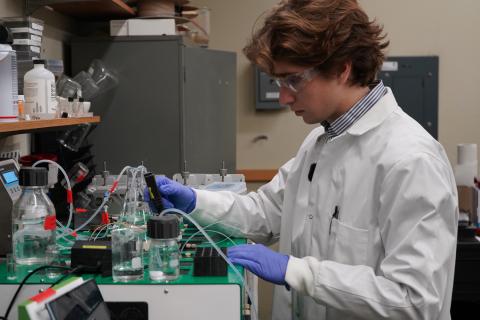
For Tulane University senior Will Hotaling, physics isn’t confined to equations on a chalkboard. It’s a hands-on, interdisciplinary experience that he’s using to help solve real-world challenges in medicine.
Hotaling, a physics and English major, conducts undergraduate research at PolyRMC, a biopharmaceutical research lab working at the intersection of physics, chemistry and biology. Under the mentorship of Wayne Reed and Curt Jarand in Tulane’s Department of Physics and Engineering Physics, Hotaling has spent the past year and a half contributing to the development and expansion of a patented dialysis system designed to evaluate the stability of complex biomolecules.
“At first glance, you wouldn’t think of us as a physics lab,” Hotaling said. “But a lot of the challenges in biopharmaceutical development, like drug stability and delivery, are deeply rooted in physical principles.”
The lab’s dialysis system addresses a major hurdle in drug development: ensuring that delicate biomolecules remain stable from the moment they leave a research lab to the time they’re delivered to patients. While discovering a promising molecule, such as mRNA used in vaccines, is a breakthrough in itself, safely transporting and delivering that molecule is an entirely different challenge.
“That delivery side is where we come in,” Hotaling explained. “We help determine the conditions under which a biomolecule stays stable or when it starts to aggregate and become unusable.”
When Hotaling joined the lab, the dialysis system had already been patented and validated on well-characterized proteins. His role became expanding its applications. During his junior year, he used the system to study DNA stability. This year, his focus shifted to homopolymeric RNA, which is simplified RNA strands composed of repeating single bases. This allows researchers to isolate and study base-specific interactions.
Using light-scattering techniques, Hotaling monitors how these molecules respond to gradual changes in pH and salt concentration over time. The continuous-exchange nature of the dialysis system enables precise, real-time measurements that would be difficult to achieve with traditional methods.
“This lets us identify aggregation thresholds,” he said. “Biopharmaceutical companies can see exactly where a molecule becomes unstable and design formulations that avoid those conditions.”
Hotaling’s contributions earned him a $4,000 undergraduate research award, which supports his continued work in the lab by allowing him to dedicate significant time to experiments and data analysis without needing outside employment.
“It’s been huge,” he said. “It lets me focus fully on the research.”
For Hotaling, the lab has been where classroom concepts finally clicked. Acid–base chemistry, organic synthesis, and physics principles that once seemed abstract now inform daily decision-making at the bench.
“In class, you sometimes wonder why you’re learning certain things,” he said. “In the lab, I’m using reading literature, analyzing data, and connecting ideas across disciplines. When it finally comes together, there’s no better feeling.”
That process hasn’t always been smooth. Failed experiments, long stretches of troubleshooting, and painstaking data analysis are part of the routine. But Hotaling sees those challenges as essential to growth.
“Most of my experiments fail,” he said with a laugh. “But when something finally works after weeks or months, it’s incredibly rewarding.”
After graduation, Hotaling plans to pursue medical school. While he doesn’t expect to spend his career in a research lab, he believes his undergraduate research experience will shape the kind of physician he hopes to become.
“I want to work with patients, but I also want to work alongside researchers,” he said. “Having seen how drug development and delivery really work, I think I can help bridge the gap between the lab and the clinic.”
His advice to other undergraduates is simple: don’t be afraid to start.
“Be curious, be honest about what you don’t know, and reach out,” he said. “Professors understand you’re learning. What matters is your willingness to ask questions and put in the work.”
Reflecting on his time at Tulane, Hotaling credits his mentors and lab colleagues for taking a chance on him when he had no prior lab experience.
“They taught me everything,” he said. “I’m beyond grateful for the patience, the opportunities, and the trust they gave me. It’s completely shaped who I am and what I want to do next.”
From a hesitant sophomore to a senior conducting industry-relevant research, Hotaling’s journey exemplifies the power of undergraduate research to turn curiosity into impact; one experiment at a time.
