
From Engineering to Entrepreneurship: How BioInnovation Is Expanding What It Means to Be an Engineer
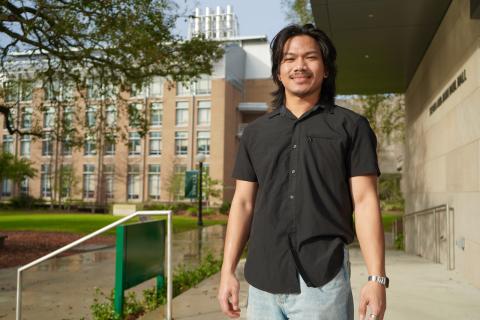
For Lennard Buluran, innovation is not just about designing a device. It is about understanding what it takes to bring that device into the world.
Now in the first year of Tulane’s BioInnovation master’s program, Buluran is part of a growing effort within Biomedical Engineering to bridge technical design with entrepreneurship, commercialization, and strategy.
“BioInnovation has been a great program,” Buluran said. “There is definitely a lot of push toward the business aspect of engineering.”
After earning his undergraduate degree in Biomedical Engineering, Buluran chose to stay at Tulane for a fifth year through the 4+1 pathway. He wanted more than research and development experience. He wanted to understand what happens after a prototype is built.
“In our senior year, we started an innovation from scratch,” he said. “The research and design is a lot of fun, but I was definitely curious to see what it takes to actually get the item into market.”
When friends ask him what BioInnovation means, he keeps it simple.
“I call it business for engineers. That’s all you need to know.”
The curriculum blends Biology, Commercialization, Technology & Design, and Policy & Regulatory Affairs. One course requires students to build a business from the ground up, developing the skills needed to move an idea beyond the classroom and into the marketplace.
“What makes an innovation successful in terms of being commercialized?” Buluran said. “And how do you ensure that when the product hits the market, it doesn’t fail immediately?”
A defining feature of the program is its built-in internship, which connects students directly to startups working to launch new technologies. Buluran is currently interning with BioProtectant Technologies, a company developing an Innovative Surgical Irrigant.
“There is a designated internship within the program that gets you connected to a startup,” he said.
The experience has given him a clear look at how early-stage ventures actually operate. Unlike a traditional lab environment, startup teams are often distributed across states, balancing funding, testing, and growth at the same time.
“It’s not like a lab where everyone’s all in one place,” he said. “It’s a couple of people in each place all working at the same time.”
Alongside engineering coursework, Buluran has taken classes in Tulane’s business school, including Management of Tech Innovation and Healthcare Policy and Social Reform. That interdisciplinary structure has broadened his understanding of how innovation functions beyond technical performance.
“It’s very interdisciplinary,” he said. “In terms of pure exposure, it’s one of the best programs for learning what you’re exactly interested in.”
Born and raised in the Philippines, Buluran came to Tulane through the Posse Foundation scholarship. He quickly found a sense of belonging in both the School of Science and Engineering and the city of New Orleans. He served as a resident advisor, co-founded the Filipino Student Association, and continues to work with a student team focused on open-source civic technologies that can be shared globally.
“Tulane was the most similar in terms of culture and community,” he said. “Its focus on community service was enough for me to come here.”
As he prepares to graduate with two degrees in five years, Buluran is exploring roles that combine engineering expertise with strategic innovation, including product strategy positions within major medical device companies and venture studios that focus on human-centered design.
“I would love to be in a supporting role helping others push their ideas forward,” he said. “Medical devices are such an underappreciated form of helping people. You know the amount of impact they’re making on people’s lives.”
For Buluran, BioInnovation has expanded what engineering can mean. It is not only about designing a solution. It is about ensuring that solution reaches the people who need it.
To learn more about BioInnovation MS, which is open to all STEM graduates from an accredited college or university. https://sse.tulane.edu/bme/academics/graduate/bioinnovation