
Engineering Trust: How Tulane Students Are Building Sustainable Solutions in Ghana Through Engineers Without Borders
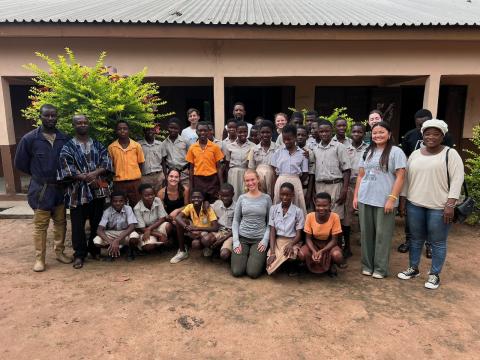
When Tulane students in Engineers Without Borders arrived in Sokode Ando, Ghana, they were not stepping into a simulation or a classroom exercise. They were entering a community with real sanitation challenges, real public health concerns, and real reasons to be cautious about outside help. What followed was not only an engineering project, but also an education in trust, adaptability, and the kind of responsibility that helps turn students into professionals.
Tulane’s chapter of Engineers Without Borders is working with partners in Ghana to address sanitation and water access issues in the rural community of Sokode Ando. The project includes the construction of school bathroom facilities and a borehole that will provide clean water for the school and surrounding community. For the students involved, the work has required far more than technical problem-solving. It has demanded fundraising, planning, documentation, travel coordination, community engagement, and a willingness to learn in conditions very different from those they know in New Orleans.
That complexity is one of the things that stands out most to Jenny Snape, a Tulane civil engineering alumna (‘04), CEO of MARAIS Consultants, and longtime professional mentor to the chapter. “It’s not all just about the engineering,” Snape said. “They’ve been doing so much planning, fundraising, logistics, and coordination—things that are essential to any real project.”
For Myla Reed, a junior engineering physics major pursuing civil engineering, the organization stood out from the beginning because it offered a chance to work on something larger than herself. “I thought it was something really, really special to be a part of,” Reed said. “There’s not really any other clubs like it at Tulane. I was excited that this is something that is impacting people that aren’t just me and my immediate surroundings, and that this is a club that I can do hands-on work for.”
That same sense of purpose drew in other students as well. Lilly Odom, a junior engineering physics major with a mechanical engineering minor, said she was pulled in by the service-driven side of the organization. “I really like doing engineering with a service aspect, because there’s not a lot of opportunities to do that on campus super easily,” Odom said. “That was Engineers Without Borders’ entire mission, and I just kind of got hooked in with the trip and everything.”
Amanda Schoaf, a junior in biomedical engineering, said she was struck not only by the mission, but by how much responsibility students carried in the organization. “I thought it was super cool how students were the ones leading the designs and working with global organizations one on one,” Schoaf said. “There’s a lot of real ownership in it.”
That ownership has become one of the defining features of the chapter’s Ghana project. Reed explained that from the start, students were involved in everything from selecting the project and gathering initial data to working through the logistics of implementation. “There aren’t a ton of student organizations where the students really are driving every single aspect of the decision making,” she said. “It’s very much student-led, and however much you want to put in is how much you can get out of it.”
The work begins long before anyone boards a plane. The chapter spends a significant amount of time fundraising, managing documentation, and navigating the requirements of Engineers Without Borders USA. Students described the administrative side of the organization as almost as instructive as the technical side. “You wear all the hats in this club,” Schoaf said. “The budgeting, the planning, the documentation, that’s all background stuff you don’t think of at first, but it’s great experience.”
Those efforts matter because Tulane does not fund international travel for the organization. Most of the money the students raise goes directly toward their Ghana project, including materials, local contractors, travel costs, and support on the ground. Reed said the chapter is now well into the first phase of construction, with the borehole completed and roughly 70 percent of the school bathroom structure finished. “All of the money that we collect during fundraising goes directly to the Ghana funds,” she said. “That’s materials, travel costs, local contractors, and local support to make sure the project stays safe and protected.”
The challenge in Sokode Ando was never just what to build, but what would actually work in the community. Snape said the team had to balance community needs with the realities on the ground. “The community really wanted flush toilets,” she said. “But there wasn’t a consistent water source, so we had to work with them on a solution that would be sustainable.”
What the students encountered in Ghana quickly expanded their understanding of what engineering work can be. The first trip focused on assessment and data collection. Later trips involved construction and implementation, with long days on site and constant coordination with local partners. Students described waking early, sharing breakfast, traveling to the work site, and remaining there until sunset. Along the way, they learned to navigate not only the technical aspects of the work, but the realities of working in a community with a different political, cultural, and material context.
For Reed, that first experience in the field changed everything. “I had never seen anything in the field before. I had never really worked on a serious project before, because I was only a freshman,” she said. “Going and meeting this community and doing the elevation and percolation tests really drove me to come back and recruit all my friends to join and to really give it my all.”
One of the most immediate lessons was that trust could not be assumed. Before the students could finalize plans for the sanitation facilities, they had to understand the community’s water system in detail. That meant mapping existing wells and making sure the bathroom site would not be too close to any drinking water source. But at first, the information they were receiving did not match what they were seeing.
“There’s a big trust issue in the beginning,” Reed said. She explained that residents were initially undercounting the number of wells in the community because of concerns about taxes, government water allocation, and whether outsiders would actually follow through on their promises. The students eventually learned that the community had been let down before, including by a previous outside group that funded a borehole without conducting the proper geological investigation. “The borehole was working for about an hour, and then it instantly was dry because there was no research done prior,” Reed said. “Their trust had been broken.”
Snape said the students handled that challenge with maturity and openness. “They really embraced the culture,” she said. “They sat with people, talked with them, and built relationships, and that went a long way with the community.” She added that the students’ willingness to ask questions, listen carefully, and spend time with residents helped them gather the information they needed while also earning confidence that could not have been rushed.
That history shaped the way the Tulane students had to approach their work. Instead of moving quickly toward a technical solution, they had to slow down, ask questions, and build relationships. Over the course of the trip, as they spoke with residents and worked alongside them, more wells were revealed and the students were finally able to map the full picture of the community’s water system. That, in turn, allowed them to select a safe site for the bathroom project.
The experience reinforced a principle that Reed said has become central to how the group thinks about development work. “If you have no ownership of something, you’re not going to maintain it,” she said. Engineers Without Borders requires community participation and financial investment, and in Sokode Ando that meant working through elders, local leadership, and a local nonprofit partner named Richard, who helps coordinate the project on the ground. The goal is not simply to deliver infrastructure, but to help build something the community can sustain after the students leave.
That emphasis on long-term use is also central to Snape’s perspective on the project. “It’s the difference between just throwing money at a problem and actually designing a sustainable solution,” she said. The group’s work, she explained, is meant to leave behind something the community can maintain with local materials, local knowledge, and clear operating guidance.
The students emphasized that what stayed with them most was not only the construction itself, but their interactions with the people the project is meant to serve. Schoaf recalled the excitement of arriving at the site and being immediately welcomed by the community. “When we showed up, they all surrounded our van, and they were so excited to meet us, and we were so excited to meet them,” she said. “Every day, they would be so excited to watch us work on the site. It just makes you excited to also be contributing to this project.”
Odom remembers the children especially. Because it was summer break, students from the local school often came to the construction site during the day. “They would come to the construction site to see what was happening,” Odom said. “We got to see who was going to be using the restrooms we were building. That was really cool to talk to them about their needs and why they want this project.”
For Matt Graf, a senior engineering physics major with a minor in electrical engineering, those relationships became the most memorable part of the trip. “The best part of the trips is definitely meeting the people there,” Graf said. “They’re so welcoming when you go. The kids would want to help us build or do things every day.”
At the same time, the work challenged the students in ways they had not expected. Construction in Ghana required them to think beyond drawings and calculations and to confront the physical realities of building. Schoaf said that, as a biomedical engineering student, seeing the construction side of the project up close was eye-opening. “I’ve taken materials, I’ve taken mechanics, but then being on an actual construction site was so cool to see,” she said.
Snape noted that even for experienced professionals, the conditions on site demanded a different mindset. “Everything was done by hand,” she said. “Moving dirt, carrying cement, without the tools we normally rely on.” Watching students adapt to that environment and continue working alongside the community, she said, underscored how much they were learning beyond the classroom.
For Reed, one of the most powerful parts of the experience was realizing how much of engineering happens outside the neat boundaries of a classroom problem set. “The trip teaches so much real-world experience,” she said. “It teaches new engineering things, like I didn’t know how to run a percolation test before, or structurally what has to be built first and then removed afterward. But it also teaches how engineering is more than just this is the problem, this is the solution. It affects the people. It affects the scheduling. It affects the communication, ordering, procurement, everything.”
Graf echoed that idea, noting how much of the actual building process was new to him. “You can solve a lot of problems, but I didn’t know anything about doing construction,” he said. “We had to do a bunch of research on how you even make a foundation right, how to put rebar in there, how to make wood forms for the concrete. You don’t learn any of that in class.”
That gap between classroom engineering and field experience has been one of the project’s biggest lessons. It has also influenced how students think about their future careers. Reed said the project helped clarify her growing interest in civil engineering and construction management. “Going and seeing the actual construction made me realize that beyond the classroom, I like this hands-on work, and I like seeing the direct impact of my work fold out day to day over the course of time,” she said. “This club was kind of a way for me to learn about the discipline in a way that no other Tulane opportunity allowed for.”
Snape sees that professional growth as one of the project’s most valuable outcomes. “Seeing the design process all the way through to construction is so impactful,” she said. “That’s something many engineers don’t experience until much later in their careers.”
Schoaf, whose interests lean toward human-centered design, said the project showed her how engineering decisions connect directly to the needs of the people using a space. “The whole part of biomedical engineering for me is humans first,” she said. “When we were looking at how we were going to do the toilet seats and the stalls, it was all based on the needs of the students. I loved seeing that correlation.”
The students also said the experience has had a major impact on their professional development. Reed pointed to the club as a meaningful factor in securing internships and building confidence. “This club has probably helped me secure both of my internships that I’ve had, because it’s such a great talking point to have,” she said. “Working with Jenny, who’s a local engineer and very intertwined with the club, has been huge. This club, I feel like, has changed my life.”
That transformation may be one of the clearest measures of the project’s success. In Sokode Ando, the students are helping build infrastructure that supports sanitation, clean water access, and long-term community use. At the same time, they are building skills that are much harder to teach in a lecture hall: how to listen, how to adapt, how to earn trust, and how to see engineering not as an abstract exercise, but as a responsibility to people.
For Tulane’s Engineers Without Borders chapter, the Ghana project is not just about what gets built. It is also about who the students become in the process.