
The Final Frontier in the Crescent City: The Rise of The Tulane Rocketry Association
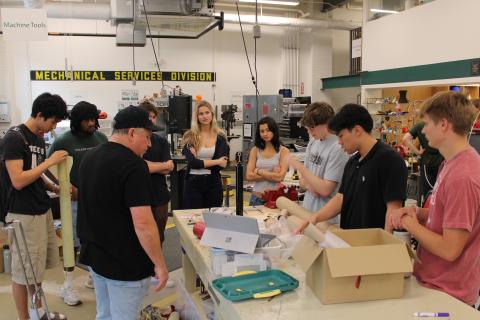
In the heart of New Orleans, where the local academic landscape has long been devoid of formal aerospace programs, two students are determined to prove that space is not just the final frontier, but a reachable one. Founded in January 2026, the Tulane Rocketry Club is the brainchild of Sam Markowitz and Joshua Nguyen, two students who independently realized that if Tulane didn’t have an aerospace program, they would build one themselves from the ground up.
The club’s origin is a story of serendipitous timing. Sam, a finance major with a lifelong awe of the cosmos sparked by childhood visits to the Hayden Planetarium, had been quietly doing the "invisible work"- researching FAA waivers and land logistics- for months. Meanwhile, Joshua, a chemical and biomolecular engineering major dreaming of becoming an astronaut, was seeking a way to demonstrate that Tulane students possessed world-class engineering capabilities. When they discovered each other's efforts in January, they combined forces to create a multidisciplinary powerhouse.
What sets The Tulane Rocketry Association apart is its corporate-style structure. Recognizing that high-power rocketry requires more than just technical skill, the founders have recruited a diverse team of roughly 25 members to focus on technical design and vehicle complexity, manage the critical "non-flight" hurdles like risk assessment and negotiating with local landowners, and document builds and tests to create a high-quality visual legacy for the club.
The club’s ambitions are anything but modest. Rather than following the traditional progression from low-power hobby rockets, the team moved directly into High-Power Rocketry, which utilizes composite motors and requires rigorous certification. Their targeted milestones include:
- Certifying members at Level 1 and Level 2 from the National Association of Rocketry (NAR) and the Tripoli Rocketry Association (the certification process allows individuals to purchase and fly higher total impulse motors, enabling larger, faster, and more complex rockets).
- Competing in the NASA Student Launch Competition.
- Reaching an altitude of 100,000 feet before graduation- roughly a third of the way to space.
- Developing two-stage rockets that require advanced avionics and "dual deployment" parachute systems to ensure safe recovery.
Launching rockets in Louisiana presents unique challenges such as the lack of available land. Currently, the nearest official launch site is over four hours away. Sam and Joshua are persistently lobbying local landowners and navigating FAA permits to establish a closer "training camp" to increase their launch cadence.
Ultimately, the founders see the club as a catalyst for academic change. As Tulane builds back its engineering programs post-Katrina, The Tulane Rocketry Association serves as a meeting ground for students to gain the tangible, project-based experience that top aerospace companies like Boeing and SpaceX demand.
Through community outreach- such as participating in "Girls in STEM" (GiST) and “Boys in STEM” (BATS)- they hope to inspire the next generation of New Orleans scientists. As Sam puts it, they are "kicking down the door" to show that with enough persistence, even a university without an aerospace department can touch the stars.
