
The Future of Farming in Orbit: Tulane Students Pitch Fungi for the ISS
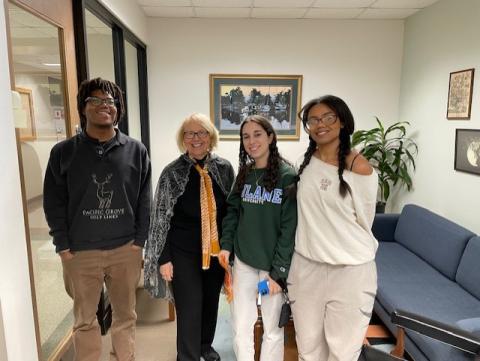
Across the labs of Tulane University’s School of Science and Engineering (SSE), a team of undergraduate researchers is looking toward the stars to solve some of Earth’s- and space's- most pressing agricultural challenges. Students Kristen, Vincent, and Yolanda have spent 2025 and the early part of 2026 developing a compelling proposal for NASA’s Student Spaceflight Experiment Program, aiming to secure a spot on the International Space Station (ISS) for their study on Aspergillus niger.
The project centers on how microgravity affects the growth of fungi. While mold is often seen as a nuisance on the ISS, this team sees economic and environmental potential. By leveraging mycelium networks, underground fungal structures that form symbiotic relationships with plant roots, the team believes they can revolutionize space agriculture.
"Instead of using all that money to send up fertilizer all the time, we could use mycelium networks to enhance plant growth," explains Vincent. This "bio-recycling" of nutrients could make long-term human habitation in space more sustainable while simultaneously reducing the strain on Earth’s topsoil and land, particularly in regions like Louisiana.
The team’s strength lies in its diversity of thought. Comprising Earth and Environmental Science, Environmental Studies, and Pre-med students, the group bridged the gap between ecology, microbiology, and engineering.
A major milestone involved constructing a 3D clinostat- a device designed to simulate microgravity by rotating samples to negate Earth's gravitational pull. Despite not being engineering majors, the team utilized 3D printing in the university Maker Space to build the device themselves. Under the mentorship of Dr. Joan Bennett, an expert in microbiology and fungi, they have moved into the lab to culture samples directly descended from those found on the space station.
For these undergraduates, the experience has been about more than just data. It has been a crash course in professional grant writing and collaborative problem-solving.
- Kristen Webster (Senior): Emphasizes that undergraduate research is "truly life-changing" and allows students to see the "bigger picture" of their studies.
- Vincent Martin (Junior): Highlights the importance of defining a research "why" to justify the investment of time and resources.
- Yolanda Canabate Garcia (Freshman): Representing the next generation of researchers, this project served as her first major introduction to the American research landscape.
As the competition concludes, the team continues their work in the Stern and Boggs buildings, running trials with the clinostat and preparing for advanced DNA analysis. Their journey stands as a testament to the power of undergraduate exploration and the interdisciplinary spirit driving the next frontier of science at Tulane.