
How Sophomore Ariana Reyes Found Her Path in Research
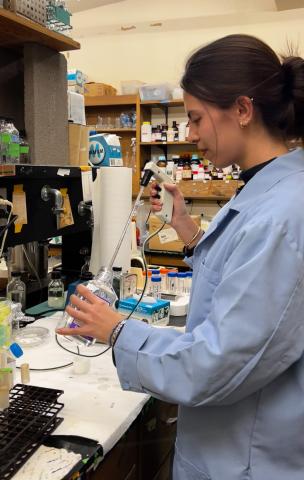
Growing up in Peru, Ariana Reyes never saw herself going into science. She wanted to be a pastry chef. With much of her family working in medicine and health related fields, though, she felt “some” pressure to follow the same path.
"Lots of people in my family are in the medical field, so that just kind of like drew my interest in that a little bit, and I kind of felt pressured to follow the pre-med track," she said.
When she applied to Tulane, she came in as an environmental science major on the pre-med track. By her second semester freshman year, she had switched to Cell and Molecular Biology (CMB). This past fall, she left the pre-med track entirely.
"I completely left the pre-med track because I just realized it wasn't for me," she said.
She is still CMB, and very passionate about her career path. She is now a recipient of a research award for her work investigating how bacterial cells respond to stress, research with potential implications for pharmaceutical applications.
Before arriving at her current lab, Reyes spent last summer in a shadowing program at a laboratory connected to a hospital network that serves patients across Peru.
"We received samples and biopsies from basically the whole entire country," she said. "So, I learned a lot about diagnostic processes through cytopathology and surgical pathology. Basically, my job was to observe and learn what they were doing, like cutting up the organs and processing the samples. I also did some tissue scraping for DNA extractions."
That experience, she says, confirmed she was on the right track.
The research opportunity at Tulane came through an email from Laurie O'Brien, the Associate Dean of undergraduates in the School of Science and Engineering. The message went out to all science and engineering students and contained an announcement seeking a student researcher.
"She sent an email to all science and engineering”,.," Reyes said. " I opened it and it was an announcement seeking a student researcher to implement cell cultures for spectroscopic dialysis experiments."
The email instructed interested students to send Professor Reed a CV and cover letter. Reyes did. He emailed her back the next day, and they set up an interview.
"I think we got along pretty well. He had been to Peru, so he speaks Spanish really well. We did like half of the interview in Spanish," she said.
Professor Reed then connected her with Professor Mullin for a second interview, as he needed a biology student to handle the cell work.
"He needed a CMB student or someone in biology to grow the cells, because his lab is more physics oriented, so he set me up with Dr. Mullin for another interview" Reyes said.
After that second interview, she received the award. Professor Mullin has since been teaching her how to grow and inoculate cell cultures and streak agar plates.
The project focuses on investigating metabolic signatures using curve-based spectroscopy, which measures how light scatters through a sample. Reyes is currently growing cell cultures using an E. coli strain called MG1655, a non-pathogenic strain used in genetic research, in a clear M9 medium that Professor Reed ordered specifically for the experiment.
"The M9 medium is super basic, it's a solution used to cultivate microorganisms. It only has glucose and some salts in it so it can be modified and altered to test if it's good or not," she said. "I've been just testing that to see what concentrations work best, what results we can get on the UV vis and the spectrometer."
The broader question driving the project is how far a cell can be pushed in terms of pH, temperature, and nutrition before it stops thriving. The team has tested growth across temperatures ranging from 18 to 40 degrees Celsius and plans to vary nutrient concentrations in the medium.
"The major point of this experiment is to see whether it can be used in pharmaceutical applications," Reyes said. "Identify the conditions in which a cell can be at its optimum stability and maybe help tweak formulations of existing medications to make them more effective."
Part of what excites Reyes about the work is the equipment itself. Professor Reed and Professor Jarand have built new technology specifically for this project, including a custom automated stirring setup. At the same time, the biology labs on the fourth floor of Stern Hall run on machines that have been around for decades.
"The labs in the biology floor, those are really old machines, so it's kind of interesting for me to see how new and old technology work together. Some machines are older than I am, but they still work perfectly" she said.
Her professors have been patient through the learning curve, accommodating her full schedule and making time for experiments. Beyond the technical skills, Reyes says she is focused on developing something harder to learn.
"That's my major focus right now, learning how to interpret results and explain what I'm doing, because I think that's one of the hardest parts of doing research," she said.
Reyes arrived at Tulane feeling uncertain about her major, and the introductory-level courses reinforced that feeling.
"When I first got to Tulane, I had a bit of imposter syndrome, because everybody here is so smart and so driven" she said.
Working in the lab with Professors Reed, Mullin, and Jarand changed that.
"They've also made me feel really confident in my research abilities," she said. "Working with them has made me realize that I am capable of, like doing stuff that makes me stand out."
She also credits Dr. Rafferty in the EAPP department, who was her English professor her first semester at Tulane, helped her write and review her cover letter, and has continued to check in on her ever since.
Reyes has two pieces of advice for underclassmen thinking about research. The first is simple.
"Read your emails, because there are so many opportunities in your emails that you just miss because you're scrolling through them really quickly. So read everything, filter through and apply to whatever interests you," she said.
The second is about comparison.
"Don't compare yourself to your classmates, because everybody has a different background and is following a different path. Just make sure that you're doing your best," she said.
She also encourages students to invest in experience outside the classroom, noting that professors value it.
"If over summer, you're able to do shadowing programs or some sort of service or anything that can give you real life experience, they're really going to appreciate that," she said. "So, make sure that your CV is updated, that you're able to write good cover letters and that stuff, instead of just focusing 100% on grades."
Reyes is thinking about pursuing a PhD or a master's degree after graduation, and is drawn to industry research over academia, though she says she is still figuring out the specifics.
"I definitely want to pursue a PhD or a master's or some sort of higher education, and then maybe get involved in the industry section of biology and research," she said. "I feel like research in industry is more of my speed, but I'm not entirely sure about what yet."
She hopes her current work will help answer that question.
"This experience will help me figure out if I want to stay in something related to just biology or maybe branch out into something different," she said.