
Learning the River: Tulane Landscape + Engineering Students Explore Louisiana’s Living Coast
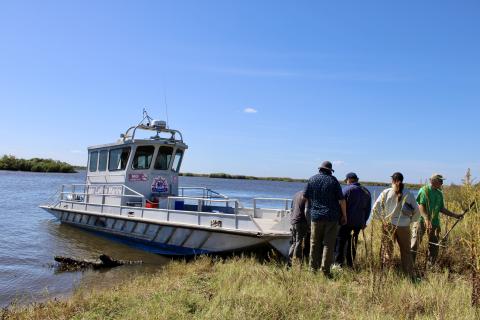
Hands-on field research and interdisciplinary collaboration come together in Barataria Bay, where students study coastal change, restoration, and resilience.
Graduate students in Tulane University’s Landscape + Engineering dual master’s program recently spent a day in the heart of coastal Louisiana, exploring the dynamic environments of the Barataria Basin. Led by Research Professor Barbara Kleiss and Professor Mead
Allison, both from Tulane’s Department of River-Coastal Science and Engineering, the trip offered students a rare opportunity to study coastal systems directly in the field, where theory and landscape meet.
“We started out in freshwater marshes, looked at the vegetation and the soils, then moved to intermediate, brackish, and saline marshes,” Kleiss explained. “And we wrapped it up by looking at a couple of dredge material sites that had only recently been created.”
For the students, stepping into these landscapes made an immediate impact.
“You don’t get to go out and walk on marsh every day,” said graduate student Emma Maass. “These environments aren’t really accessible to most of us, so it was really meaningful to get right up on it and see how these systems actually function.”
Along the way, Allison described how wetland plants transport oxygen to their roots, how estuarine systems sustain high productivity, and how land in coastal Louisiana is continuously formed and lost. “You build 100 acres of wetland,” he noted, “and subsidence starts to take it away.”
Standing on a newly built marsh platform constructed through sediment dredging, graduate student Gabriel Musselman reflected on how powerful it was to encounter restoration firsthand. “Until you actually step on it with your own two feet,” he said, “it’s hard to make the connection that this is real, artificial land.”
The Landscape + Engineering program attracts students from diverse academic and professional backgrounds; including those seeking to shift into climate-focused work. “I decided to enroll in this program as a career change,” shared graduate student Brian White, who previously worked in insurance defense. “When you’re able to look across multiple disciplines, you can come up with better ideas—not just one lane, but many.”
This interdisciplinary approach is core to the program’s design. Students collaborate with earth scientists, engineers, architects, landscape designers, and wetland biogeochemists; integrating scientific understanding with spatial and ecological thinking.
“I don’t think this combination exists anywhere else,” Maass added. “It’s unique that we’re able to cover so many interrelated fields of study at once.”
The timing and location of this learning are just as essential. Louisiana’s coast is changing faster than nearly anywhere else in the United States. Studying it here matters.
“Location is everything,” Musselman said. “Doing this work in one of the most important places in the country for understanding coastal change is just incredible.”
The field experience will directly inform the cohort’s current studio project, which focuses on restoration alternatives for the Barataria Basin. As Kleiss noted, “They now have a visual, a lived sense of what’s happening out here. And they can use that knowledge in their own design work.”
Through immersive, hands-on research and collaborative interdisciplinary learning, Tulane’s Landscape + Engineering students are preparing to lead in the future of coastal resilience.
To learn more about Tulane’s Landscape + Engineering dual master’s program, including curriculum, field research opportunities, and admissions, visit: https://landscape-engineering.tulane.edu
Watch a video from this trip: https://youtu.be/VnI6fSFrpjU