
From New Orleans to the Arctic: How Tulane Alum Kobi Jones is Powering the Future of Cold-Weather Technology
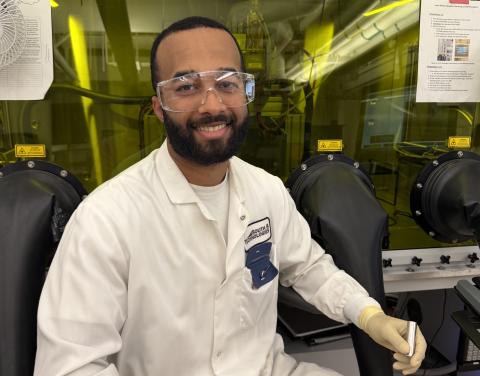
Kobi Jones graduated from Tulane University's School of Science and Engineering in 2020 with a degree in chemical engineering. Four years later, he is a manufacturing engineer at South 8 Technologies, a San Diego-based startup developing battery electrolyte technology designed for extreme cold-weather applications. His customers include the United States Army, defense contractors, and research partners working on the next generation of soldier power and unmanned aerial systems.
It is a long way, geographically and professionally, from a Xavier University chemistry classroom to the manufacturing floor of a battery technology startup. Jones arrived at that destination by staying curious, staying open to unexpected intersections between disciplines, and taking advantage of a unique academic partnership that gave him the best of two very different New Orleans institutions.
Jones began his undergraduate studies at Xavier University of Louisiana, focusing on chemistry. His trajectory shifted when he took a materials and energy balances course at Tulane during his junior year, the foundational entry-level class in chemical engineering. He liked what he found.
The proximity of the two campuses made exploration easy. There were days where he was, as he puts it, "riding my bike back and forth between Xavier and Tulane just to go to class." He began accumulating credits at Tulane, meeting professors and fellow students, and by the time he was ready to transfer, the groundwork was already laid.
What drew him to chemical engineering specifically was a desire to get into industry quickly rather than extend his academic career indefinitely. He knew that Tulane's program had a strong reputation in renewables and engineering hardware, and he wanted to build things, not just study them.
"I wanted to get into that field," he says, "do engineering, and get a job right out of college and then just start working in the industry as opposed to just doing research for another 5 or 6 years."
Looking back, Jones credits two Tulane faculty members with shaping the way he approaches problems today. The first is Dr. Godbey, who taught him numerical methods and biotechnology, and who recently retired from the program. The numerical methods course, Jones says, was formative not because of the material itself, but because of how it trained him to think.
The second professor Jones singles out is Dr. Ashbaugh, now dean of the engineering program, who taught separation processes. What Jones remembers most is not the textbook content but the way Dr. Ashbaugh made problems feel alive. One memorable exam was built around an Avengers film plot, asking students to calculate, among other variables, how much fuel Tony Stark would need to return to Earth.
"I always appreciate teachers that make things interesting and fun and give it some real application," Jones says. "A lot of Chem-E stuff can be dense. So seeing a modern application and being taught in that way is always appreciated."
When Jones joined South 8 Technologies four years ago, the company had about eight employees. His first desk was, as he describes it, simply a big table inside the lab. His title was research associate, which in practice meant hand-building prototype battery cells one by one and shipping them to early customers as proof-of-concept samples.
Every cell that went out the door carried his initials. "There was a point where [every battery] would literally say KJ, my initials, and we'd send it out to a customer," he recalls.
The technology at the core of South 8's products is what Jones calls a liquefied gas electrolyte, a mixture of solvents and a compressed gas blend that allows batteries to function at temperatures where conventional lithium-ion cells fail. The chemistry draws directly on his academic training. Vapor pressure, heat exchange, the ideal gas law, material and energy balances: these are the same concepts covered in first-year chemical engineering, now applied to a very real manufacturing challenge.
South 8's primary customers today are military. The company holds a significant partnership with U.S. Army C5ISR, the command focused on intelligence, surveillance, and reconnaissance technology. Their batteries go into soldier radios, surveillance drones, and wearable systems, small but critical applications where battery failure in cold weather is not a technical inconvenience but a matter of operational readiness.
For Jones, this is not abstract. His father served in the military, and Jones grew up around service members throughout his childhood and into adulthood.
"A lot of the technology that the military has is old," he notes, “stuff from the 80s or even Vietnam era." Being able to contribute something new, he says, matters to him on a personal level, even when the contribution is as unglamorous as a radio battery that works in the cold.
Jones has moved steadily from hands-on prototype work to process engineering as the company has grown to over 40 employees. This summer, South 8 is undertaking a significant production scale-up, bringing in larger automated equipment capable of manufacturing hundreds of thousands of cells. It is a transition that puts his Tulane training to work in a new way.
The core challenge of scaling, he explains, is that small errors get amplified. When he was building ten or twenty cells by hand, he could catch every imperfection. A machine running thousands of cells offers no such visibility.
"Trying to design in methods and operator instructions, like fail safes, up front is probably the biggest challenge," he says.
The longer-term vision is the automotive industry. Getting a South 8 battery into an electric vehicle would require manufacturing at a scale the company cannot yet reach, but the scale-up underway this summer is one step in that direction.
When asked what he would tell current Tulane chemical engineering students hoping to enter the energy or technology startup world, Jones resists the obvious answers. He does not tell them to network aggressively or target the right companies. Instead, he offers something more foundational: do not get locked into a single disciplinary identity.
"You never know what fundamental chemical engineering or any other fundamental science might creep into an existing industry," he says. South 8 is a battery company, and batteries are typically understood through the lens of electrochemistry and physics. But because of the liquefied gas electrolyte at the heart of the product, the work became a different kind of process engineering problem, one that most battery companies never encounter.
"Don't get too locked into the idea that this is the only thing that exists in the world, therefore I must go down this route of application," he says. "At the end of the day, it's all fundamental physics and fundamental chemistry." The best innovations often come from applying the concepts of one discipline into a new domain that was never considered before.
Jones says he has not been back to New Orleans or the Tulane campus in about three years, but that he plans to visit soon. The city, the university, and the bike rides between two campuses are part of what got him to where he is today.
