
Reimagining Mobility: Tulane Students Design Low-Cost Device for Foot Drop
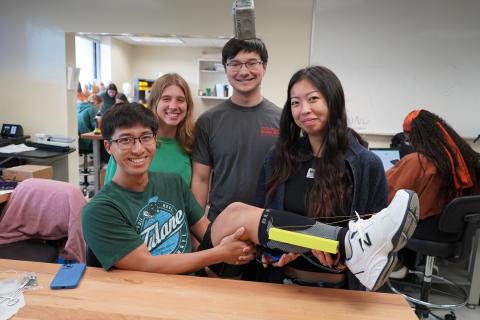
In a biomedical engineering lab at Tulane University, a group of students is working on a problem that shapes everyday life for thousands of patients but rarely gets attention outside clinical settings.
It is called foot drop. And for those who live with it, something as simple as walking becomes unpredictable.
“It’s pretty much the inability to lift your foot,” said Marisa Ricci. “So your foot’s kind of hanging down… your toes are pointing toward the ground. That makes it really difficult to walk, because you’re pretty much going to run into the ground and trip and fall.”
Foot drop is not a standalone condition. It is often a symptom of neurological disorders such as stroke or multiple sclerosis. Through their research and clinical exposure, the team learned just how common it can be.
“The statistic that we have is 20 to 30 percent of stroke patients develop foot drop,” said Matthew Vuong.
For the team behind ExoStride, the project began long before the semester started.
“We’ve been plotting on it for a while,” said Allison Wu. “Marisa has a family friend who has foot drop and has been struggling to find a device… after interviewing him, we felt like that was a good fit.”
By the time they entered Tulane’s capstone sequence, they were ready to move.
“Team ExoStride came into the semester with a well-researched problem statement,” said Dr. Katherine Raymond, professor of biomedical engineering. “They hit the ground running with early ideation of their solution concept and prototyping, allowing for rapid iterations of their design.”
That momentum carried into clinical observation, where the team spent weeks at a rehabilitation clinic working alongside stroke patients.
“We just got the opportunity to come and hang out and learn a bit more about what it really looks like for people that have foot drop,” Vuong said.
What they saw shaped everything.
Most existing solutions rely on rigid braces that hold the foot in a fixed position. While those devices can prevent tripping, they often come with tradeoffs in comfort, cost, and long-term recovery.
“This is $600,” Ricci said. “And it’s not really very comfortable, and it also doesn’t help you recover.”
The team set out to build something different. Not a brace, but a system that moves with the body.
Their device uses linear actuators and microcontrollers to track motion and respond in real time. Sensors on the thigh measure movement and angle, sending that data to the system at the ankle.
“What the thigh does is it actually has an accelerometer and gyroscope… determining the angle of the person’s thigh as they are walking,” said Matthew Scherp. “It will determine the person’s angle and tell the linear actuators whether to extend or retract.”
As the user steps forward, the device lifts the foot just enough to clear the ground, then releases it back into a natural position.
The result is a system designed to restore a more natural gait, not restrict it.
“Their device is a thorough, well-considered solution to help patients with foot drop walk with a normal gait cycle, improving their quality of life,” Raymond said.
Just as important as functionality is access.
Many assistive devices are priced out of reach for the patients who need them most. By building with widely available components, the team kept their prototype remarkably affordable.
“Our linear actuators are like $20… we just bought hobby components,” Ricci said.
“I could say we’d be hitting around 100 bucks for cost,” Scherp added.
That shift matters. It moves the conversation beyond innovation into accessibility.
The project itself reflects a broader philosophy within Tulane’s biomedical engineering program, where students are encouraged to pursue real-world problems and develop their own solutions.
ExoStride’s work is supported by the David A. Rice Design Endowed Fund in Biomedical Engineering, which provides students the flexibility to explore ideas they have identified themselves.
“While many students benefit from the support of a company-funded project, having departmental funds like these allows students with their own ideas to see them to fruition,” Raymond said.
For the students, the experience brought together everything they have learned across four years, from circuits and coding to design and patient-centered thinking.
“It’s seeing all the things we’ve learned over the past four years come together,” Ricci said. “The marrying of the electrical and the mechanical side.”
It also pushed them beyond engineering alone.
“The class also gives you a lot of exposure to other facets of biotech,” Wu said. “We talk about commercialization, entrepreneurship… and I’ve gotten to practice writing a patent.”
For Raymond, the project represents something even bigger.
“As a professor, it’s incredibly rewarding to recall a year ago these students sitting in my office pitching this idea,” she said. “And now to see how, with mentoring, resources, and their own innovative work, they have a working prototype that solves a problem many patients face every day.”
The device is still in development, with testing and approvals ahead, but the team is ready to share what they have built.
“It’s really awesome to show off what we’ve learned, because Expo is a really big event for us,” Wu said. “We love when people come, and we’re really excited to demo our product.”
Looking ahead, the team hopes their work continues beyond this semester.
“We hope to pass down the project,” Wu said. “I think it could be a good project to continue for future classes.”
That is part of the point. This is not just about a single device. It is about what happens when students are given the freedom to identify real problems, pursue their own ideas, and build something that has the potential to improve lives.
They are not just learning engineering. They are learning how to apply it where it matters most.