
So You Want to Be a Researcher? Tulane SSE Launches New Video Series Spotlighting Undergraduate Discovery
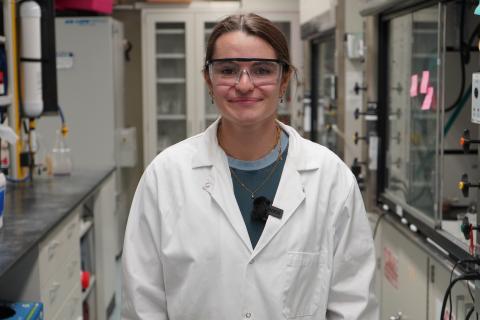

Undergraduate research often happens quietly; in labs humming late into the evening, in marshes at sunrise, and at workbenches scattered with notebooks, samples, and questions. At the Tulane University School of Science and Engineering (SSE), those moments are foundational to how students learn, grow, and imagine what’s next.
This year, SSE is bringing those moments into focus with the launch of, So You Want to Be a Researcher?, a new video series that highlights undergraduate students engaged in hands-on research across disciplines. The first collection features seven undergraduates working in labs that span biomedical engineering, neuroscience, chemistry, physics, environmental science, and coastal research; offering a candid look at what it means to be a student-researcher at a Tier One research institution.
Together, the videos capture not just experiments and equipment, but curiosity, mentorship, and the collaborative energy that defines research at Tulane.
In one episode, biomedical engineering student Trishita Paul demonstrates acoustic tweezing techniques used to study how blood thinners affect coagulation. Working alongside graduate students and faculty mentors, Paul’s research is driven by her long-standing interest in cardiology and its real-world applications.
“I get to test blood thinners and other medications here in the lab,” Paul explains. “We want to
ultimately use acoustic tweezing in clinical settings.”
In Stern Hall, senior Lavinia Palmer works in the Grayson Group Research Lab synthesizing new biomaterials like hydrogels, that are designed for tissue healing, regeneration, and other biomedical applications. Her work blends creativity with precision, drawing directly from concepts she first encountered in the classroom.
“It’s completely transformed my life and the path that I’m on,” Palmer says. “I love the creativity and innovation that comes with making new materials.”
For Laney Druhan, that transformation came through synthetic biology and CRISPR gene-editing research. In the lab, Druhan engineers DNA sequences, visualizes genetic material through gel electrophoresis, and studies how single base-pair changes can lead to major genetic disorders.
“Research has allowed me to answer deeper questions you can’t get from a lecture,” she says. “It pushes you to think analytically in a way classes alone can’t.”
Neuroscience undergraduate Dylan Ratner takes viewers inside a cellular neuroscience lab where she studies the brain circuitry involved in voluntary motor movement. Her research examines how different types of neurons project from the brain to the spinal cord; work that has implications for understanding neurodegenerative diseases such as ALS, Parkinson’s, and multiple sclerosis.
“Scientists are innately curious people,” Ratner reflects in the video. “Finding solutions and solving problems is what makes science exciting.”
In another lab, physics student Robyn Kopeny explores optics and photonics, investigating how lasers and light-based systems could be used to transmit information more efficiently than traditional electronics. Her work touches on image denoising, phase masks, and the role optics plays in modern physics and emerging quantum technologies.
“If we can use optics to do the same work,” Kopeny explains, “it takes a lot less energy, and it works much faster.”
The series also highlights research that extends well beyond campus. Environmental science undergraduate Gracen Miller studies carbon fluxes in mangrove ecosystems, combining field sampling with detailed lab analysis to understand how these environments store carbon and recover from disturbance.
“I get a really well-rounded experience combining field work and lab work,” Miller says. “By knowing how much organic carbon is in the soil, we can help inform restoration projects.”
In the final episode of the initial series, a senior researcher named Claudia Miller takes viewers into the field to study restorative oyster reefs along Louisiana’s coast. Using drone-mounted LIDAR, she collects high-resolution elevation data to track reef growth and understand how these living structures help protect shorelines.
“I didn’t even know restorative oyster reefs were a thing when I started,” she reflects. “Now I know so much about them. I’m really happy to leave Tulane with such a meaningful experience as a scientist.”
While So You Want to Be a Researcher? centers undergraduate voices, each story reflects the collaborative ecosystem that supports research at Tulane SSE. Every student featured works alongside graduate students, postdoctoral researchers, and faculty principal investigators, where they learn techniques, ask questions, and contribute meaningfully to active research programs.
That mentorship model is intentional. Undergraduate research at Tulane is not an add-on, but a core part of the academic experience; preparing students for graduate study, professional careers, and a lifelong engagement with discovery.
The launch of So You Want to Be a Researcher? marks the beginning of an ongoing storytelling effort. While these seven videos will be featured and promoted throughout the year, additional student research stories are already planned for future installments.
Together, the series offers a clear message: at the Tulane School of Science and Engineering, research isn’t something students wait to do; it’s something they begin now.

