Tulane Engineering Senior Embodies University's Spirit of Innovation and Community
Miriam Lerner, a senior at Tulane University studying Engineering Physics with a minor in mechanical engineering, represents the kind of student success that emerges when innovation meets community. Currently on the 4+1 track to earn her master’s in electrical engineering, Lerner has built a college career defined by mentorship, technical excellence, and a commitment to passing knowledge forward.
"I think that that's one of the things I really love about engineering at Tulane, is that we have such a strong sense of community," Lerner says, reflecting on her four years at the university.
Lerner's involvement at Tulane began in the Society of Women Engineers (SWE), where she has been active since her freshman year. "I applied and then joined as the freshman rep because I was really looking for [community]," she explains. Her dedication to the organization has grown throughout her time at the university, where she has worked to create pathways for younger students.
The impact of this mentorship culture resonates deeply with Lerner. "I still sometimes call the people that were seniors when I was a freshman and update them on my life, hear about their lives, and … they still have advice to give me, and it's fun to really just be able to talk to them as friends," she says.
Looking at the next generation of engineering students, Lerner finds fulfillment in watching them grow. "And it feels really, really rewarding," she says, "Genuinely being able to see this torch pass down from grade to grade, and knowing that if I come back in a few years and I see these current freshmen as upperclassmen, and I'll be able to talk to them, and I just know that I'll be so proud of them seeing them in these roles."
Beyond SWE, Lerner is also involved in Theta Tau, the engineering professional fraternity. "I definitely think that being a part of these communities has made me realize how much I value it, and how much I value playing an active part in these kinds of organizations and spaces," she says. "And it's definitely made me think to post grad and go, ‘Okay, what can I do in my post grad life, to find these kinds of communities again and to build these up?’"
Lerner's commitment to community extends beyond campus through K-12 STEM education outreach programs, including GiST (Girls in STEM at Tulane) and BATS (Boys at Tulane in STEM). This work reflects her dedication to making STEM accessible to younger students and fostering the next generation of engineers.
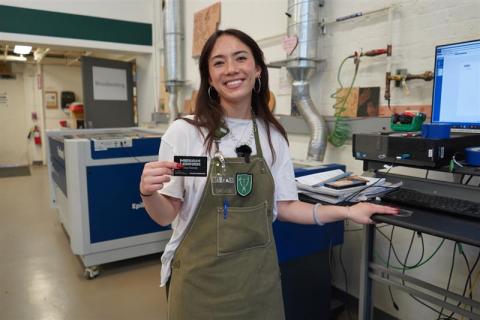
Additionally, as a Fabtech in the Tulane makerspace, Lerner helps fellow students bring their projects to life. Through this role, she supports peers in developing real-world solutions and gaining hands-on experience with fabrication and design.
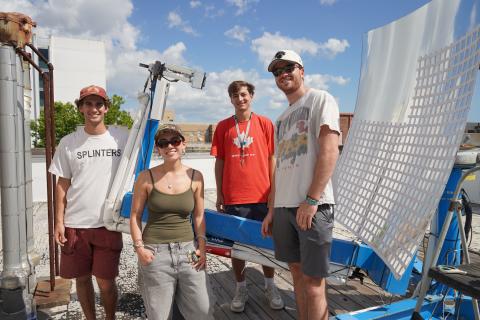
Lerner's capstone project, Flower Power, focuses on photonic materials and solar cogeneration, tackling critical problems in renewable energy. Working with Dr. Escarra as her advisor, she is part of a team addressing complex challenges in the field. Her capstone won Best Project in Engineering Physics and the 2026 Tulane Engineering Capstone Expo.
"It's definitely a lot of work for the project, but I feel like I've learned so much on this project, and I appreciate the fact that Dr. Escarra, as our advisor, has very high expectations for us, because we all kind of feel like we're working in a very professional setting, and I think that's going to translate really well to working in the industry and [its] also just fun, because I just got to work with fun people on a cool project," Lerner says.
Her research experience extends beyond the capstone. Working in the clean room in Paul Hall, Lerner is building on the work of a master's student who mentored her, continuing his thesis project by working with 2D semiconductor materials to design new photonic devices."It's really cool to be working on something that's kind of at the forefront," she said about her photonic materials and devices research.
Of course, she is quick to recognize her mentors. "Shout out to Dr. Sanchez! She has been such an incredible mentor and figure to me,” Lerner says. She particularly emphasized Dr. Sanchez's role in creating K-12 outreach opportunities for SWE members. "I would really credit Dr. Sanchez with a lot of that, and she's also just been such a wonderful professor and advisor to talk to," Lerner says.
This emphasis on relationships has shaped not only her academic journey but also her approach to leadership. The connections she has built, from the seniors who mentored her as a freshman to the younger students she now guides, have created a network of support that extends well beyond graduation.
As Lerner prepares to continue her education in the master’s program, she carries forward the lessons learned from years of community building, research, and mentorship. Her journey from freshman mentee to senior mentor demonstrates the transformative power of finding community, pursuing challenging research, and paying forward the support she received.