
Tulane Engineering Students Design New Inhaler to Help Patients With Lung Disease
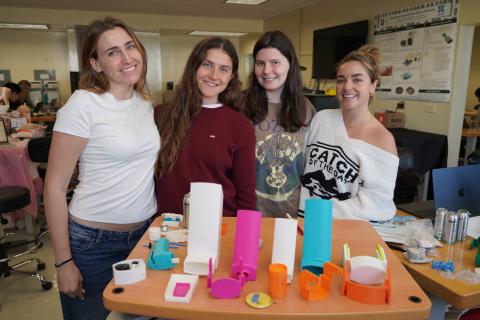
A team of Tulane biomedical engineering seniors is designing a new type of inhaler that could help patients with severe lung disease receive medication more effectively.
The students are developing an enhanced dry powder inhaler designed specifically for people with idiopathic pulmonary fibrosis, a progressive lung disease that weakens breathing capacity over time. The goal is simple but challenging: deliver medicine deep into the lungs for patients who physically cannot generate a strong enough breath to use most inhalers.
“Our design adds a small boost of airflow to help push the medicine deeper into the lungs,” said Jenna Al-Hachem, a member of the team. “Patients with compromised lung function may not be able to inhale strongly enough on their own, so we’re trying to supplement that gap.”
Dry powder inhalers already exist and are commonly used for respiratory conditions. Unlike traditional inhalers that spray liquid medication, these devices deliver powdered medicine that is activated by a patient’s breath. The problem is that patients with severe lung diseases often cannot inhale forcefully enough to activate the device.
The Tulane team’s design addresses that problem by incorporating compressed air that adds a small burst of airflow during inhalation. The system is designed to help carry the medication further into the lungs without applying harmful pressure.
“We’re trying to make up the difference in breath strength,” said Avery Ross, another student on the project. “If a healthy person can take a full breath and someone with pulmonary fibrosis can only reach part of that capacity, our device is meant to bridge that gap.”
The project began through an industry connection. Ross interned at Graviton Bioscience, a pharmaceutical company developing a drug for idiopathic pulmonary fibrosis. During her internship she asked the company what type of innovation could help their drug reach patients more effectively.
The answer led directly to the inhaler project.
The medication is currently delivered in pill form, but researchers believe that delivering it directly to the lungs could make the treatment significantly more effective.
“Sending the drug straight to the lungs is the most direct and efficient delivery pathway,” Ross explained. “Right now, the pill has to go through the bloodstream and other systems before reaching the lungs.”
Turning that idea into a real device has required rapid prototyping and constant iteration.
The students have been designing and printing multiple versions of their inhaler using Tulane’s Scot Ackerman Makerspace. Each full print can take several hours, and the team has produced numerous prototypes while refining the mechanics.
“There’s been a lot of time in the Makerspace,” Al-Hachem said. “We’re really lucky to have access to the 3D printers and tools. It lets us quickly test new ideas without waiting weeks for manufacturing.”
The project has also drawn support from faculty mentors across Tulane’s engineering programs.
The students credit professors including Dr. Mondrinos, Dr. Gelfand, and Dr. Rajappan for helping them troubleshoot design problems and guide the development process.
“We’ve had so many professors willing to help us work through challenges,” Ross said. “That support has made a huge difference.”
The project recently took another major step forward when an international testing laboratory agreed to evaluate the device.
Intertek, a global testing and certification company based in Edinburgh, Scotland, will run preliminary tests on the inhaler using specialized equipment that measures how particles disperse and travel through simulated lungs.
The opportunity came after the students cold-emailed companies searching for access to a specific testing device called a next generation impactor.
To their surprise, Intertek responded.
“They normally test inhalers for major companies,” said Hailey Dunsby, another member of the team. “But they agreed to run some short-term testing for us because they liked the idea.”
In exchange, the students will present their findings at an international conference in Edinburgh next year.
The project may also move toward intellectual property protection. With support from Graviton Bioscience, the team is already working with a patent attorney to explore filing a patent on the inhaler concept.
For the students, the project has transformed from a classroom assignment into something that feels much closer to real-world engineering.
“It makes it feel much more real,” Ross said. “We’re not just designing something for a grade anymore. We’re designing something that could actually help patients.”
The team plans to send their first working prototype for testing in early March and will continue refining the design.
What began as a simple concept, essentially a syringe attached to an inhaler, has evolved into a more sophisticated mechanical system shaped by months of iteration, feedback, and hands-on problem solving.
Looking at the early prototypes scattered across the table, Ross laughed.
“Our first version was basically a syringe attached to an inhaler,” she said. “Now we’ve come so far from that.”