
Tulane-led team develops parameter-free route to accurately predict electron–phonon inter- actions in complex materials

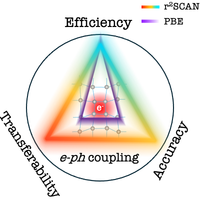
A short lay-summary for a general audience– Electron–phonon coupling (EPC)—the interaction between electrons and crystal-lattice vibrations (phonons)—is central to many phenomena in condensed-matter physics and materials science. It underpins phonon-mediated superconductivity, sets the electrical resistivity of metals, governs carrier lifetimes and mobilities in semiconductors, and drives temperature-dependent changes in electronic band structures, among many other effects. Modern “first-principles” EPC calculations are typically based on density functional theory (DFT), but their predictive power ultimately depends on the accuracy, transferability, and efficiency of the underlying exchange–correlation functional. For many complex materials involving transition metals and rare earth metals, widely used functionals such as local density approximation (LDA) and the Perdew-Burke-Ernzerhof (PBE) generalized gradient approximation (GGA)
can yield incorrect electronic structures, unstable phonons, and therefore unreliable EPC predictions. A common workaround is to introduce Hubbard-U (DFT+U) and sometimes intersite V corrections, but these approaches rely on material- and environment-dependent parameters, which complicates truly predictive modeling.
In a recent study published in the journal PRX Energy, Tulane researchers, Jianwei Sun and Ruiqi Zhang, demonstrate that the advanced r2SCAN meta-GGA developed at Tulane offers a transferable and computationally efficient route to parameter-free EPC predictions across a broad class of materials. They show that r2SCAN captures strong EPC in challenging transition-metal oxides such as CoO and NiO without introducing any Hubbard-U parameters, reproducing key polar-phonon physics and yielding substantially larger EPC matrix elements than those from PBE calculations. The same approach also resolves a long-standing difficulty in the prototypical ferroelectric BaTiO3, where a subtle balance between ionic and covalent bonding is essential: r2SCAN stabilizes the correct low-temperature rhombohedral phase and captures strong EPC, again without requiring U or intersite V corrections. Beyond oxides, r2SCAN improves EPC-relevant electronic properties in the semiconductor GaAs—including the band gap, dielectric screening, effective masses, and EPC matrix elements—and provides reliable EPC predictions for the superconductor MgB2.
"r2SCAN has been demonstrated to provide accurate and efficient predictions across a wide range of material properties, and this work extends its strong performance to electron–phonon coupling—the interaction between electrons and atomic vibrations—which critically influences electrical conductivity, heat transport, and superconductivity, and is therefore central to materials design and industrial technologies," says Sun.
Overall, this work establishes r2SCAN-based EPC as a practical, parameter-free framework for predictive, material-specific modeling of electron–phonon physics, and it points toward scalable, high-throughput screening of superconductors, thermoelectrics, optoelectronic semiconductors, and functional oxides for energy applications.
"Electron–phonon coupling sits at the heart of transport, band renormalization, and superconductivity, but its prediction is only as reliable as the underlying density functional. Our key result is that r2SCAN provides a transferable, parameter-free route to accurate EPC predictions across very different material classes—from correlated oxides and ferroelectrics to semiconductors and MgB2—without turning to the Hubbard-U or intersite V corrections. This opens a practical path toward predictive, material-specific modeling and eventually high-throughput screening of EPC-driven phenomena," says Zhang.