From Tulane to NVIDIA GTC: Stepping Into the Future of AI
Michael Weild, a member of Tulane’s Class of 2026, arrived at Tulane planning to study finance, following a path that felt both familiar and expected. His direction shifted during his early years on campus, as a combination of personal challenges and changing circumstances forced him to think more critically about what his education needed to deliver.
“At some point, it stopped being about just being here,” he said. “It became about return on investment.”
The shift in perspective reshaped how he approached his time at Tulane. Courses became tools rather than requirements. Time became something to allocate intentionally. A single question began guiding his decisions. What is actually going to create value?
A move into computer science followed, where he is now fully focused with an emphasis in artificial intelligence. The decision was not driven by trend, but by a clear assessment of where the field is heading and how he could position himself within it.
“I needed to figure out what would actually make me competitive,” he said.
Work outside the classroom became central to that effort. Weild sought out opportunities that connected academic concepts to real-world application, combining his background in finance with technical training in computer science. The combination led to a role with an investment bank, where he is now working on AI systems applied to public finance, building tools that help process complex financial data and support decision-making.
“I don’t think I’ve ever regarded myself as the best student in the classroom,” he said. “But where I realized I could differentiate myself was in identifying where those concepts could actually be applied.”
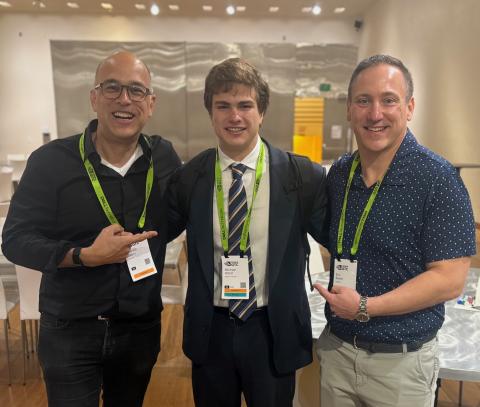
The same mindset carried into his experience at the NVIDIA GTC Conference in San Jose, one of the world’s leading gatherings in artificial intelligence. Through Tulane, Weild applied for and received support to attend, placing him in direct proximity to engineers, executives, and researchers from companies including OpenAI, Google, and Anthropic.
“The first person I ran into on the way to pick up my badge was a senior cloud architect at Google,” he said. “Seeing people at that level in person was surreal. I realized this was a once-in-a-lifetime opportunity, so I treated it that way.”
Initial moments at the conference felt uncertain. Most attendees were significantly older, with years of industry experience. One conversation changed the trajectory of the experience.
“The first day I was sort of paralyzed,” he said. “But after I talked to one person, the rest of the conference was like butter.”
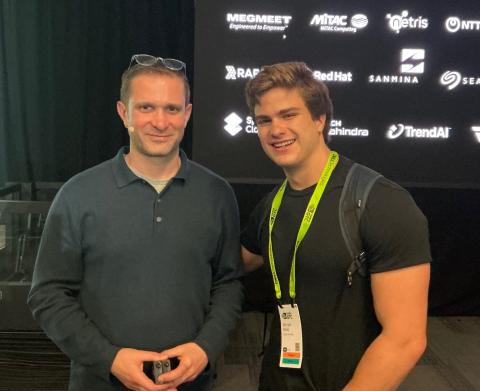
Confidence built quickly. Weild began approaching conversations with purpose, identifying individuals he wanted to meet and introducing himself. In one instance, he recognized a senior leader responsible for computing infrastructure at OpenAI and initiated a discussion about how large-scale AI systems are designed and deployed.
Informal settings extended the impact of those conversations. Smaller group discussions and networking environments created space for more direct exchanges. Over the course of the conference, Weild connected with professionals across the field, including senior leaders at major technology and financial institutions.
The experience reinforced a belief that had already been shaping his approach.
“Your education is what you make of it,” he said. “You can go through it passively, or you can use it.”
A clearer view of the field also emerged. Across panels and conversations, one theme surfaced consistently. The role of the programmer is changing. As AI systems become increasingly capable of generating and refining code, the value of technical work is shifting.
“The value is shifting from being the person who writes the code to the person who defines what the system should do,” he said.
Technical knowledge remains essential, but its role is evolving. Understanding how systems function at a fundamental level becomes critical for guiding them effectively, particularly as they operate within constraints of time, cost, and computational resources.
“The fundamentals are everything,” he said. “If you don’t understand what’s happening underneath, you can’t guide the system effectively.”
Problem definition emerged as a central factor. A well-defined problem allows AI systems to produce meaningful results efficiently. A poorly defined one leads to wasted resources and weaker outcomes. Domain expertise becomes a form of leverage in that process.
Students who rely entirely on tools without developing that underlying understanding risk falling behind. The technology can execute tasks, but it cannot replace the ability to define those tasks clearly.
“The value isn’t disappearing,” he said. “It’s shifting.”
Academic experience at Tulane played a direct role in shaping that understanding. In his junior year, Weild enrolled in a graduate-level course in reinforcement learning with Dr. Zizhan Zheng, who later became his research advisor. Exposure to multi-agent systems introduced a framework in which multiple AI programs coordinate to solve complex problems.
Familiarity with those ideas provided an advantage. By the time Weild encountered similar concepts at NVIDIA GTC, he was engaging with them at a deeper level than many of his peers.
“It felt like I had already been working on the future,” he said.
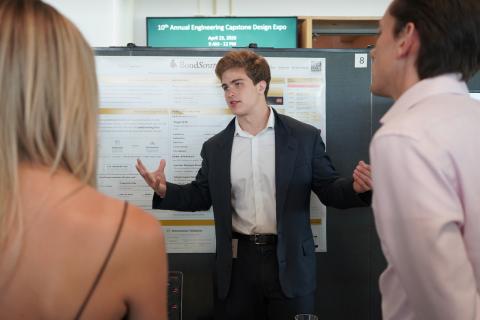
Work now continues beyond the classroom. Weild’s senior project, BondScrape, is an AI system designed to help municipal bond underwriters evaluate new deals more efficiently by extracting key information from complex financial documents and supporting decision-making.
“I want to take what I’ve learned and actually use it to create value,” he said.
Advice for other students reflects the same mindset.
“You have to find your niche,” he said. “It’s not about being the best. It’s about finding an area where your combination of skills is distinct and actually useful.”
A clear perspective now defines his approach. College is no longer just an experience. It is an opportunity to build something meaningful.