Tulane Professor Secures Prestigious NIH Award to Study Family Mental Health
Dr. Selin Zeytinoglu, an Assistant Professor at Tulane University's School of Science and Engineering, has been awarded a prestigious K01 Research Scientist Development Award from the National Institute of Mental Health. The four-year grant, totaling $616,658, will fund her research project titled "Social and Neural Pathways Linking Parental Anxiety with Youths' Daily Emotions," positioning Tulane as a growing center for innovative family mental health research.
The research addresses a fundamental question in developmental psychology and mental health: How does a parent's anxiety influence their child's emotional experiences from day to day? While scientists have long known that anxiety tends to run in families, the specific mechanisms through which parental mental health shapes children's daily emotional lives remain incompletely understood. Zeytinoglu's work at Tulane will investigate both the social interactions between anxious parents and their children and the underlying neural processes that may link parental and child mental health.
This research has important implications for understanding how mental health challenges are transmitted across generations and could ultimately inform interventions designed to break cycles of anxiety within families. By examining these dynamics as they unfold in real time through Ecological Momentary Assessments (EMAs), the study will capture the lived experiences of families in ways that traditional research methods cannot. EMAs are smart-phone based assessments in which children receive prompts to report on their feelings several times a day for 10 days.
At the heart of Zeytinoglu's research is an integrative approach that examines multiple levels of influence simultaneously. The project will investigate social pathways, looking at how anxious parents interact with their children, the emotional climate they create in daily family life, and how they model responses to stressful situations relative to parents who are low in anxiety. These social mechanisms operate through the countless small interactions that make up family life: how a parent responds when a child expresses worry, the tone of voice used during stressful moments, the messages conveyed about whether the world is safe or threatening.
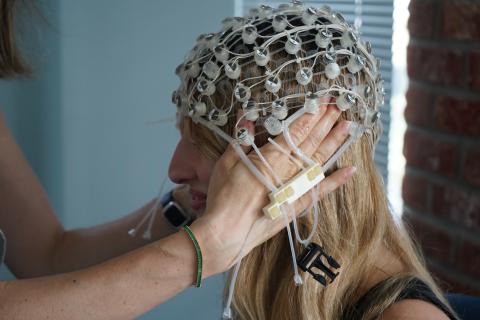
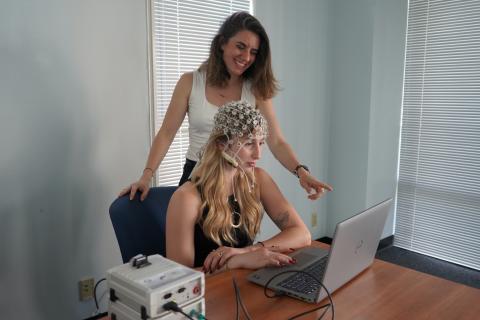
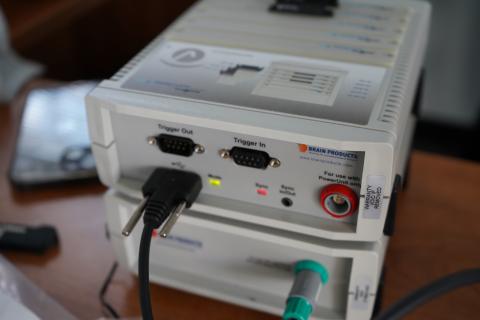
The research will also examine neural pathways using EEGs, which is a non-invasive method that can easily be used with developmental populations, investigating how parental anxiety might be associated with patterns of brain activity in children that relate to emotional processing and regulation. This biological dimension recognizes that our emotional experiences are shaped not just by our social environments but also by underlying neural processes that can be influenced by those environments.
By studying both social and neural pathways together, the research takes a comprehensive view of how parental mental health influences child development. This multi-level approach is essential because anxiety transmission likely occurs through multiple interconnected mechanisms. A parent's anxiety might influence their behavior toward their child, which in turn shapes the child's developing neural systems for processing emotions, which is associated with how the child experiences and responds to emotional situations in daily life.
The use of Ecological Momentary Assessments represents a methodological innovation that will allow Zeytinoglu's team to capture these dynamics as they naturally occur. Rather than asking families to recall their experiences days or weeks later in a laboratory setting, Ecological Momentary Assessments involve repeated real-time sampling of experiences as people go about their daily lives. This approach provides a window into the actual emotional experiences of parents and children in their natural environments, offering insights that cannot be obtained through traditional research methods.
Since arriving at Tulane, Zeytinoglu has come to appreciate how the unique characteristics of New Orleans provide a rich context for understanding family mental health. The city presents both distinctive challenges and distinctive strengths that shape how families function and how children develop emotionally.
The challenges facing many New Orleans families are significant and multi-layered. "There are very unique challenges, like socioeconomic stress, inequality in accessing resources, infrastructure problems, and climate related trauma, lasting stress, or uncertainty," she observed.
For a researcher studying how parental anxiety influences children's daily emotions, understanding these contextual stressors is essential. Parents in New Orleans may be managing anxiety related not just to typical parenting concerns but also to economic insecurity, infrastructure failures, and climate threats. How this broader context of stress influences parent-child interactions and children's emotional development is an important question that the research conducted at Tulane will be positioned to address.
But Zeytinoglu is equally attentive to the distinctive strengths she has observed in the New Orleans community, characteristics that may serve as protective factors for family mental health even in the face of significant stressors. "I think there are a lot of unique strengths in New Orleans too. People talk to each other, they support their neighbors, they're outside, celebrating, there are so many festivals," she noted.
This observation about community connectedness is particularly relevant to her research on family mental health. Social support from neighbors and the broader community can buffer families against stress. When parents have supportive relationships with neighbors and participate in community celebrations, they may be better able to manage their own anxiety and create positive emotional environments for their children. The cultural emphasis on celebration, music, and communal gathering that characterizes New Orleans may provide families with regular opportunities for positive emotional experiences that counterbalance daily stressors.
A major component of the K01 award's impact at Tulane will be the development of a new research laboratory and the training of the next generation of mental health researchers. Zeytinoglu is in the process of building a team that will carry out the funded research while also creating valuable learning opportunities for students at multiple levels.
"I think the part that I'm really excited about is I'm building a new team at Tulane. My first Ph.D. student is coming soon. I'll be recruiting a lab manager," she shared. "I'm also directly working with undergraduate students and students who are already here, like other graduate students."
This emphasis on training reflects an understanding that the impact of research extends beyond the specific findings of any single study. When students learn sophisticated research methods and develop skills in scientific thinking, they carry those capabilities forward into their careers, whether in academia, clinical practice, industry, or other settings. The investment in training that is built into the K01 award thus creates a multiplier effect, with benefits that will extend far beyond the four-year funding period and far beyond Tulane itself.
Anxiety disorders are among the most common mental health conditions, affecting millions of families across the United States and around the world. Research has consistently shown that children of anxious parents are at elevated risk for developing anxiety themselves. Understanding why this occurs and identifying the specific mechanisms through which risk is transmitted is essential for developing effective interventions.
Some of the transmission of anxiety from parents to children likely occurs through genetic mechanisms. Twin studies and other behavioral genetics research have shown that anxiety has a heritable component. However, genes are not destiny, and environmental and social factors play crucial roles in determining whether genetic vulnerabilities are expressed as clinical anxiety disorders.
This is where Zeytinoglu's research becomes particularly important. By identifying the social pathways through which parental anxiety influences children's daily emotional experiences, the research can point toward specific targets for intervention. If certain types of parent-child interactions are found to be particularly important in transmitting anxiety, then interventions can be designed to help anxious parents modify those specific interactions. If particular patterns of emotional communication within families are identified as risk factors, then family-based therapies can address those patterns directly.
Similarly, understanding the neural pathways involved in anxiety transmission could help identify children who are at highest risk and who might benefit most from early intervention. If specific patterns of neural activity are associated with vulnerability to anxiety, then these neural markers could potentially be used to identify children who would benefit from preventive interventions before they develop clinical levels of anxiety.
Zeytinoglu's K01 award is part of a broader pattern of growth in mental health research at Tulane University. The School of Science and Engineering has been actively building capacity in psychology, neuroscience, and related fields, recruiting faculty members who bring expertise in cutting-edge research methods and who are addressing important questions about mental health and well-being.
The success of faculty members like Zeytinoglu in securing competitive external funding strengthens Tulane's research profile and demonstrates the university's capacity to support ambitious science. The fact that Zeytinoglu was able to secure this funding speaks to both the quality of her proposed research and Tulane's ability to provide an environment where early-career faculty can develop successful research programs.
The four-year funding period for the K01 award will be a time of intensive research activity and professional development for Zeytinoglu. She will be recruiting families to participate in her research, a process that involves building relationships with community organizations, schools, and other institutions that can help connect researchers with potential participants. She will be training her research team in the sophisticated methods required for the study, ensuring that data are collected reliably and that participants have positive experiences with the research process.
As data collection proceeds, Zeytinoglu will be analyzing complex datasets that integrate information about family social interactions, children's daily emotional experiences, and neural measures. This kind of multi-level analysis requires sophisticated statistical approaches and careful interpretation. The findings will be disseminated through publications in scientific journals and presentations at conferences, contributing to the broader scientific conversation about how parental mental health influences child development.
As Zeytinoglu builds her research program at Tulane over the coming years, the work funded by this K01 award will contribute to scientific understanding of how parental mental health shapes children's emotional development. The students she trains will carry forward the skills and knowledge they gain, extending Tulane's impact on the field. And the findings that emerge from this research may ultimately inform interventions that help break cycles of anxiety within families, improving mental health outcomes for future generations.
The K01 award represents a significant achievement for Dr. Zeytinoglu and an important milestone for mental health research at Tulane University. The research being conducted in New Orleans, informed by the unique challenges and strengths of the local community, will contribute to our understanding of family mental health and demonstrate Tulane's growing impact in this vital area of science.