
Tulane Researcher Elected Fellow of the American Association for the Advancement of Science
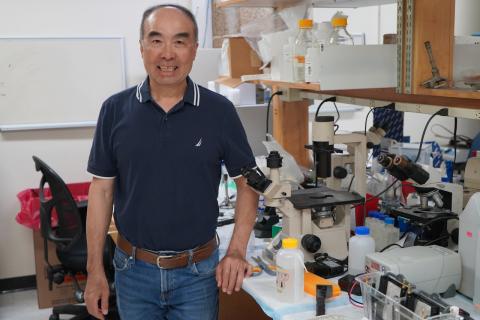
YiPing Chen, a professor of Cell and Molecular Biology in the Tulane School of Science and Engineering, has been elected a Fellow of the American Association for the Advancement of Science (AAAS) in the Section of Biological Sciences. The honor recognizes individuals for distinguished contributions to science and its applications.
For Chen, who has spent almost three decades as an independent researcher, the recognition carries personal weight. "This is a nice honor for me and recognition of my contribution to the science," he said.
Chen joined Tulane in 1997 and has built a research program that spans several interconnected areas, including craniofacial development, cardiac biology and, more recently, fat cell biology. His original training was in embryology, focusing on the molecular and cellular basis of vertebrate early embryonic development. During his postdoctoral work at Harvard Medical School, he shifted his attention toward organ formation, particularly tooth development. That work set the course for much of what followed.
"One of the genes I studied plays an important function in tooth development," Chen explained. When the gene, known as MSX1, is deleted in mice, the embryo develops without teeth. The same holds true in humans: mutations in the same gene lead to tooth agenesis. That discovery pulled Chen into the broader field of craniofacial development, which includes teeth, the palate, the face, and the temporomandibular joint.
One of the more surprising findings from his lab involves a rare form of cleft palate. Typically, palate formation runs from front to back, like a zipper, and a complete cleft is the expected outcome when the anterior portion of the palate fails to close. But Chen's lab identified a gene whose mutation causes something different: anterior clefting, where only the front portion of the palate is affected while the back remains closed. "People usually consider this kind of post-fusion rupture," Chen said, noting that mechanical forces had long been assumed responsible. "It was never considered to be a genetic mutation. But we show, for the first time, that gene mutation can lead to anterior cleft."
His lab's work on cardiac development has been equally far-reaching. Chen described cloning the first transcription factor known to control the position of the heart, relevant to a condition in which the heart sits on the right side of the chest rather than the left, occurring in roughly one in 8,000 people. Subsequent work on another gene led his lab into cardiac pacemaker research. "When we delete a gene named Shox2 from mice, the mice develop without regulated heartbeat rate" he said. "That's how we jumped into pacemaker formation and differentiation."
In recent years, Chen's lab made an accidental discovery that has opened an entirely new line of inquiry. While studying bone differentiation from stem cells, his team was using fat cell differentiation as a negative control, a standard check to confirm that experimental conditions were working correctly. Fat cells, in conventional biology, do not require WNT signaling. In fact, WNT signaling inhibits their development. But Chen's lab observed WNT activation in what should have been a straightforward fat cell differentiation experiment.
"That was pretty much an accident," Chen said. The cells they had identified behaved in a way that was, as he put it, "completely opposite to our conventional knowledge of fat cells." His lab has since named them WNT-positive cells, and he believes they play an important role in the regulation of whole-body metabolism. The population had never been described before.
The practical motivation underlying all of this work, Chen said, is the potential to understand and eventually address birth defects. "If we can completely understand the genes and the process involved in normal organ formation, it will provide the basis for our understanding of birth defects," he explained. "If we have a baby born with a defect in the heart, or in teeth, or in craniofacial regions, and if we understand the molecular basis, we could possibly provide a therapeutic correction before it is born."
The field itself has changed enormously over the course of Chen's career. When he began, creating an animal model with a targeted gene deletion required gene-targeting in embryonic stem cells and injecting genetically modified embryonic stem cells into embryos, a process that could take one to two years. Today, the gene-editing tool CRISPR has compressed that timeline to a matter of months.
Tulane has been central to his career throughout. Chen was promoted to full professor within seven years of joining the faculty. "I really appreciate Tulane's support," he said. He credited his colleagues specifically former administrators Nick Altiero and Gary McPherson for supporting him across his career at the university.
Looking ahead, Chen said his lab will continue exploring the newly identified WNT-positive fat cell population and its role in metabolism, while maintaining its long-running work on craniofacial development. Tooth regeneration remains a personal scientific ambition, he added, even if the goal has proved elusive so far. "Everybody has teeth and everybody loses teeth at a certain time in their life," he said. "Tooth regeneration is my dream to address."