
Tulane study finds that magnetism dramatically strengthens electron-phonon interactions in nickelate superconductors
Superconductors can carry electricity with zero resistance, but only below a material-specific critical temperature, Tc. In conventional superconductors, this state typically emerges when electrons pair through interactions with lattice vibrations (phonons), a mechanism known as electron–phonon coupling. By contrast, high-Tc superconductors become superconducting at much higher temperatures than conventional materials, often approaching or even exceeding the boiling point of liquid nitrogen (77 K). Despite decades of intensive research, the microscopic mechanism responsible for high-Tc superconductivity remains unresolved.
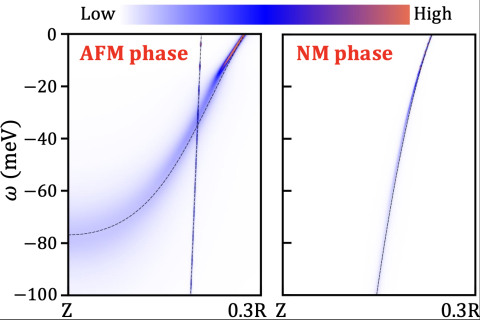
Nickelate superconductors, which share intriguing similarities with cuprates (the best-known high-Tc materials), have recently emerged as a promising new platform for probing the long-standing mystery of high-Tc superconductivity. A recent theoretical study led by Tulane researchers, Profs. Ruiqi Zhang and Jianwei Sun, used the advanced r2SCAN density functional - developed at Tulane - to quantify how electrons in the infinite-layer nickelate LaNiO2 interact with crystal-lattice vibrations (phonons). While earlier non-magnetic calculations suggested that electron–phonon coupling is weak in nickelates, the Tulane team found that the picture changes dramatically once realistic local magnetic moments are taken into account. In a low-energy antiferromagnetic phase, the total electron–phonon coupling is enhanced by roughly a factor of four relative to the non-magnetic solution.
"Nickelates have reignited the search for the key ingredients behind high-temperature super-conductivity. Our results show that electron–phonon coupling can be substantially stronger once magnetic effects are properly included. Equally striking is which vibrations matter
most: the dominant coupling arises from low-frequency motions of lanthanum and nickel atoms interacting with an unusually flat Ni-derived electronic band, rather than from the high-frequency oxygen “breathing” modes that often receive the most attention. Together, these findings sharpen and potentially reshape how the community evaluates the role of electron–phonon coupling in understanding high-Tc superconductors," says Prof. Zhang.
Crucially, this enhancement is driven primarily by low-frequency La/Ni vibrational modes that couple strongly to unusually flat Ni-derived electronic bands, rather than by the high-frequency oxygen “breathing” modes often emphasized in cuprates. The calculations also predict a distinctive low-energy kink in the electronic structure near 15 meV, providing a clear and experimentally testable fingerprint of magnetism-enhanced electron–phonon coupling in nickelates. Together, these results suggest that electron–phonon coupling—intertwined with strong electronic interactions and local magnetism—can play a central role in shaping the low-energy physics of nickelates and may be essential for understanding their superconducting phenomenology.
https://doi.org/10.1103/84jh-sx4m
Phys. Rev. B 112, L241115 – Published 24 December, 2025