
Tulane Undergraduates to Study Origins of Life in Microgravity with NASA-Supported Experiment
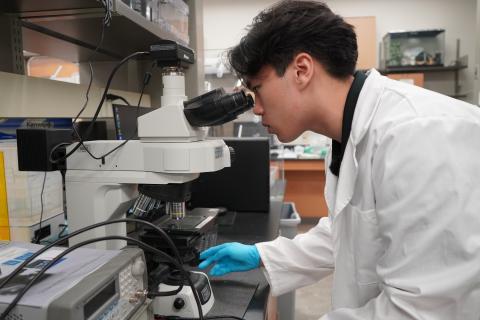
A team of Tulane University undergraduates is preparing to send a cutting-edge experiment to the International Space Station- one that could deepen our understanding of how life may have first formed and how biological materials could be manufactured in space.
The NASA-supported project, “Coacervate Protocells in Microgravity: Stability, Function, and Implications for the Origins of Life Beyond Earth,” was selected through the Student Spaceflight Experiments Program and will investigate how microscopic droplets known as coacervate protocells behave in microgravity.
The student research team includes Noa Aval, Brenden Findlay, and Nam Joshua Nguyen, all undergraduate researchers at Tulane. The project is facilitated by Noshir Pesika, PhD, who serves as the team’s faculty mentor. When discussing the team, Aval mentions how none of them knew each other before the project and how they “all come from differing realms of the scientific world, which has led to an amazing collaboration. I come from an environmental biology major, [Findlay] comes from chemistry and neuroscience, and [Nguyen] studies chemical and biomolecular engineering, which makes us a mosaic of scientific knowledge. The coalition of our scientific understanding definitely shaped the way we've divided the work, with [Nguyen] taking the lead on the specific experimental design, [Findlay] supporting the overall proposal development, and myself taking on the literature review and writing-based portions of the project.” It’s exciting to see such a meeting of the minds to approach this project from multiple angles.
Coacervates are dense liquid droplets formed through the phase separation of oppositely charged polymers. Scientists believe they may have been precursors to modern cells during early Earth history, capable of compartmentalizing molecules and supporting primitive biochemical reactions.
“The idea is that these droplets act like tiny reactors,” said Nguyen, a junior in Tulane’s Department of Chemical and Biomolecular Engineering. “They concentrate molecules, increase reaction rates, and behave in ways that resemble early life.”
While coacervates have been studied extensively under Earth’s gravity, their behavior in microgravity has never been directly examined- a gap this experiment aims to fill.
As Findlay states, “On Earth, gravity constantly makes droplets settle and merge, even if we do not notice it. In microgravity, that interference disappears, so we can see how the chemistry behaves on its own. We think that could make the protocells more stable and possibly improve enzymatic activity.”
The Tulane team will measure the shape, stability, and function of coacervate droplets in orbit and compare them to identical ground-based controls. The researchers hypothesize that in microgravity:
Droplet coalescence will be reduced
Molecular cargo partitioning will be enhanced
Enzymatic activity inside the droplets will increase
By isolating gravity’s role, the study will provide insight into whether protocell-like structures could persist beyond Earth and what that means for the plausibility of life elsewhere in the universe.
Aval adds that, “The true beauty in this experiment lies with its implications. If we can show that coacervate droplet formation is similarly stable in microgravity compared to Earth, then that may prove it's very possible for cells to have evolved elsewhere in the universe. By studying protocells in microgravity, we explore whether or not it's possible for life to evolve beyond Earth, implicating if extraterrestrial life could be out there. This experiment has the potential to implicate there may actually be life to find on Europa and Enceladus.”
Beyond astrobiology, the research has implications for space biomanufacturing, an emerging focus area for NASA. Understanding how biological materials self-assemble and stabilize in microgravity could enable the production of materials in space rather than launching them from Earth.
“If you can grow or assemble materials in orbit,” Nguyen explained, “you don’t have to bring everything with you. You can build it there.”
Notably, the experiment was developed entirely outside of coursework. The students worked closely with faculty mentors and external collaborators to craft a proposal that met NASA’s strict technical, safety, and feasibility standards.
“This wasn’t a class assignment,” Nguyen said. “It was an opportunity to push ourselves, learn how real science proposals are written, and see if we could actually get something to space.”
That process required simplifying the experiment while ensuring it would still produce meaningful, analyzable data- an essential balance for spaceflight research.
Although Tulane does not have an aerospace engineering program, Nguyen says the university’s research culture made this opportunity possible.
“With the resources here, if you want to do something ambitious, you can,” Nguyen said. “I want to go to space and working on this project makes that goal feel real.”
The experiment is scheduled to fly aboard a future SpaceX mission to the International Space Station, with results expected later this year. Findlay shares that he is “most excited and nervous about seeing the data when it comes back. Once it launches, it is completely out of our hands. Finding out whether space confirms or challenges our hypothesis is what we are most looking forward to.”
As the team prepares for launch, the project stands as a powerful example of what undergraduate research at Tulane can achieve: curiosity-driven science, faculty mentorship, and discoveries that reach far beyond campus, into orbit and beyond.