Turning Seconds into Safety: Tulane Students Build Automated System to Strengthen Airport Explosive Detection
In airports across the country, security decisions are often made in seconds. When a bag is flagged for further inspection, Transportation Security Administration officers move to a secondary screening process that can determine whether a substance poses a real threat. That process, however, still relies heavily on manual chemical testing and human interpretation.
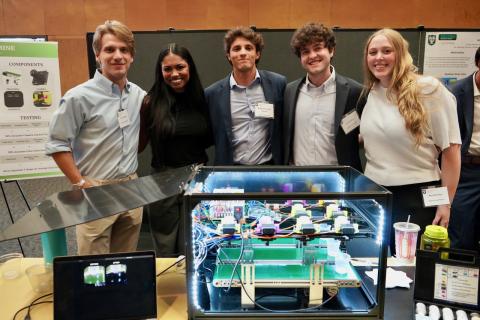
A team of Tulane University engineering physics students, Mia Stolakis, Kyler Silas, Jude Kelley, Avery Lahm, and Matheo Graham Capasso saw an opportunity to change that.
At the School of Science and Engineering’s Engineering Design Capstone Expo, the team unveiled the ColorBoom Detection Machine, an automated system designed to improve explosive detection by reducing human error, increasing consistency, and accelerating the screening process.
“We were approached by TSA to solve a problem with their current system,” said Jude Kelley. “They’re currently using a kit that has led to a lot of human error and waste, so we automated that process.”
The current method relies on applying a sequence of chemical reagents to a sample and visually monitoring for color changes that indicate potential explosive materials. While effective, the process depends on precise timing and subjective interpretation, creating variability in high-pressure environments.
The Tulane team replaced that uncertainty with automation.
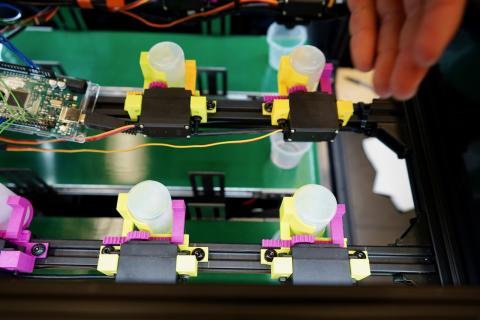
“As you can see, these modules dispense the chemical reagents, and then a camera immediately starts analyzing what it sees,” said Matheo Graham Capasso. “It takes an initial photo and then monitors for changes over time using what’s called a delta E value to detect color change.”
By analyzing color shifts frame by frame, the system can be tuned for sensitivity, allowing it to detect even subtle reactions while filtering out environmental noise. When a change is detected, the system flags the result and logs it in a digital interface.
Mia Stolakis demonstrated how the system communicates results to the user.
“It will say whether the sample is clear or not,” Stolakis explained. “Then you can go into the system and see a before-and-after image showing the color change that was detected.”
Instead of relying on human judgment alone, the machine produces a clear, standardized output, helping reduce the likelihood of false negatives in critical screening scenarios.
“It’s a safety issue if human error is part of the process,” said Matheo Graham Capasso. “Our goal is to reduce that risk and make flying safer.”
The system is designed specifically for secondary screening, the stage that follows an initial flag during standard TSA processing. In these moments, speed and accuracy are essential, and automation offers a path to improving both.
Beyond airport security, the team also sees broader applications for their system.
“This could be used for any kind of testing that relies on liquid reagents,” Kelley said. “Drug testing or other chemical detection processes could use the same approach.”
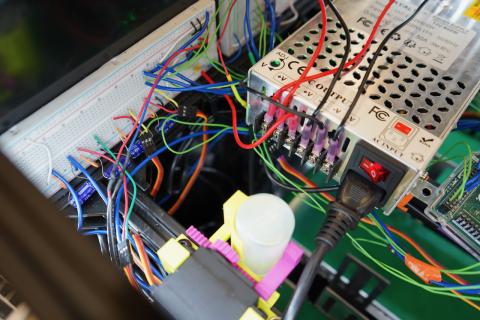
The prototype was built over the course of the academic year, combining mechanical systems, electronics, and software into a single integrated platform. For a team of engineering physics majors, that meant stepping into unfamiliar territory.
“None of us are computer science or electrical engineering majors,” Capasso said. “We had to learn how to wire everything, code the system, and troubleshoot it as we went.”
Much of that work took place in Tulane’s Makerspace, where the team designed, fabricated, and refined their system through repeated testing and iteration.
“They needed something cut, and I would cut it,” said Kyler Silas, who helped lead system integration and interface development. “I also worked on the code and connecting everything so we could run it from the computer.”
The team credits both the Makerspace and faculty mentorship for helping bring the system to life. Guidance from Professor Barrios helped them navigate design challenges and make key decisions about how to move forward when early prototypes fell short.
“There were times where something worked once and then didn’t work the next time,” Capasso said. “Figuring out why and fixing it was actually one of the most rewarding parts.”
After months of development, testing, and refinement, the team arrived at the Capstone Expo with a fully functioning prototype capable of demonstrating real-time detection.
“I mean, we worked on it for almost eight months,” Kelley said. “So we’re really happy that it’s working and that we can show it to people.”
Together, Stolakis, Silas, Kelley, Lahm, and Capasso transformed a manual, error-prone process into a scalable, automated solution with the potential to improve safety in one of the most critical environments in modern travel.
Their work reflects the power of Tulane’s engineering physics program, where students are trained to move across disciplines and apply their knowledge to real-world challenges.
And in this case, that challenge is one that millions of travelers encounter every day, even if they never see it happening behind the scenes.