Turning Sunlight Into Power and Heat
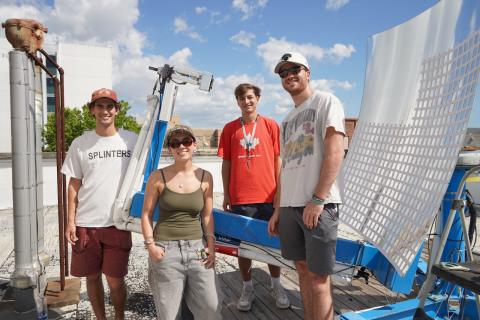
Known as “Flower Power,” a Tulane engineering team’s rooftop system captures both electricity and usable thermal energy
On the rooftop of Flower Hall at Tulane, a group of engineering physics students is working with something most solar systems try to avoid: heat.
In conventional solar panels, excess heat reduces efficiency and is typically lost to the environment. For a team of Tulane seniors, that loss is the opportunity.
Conor Farnan, Corey Hart, Matt Graf, Miriam Lerner, and Anna Walker have spent the past year developing a hybrid concentrated photovoltaic system designed to capture both electricity and thermal energy from the same stream of sunlight. Their goal is to turn more of the sun’s energy into something a building can use.
“The real-world kind of implications,” Farnan said, describing what drew the team to the project.
The system operates under extreme conditions. Using a mirrored array, sunlight is concentrated to nearly 500 times its normal intensity and directed onto a compact receiver. That energy is split into two outputs: electricity generated by solar cells and heat captured through a water-based system.
“It’s called hybrid concentrated photovoltaics,” Farnan said. “You get hot water and you get electricity.”
That dual-output design addresses one of the biggest inefficiencies in solar energy systems.
“There’s usually a huge loss in efficiency for most solar devices through thermal loss,” Lerner said. “We’re turning it into actual useful energy output for a building.”
The team is not just modeling performance. They are actively integrating the system into a working building environment, measuring how much energy it can realistically produce and where losses occur along the way.
“We’re actually integrating this with the building,” Graf said. “So, it’s kind of like proving that this can be a viable product in the market.”
That focus on viability extends to cost and return.
“We’re basically showing, how much it costs, by how much energy it takes to run the pump and the tracker all day,” Graf said. “This is a worthwhile investment, and it’ll pay itself back.”
Much of the team’s work has centered on understanding system performance beyond the initial energy capture. Once heat is generated, it must be retained and transferred efficiently through a network of pipes and exchangers.
“A lot of my work has been figuring out where we are having losses,” Graf said. “Once the water leaves the receiver and it’s coming down through all this piping, it’s going to be losing heat. So, we take various temperature measurements throughout the pipeline to isolate where our biggest loss is.”
The system builds on an existing research platform, but much of what is now in place has been rebuilt, rewired, or learned from scratch.
“I did a lot of the piping by myself,” Graf said. “I learned how to do it and got a lot of help from a PhD student who taught me how to use all these different fittings and tubing.”
Working at this level of energy concentration also comes with risk.
“It got too hot, but the radiator wasn’t pulling it off fast enough,” Graf said, describing a test that pushed the system beyond its limits. “When you’re dealing with something at that scale, you’ve got to be careful,” Farnan added.
Despite those challenges, the design offers advantages over traditional solar installations. The system is compact and modular, allowing it to be deployed in urban environments or scaled based on need.
It also targets a different energy use case. While most solar systems focus solely on electricity, this platform is designed for environments where heat is a major operational demand.
“Industries that need a lot of hot water, like bottling plants or paper manufacturing,” Lerner said.
The team has also identified geographic markets where the system could be most competitive, particularly regions with high solar exposure and rising natural gas costs.
“Central Valley, California,” Graf said, pointing to the balance between abundant sunlight and expensive conventional energy.