"We Can Do Hard Things": How Tulane Helped Shape Mari Domingo's Mission to Advance Women's Health
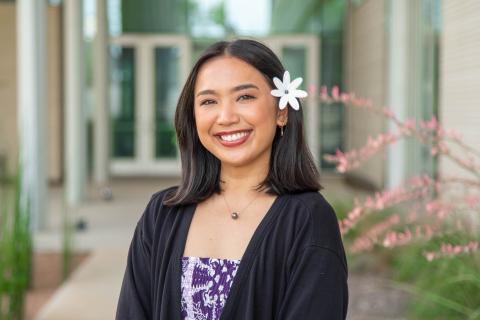

When Mari Domingo enrolled at Tulane University's School of Science and Engineering in 2020, she already knew exactly what she was there to do. Fresh from an undergraduate research experience at Oregon State University that had opened her eyes to how little medicine understood about female reproductive health, she made herself a promise before even submitting her applications.
"I'm not going to grad school if I'm not going to study women's health," she said.
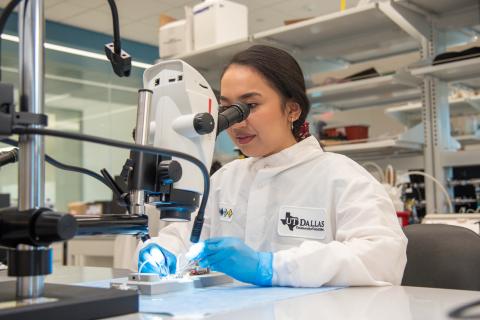
She kept that promise. Domingo joined the lab of Dr. Kristin Miller at Tulane, where she began studying the biomechanics of the female reproductive system, and she has not looked back since. When Dr. Miller's lab relocated to the University of Texas at Dallas in 2023, Domingo went with her. Now a sixth-year Ph.D. candidate, she is building on the foundation that Tulane helped lay, working to answer questions about the uterus that researchers have barely begun to ask.
Domingo's research centers on three areas that sit at the edges of what science currently understands. She examines how the uterus changes with age, how it recovers during the postpartum period, and how advanced maternal age may contribute to complications during pregnancy and recovery. Using mouse models, which undergo reproductive processes similar to humans to serve as a meaningful stand-in, she focuses specifically on uterine contractility and how the organ's function and composition shift across different life stages.
The questions sound straightforward. The answers, it turns out, largely do not exist yet.
"We know that women undergo menopause, but we don't really know what actually happens to the uterus itself during and after that transition," Domingo said. "Additionally, we know what happens to the uterus during pregnancy, but we don't fully understand what happens after that."
That gap has real consequences. Maternal mortality in the United States continues to rise, and postpartum care remains inadequate for millions of women. Domingo's work is not aimed at solving those problems directly, at least not yet. What she is building is something more foundational: a baseline understanding of how uterine tissue actually functions, the kind of bedrock that future research and diagnostics can be built on.
The hope is that this baseline could one day inform tools to identify postpartum hemorrhage risk before it becomes a crisis, or flag concerns for people considering pregnancy at an older age. For now, she is focused on the groundwork.
"It is really hard to get people to care about women's health, especially when it doesn't involve pregnancy," she said. "Just looking at menopause and aging, it's really hard to get funding for baseline characterization. Why do we not care about that? Everybody ages."
Domingo's years at Tulane were formative in ways that stretched well beyond the lab. Working under Dr. Miller, she found the research home she had been looking for, one that took women's health seriously as a scientific priority and provided its graduate students with intentional and caring mentorship. Dr. Miller's commitment to her students, Domingo noted, extended to ensuring they were financially supported for the full duration of their Ph.D.s before she would agree to take them on.
Those years also brought personal challenges that reshaped how Domingo approaches her work and her life. Carrying the relentless pace of her undergraduate engineering program into graduate school, she hit a wall early in her Ph.D.
"You have to take time to rest your mind and your body, or your body will decide when it's time for you to rest," she said. "I kind of learned that the hard way."
She turned to therapy, yoga, meditation, and a more deliberate effort to protect time for the things she enjoys. The balance she found, or rather continues to find, is something she now tries to pass along through her work building community among her colleagues and graduate students nationally.
Domingo serves on the student leadership committee and as a student representative on the diversity, equity and inclusion committee for the bioengineering division of the American Society for Mechanical Engineers (ASME). Through that role, she has helped develop programming aimed at making graduate school more navigable and less isolating for students across the country.
This year, with no in-person conference on the calendar, the committee has leaned into virtual gatherings. Domingo organized a workshop on how to evaluate and select a graduate lab, a resource she would have valued when she was applying. Upcoming events include a computational modeling software workshop for students whose institutions do not offer coursework on the tool, informal coffee chats on topics like mindfulness, and an international student panel designed to surface the specific barriers that students from outside the United States face in navigating American graduate programs.
"We aimed to create a safe place to come, ask questions and voice concerns they may have throughout grad school."
The mindfulness session, she acknowledged, is the kind of thing she could have used herself years ago. Her conviction is that the lessons do not have to wait until graduate school.
"I think if we can start showing students at a younger age that you can find balance and still be a successful, good student and accomplish great things while focusing on your mental and physical health," she said.
Domingo is quick to credit the people who helped her get here. Her high school AP calculus teacher, Mr. Patrick Riehle, stands out as someone who made difficult material feel conquerable through encouragement rather than pressure. A summer program hosted by Dr. Skip Rochefort, in which high school students came to campus for a week to carry out actual research experiments, was what first introduced her to bioengineering and set her on the path toward college and eventually graduate school.
"I never would have even really known what bioengineering was without that program," she said.
At Oregon State, her undergraduate research advisor, Dr.Tala Navab-Daneshmand showed her something she had not expected to see: women are underrepresented on engineering faculties, and that fact, rather than being a reason to hesitate, was a reason to push forward.
"She was really encouraging that we can't really let those numbers be a reason why not to pursue something," Domingo said. "She was instrumental in helping me realize I can go to grad school. I can be a Ph.D. student."
When her Ph.D. is complete, Domingo plans to return to Hawaii, where her family and her partner's family both live. She intends to stay in women's health research in some capacity, carrying forward the work she began at Tulane into whatever comes next.
In the meantime, she finds balance where she can: in a deep love of Star Wars and, in a hobby she describes with a laugh as maybe sounding “a little silly," a recently rekindled passion for collecting and trading Disney pins.
For students weighing whether graduate school is right for them, she offers a message shaped by everything she has been through.
"Ph.D.s can understandably be intimidating," she said. "A lot of things are outside of our control. But positive Ph.D. experiences are possible. It's hard. It's a lot of work and sometimes it is a struggle, but it can be a really rewarding experience at the same time."
And for anyone who doubts whether they are up to it, she has a simpler reminder, the kind her calculus teacher once offered her and that has stayed with her ever since.
"We can do hard things," she said. "It might be difficult and some days it might feel impossible, but if we work hard and try our best and be honest, kind people, I feel like it'll work out."