
When Art Meets Anatomy: Tulane Students Learn to Draw What They Study
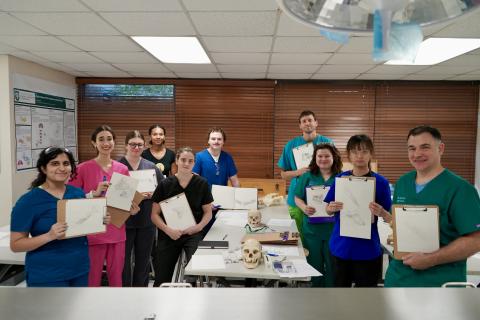
Inside Tulane’s Center for Anatomical and Movement Sciences (CAMS), the room is designed for precision and focus. But on this particular day, something unexpected took hold: a long, shared silence. Students leaned over sketchbooks, eyes moving carefully, hands working slowly—learning not just anatomy, but how to see it.
The workshop brought together students from Tulane’s School of Science and Engineering and School of Liberal Arts in a collaboration that felt both innovative and deeply rooted in history. Studio art seniors Owen Canter and Carmen Alcocer led anatomy students through a hands-on observational drawing workshop, introducing techniques such as gesture drawing, line, shading, and breaking complex forms into simpler shapes—all with the goal of helping students better understand the human body.
“Drawing is a way to really understand what you’re observing,” said Aaron Collier, associate professor of studio art at Tulane. “It means that you’re spending a lot of time with it. It’s a slow and physical process.”
That idea of spending time with what you’re learning is at the heart of the collaboration.
According to Dimitri Papadopoulos, Director of the Center for Anatomical and Movement Sciences (CAMS) and Professor of Practice in Tulane Biomedical Engineering, the relationship between anatomy and art stretches back centuries. “Anatomy and art have always been related,” Papadopoulos said. “They’ve always been coupled from the very beginning.” From Leonardo da Vinci’s sketches to modern anatomical atlases, illustration has long been a critical tool for understanding the human form.
In CAMS, where photography is not permitted, drawing becomes more than an artistic exercise—it becomes a practical study method. “In the lab, there’s no photography,” Canter explained. “So to take what you see home with you, you need to make a drawing. And without that skill set, it can be really intimidating for anatomy students to create accurate reference materials.”
The collaboration itself began simply with an email.
Canter and Alcocer reached out to Papadopoulos to ask if they could observe an anatomy lab session and draw alongside students. Over the course of the semester, they returned regularly, becoming familiar with the lab environment, the course structure, and how anatomy students study. Eventually, they began asking a bigger question: could their drawing expertise help anatomy students learn more effectively?
“This semester, we started coming in during lab sections and drawing while the students worked,” Alcocer said. “As we realized how much illustration already played a role in their studying, we thought about how we could share our techniques in a way that would actually support them.”
That support took shape in a structured workshop designed to ease students into drawing without pressure. Canter emphasized speed, looseness, and process over perfection. “Drawing can be intimidating, just putting pencil to paper,” he said. “Those very first marks come with a lot of pressure. But the drawing process unfolds over time. If you try to make it perfect from the very beginning, you’ll get nowhere.”
As the session unfolded, Collier noticed something rare. “There was this very intense silence,” he said. “People were truly locked in. It was a beautiful thing to look around the room and see everybody focused.”
For Papadopoulos, the value of the workshop extended beyond the drawings themselves. “If you want to learn something in anatomy, you have to spend time with it,” he said. “One way to do that is to sit down and try to illustrate it.” Even as an experienced anatomist, he found the process revealing, noting that drawing offered “a new window” into structures he knows well.
Students felt the impact immediately. Paula Gaya Bisquerra, an anatomy student, said drawing has always been part of how she learns—especially in lab. “I always take notes with drawings,” she said. “And it’s even better if you do it yourself.” After the workshop, she said she felt more confident integrating drawing techniques into her studying and note-taking.
Alcocer described working with a student who was struggling to draw the foot's tendons, a complex and overwhelming structure. “She kept getting frustrated by how many tendons there were,” Alcocer said. “So I tried to help her break them down into simpler shapes. Once you do that, something that feels intimidating becomes much easier to understand.”
Beyond technique, the experience highlighted the power of interdisciplinary collaboration. “We have these different departments across the university, and we all have skills to share,” Papadopoulos said. “There’s often a disconnect between liberal arts and science and engineering. This was a way to bridge that gap.”
For Alcocer, that bridge is the most meaningful takeaway. “This is learning at its most interdisciplinary,” she said. “It shows exactly how much is possible if you send emails, ask questions, and push to make things happen.”