
Above the Cleanroom: The Infrastructure Behind Tulane’s Latest Micro/Nanofabrication Facility
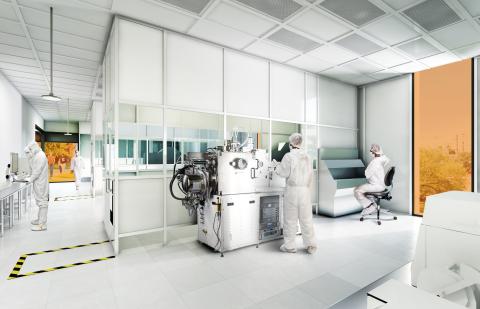
Tulane School of Science and Engineering’s new cleanroom and micronano-fabrication facility in Paul Hall is taking shape on the ground level, a deliberate decision for a space where stability matters. But what many people won’t see is that a cleanroom doesn’t begin and end at its walls. It depends on an entire network of infrastructure (air, water, temperature control, humidity control, vacuum, and compressed air) engineered into the building to create a tightly controlled environment for precision work.
First announced in 2023, the cleanroom represents a $5 million external investment from state and federal funding in advanced research infrastructure, along with internal funds. Approximately $3 million in state funding was allocated for the construction of the cleanroom, with an additional $2 million from the National Institute of Standards and Technology (NIST) to support the acquisition of specialized systems and capabilities. Designed as a regional resource, the facility is intended to support research and training for Tulane students and faculty while strengthening collaborations across the Gulf South.
Over the coming months, Tulane will be documenting the final stages of the build, the commissioning and “punchlist” work that follows, and the transition into installation and early use. We’re starting that story where much of the real work happens: the building systems that make a cleanroom possible.
“A cleanroom” can mean different things depending on its purpose, says Michael Johnson, a research scientist who has been closely involved with the planning and infrastructure that support the new facility. Some cleanrooms are designed to keep dangerous materials in (as in certain biosafety labs). The cleanroom Tulane is building is designed to keep contaminants out by controlling airborne particles, temperature, humidity, and airflow so the room stays stable and clean.
One of the core concepts behind that stability is pressure control. Rather than leaving air movement to chance, cleanrooms typically use intentional pressure gradients (keeping the cleanest areas at a slightly higher pressure than adjacent spaces) so particles are less likely to enter when doors open or people move through the facility.
And because people themselves are a primary source of particles, Tulane’s cleanroom is designed to move clean air in a very specific way: downward, in a steady laminar flow, so particles are carried away from work surfaces. “People are typically particulating,” Johnson explains, meaning that even in protective cleanroom clothing, tiny particles can shed and drift. The airflow strategy helps move those particles down and away, rather than letting them circulate through the workspace.
A major part of the cleanroom’s air supply begins above it. In the building’s upper-level mechanical space, dedicated air-handling equipment brings in outside air and begins the filtration process. Johnson points to a cleanroom-specific unit, one of several air handlers serving different parts of the building, that acts as the “front line of defense” for keeping dirt out of the cleanroom air.
Air entering the building goes through prefilters, then passes through cooling and reheat coils and a UV sterilizer bank, before moving through a final high-efficiency filter (Johnson notes the system uses a MERV 17 final filter). Once air reaches the cleanroom itself, it is further conditioned and continuously recirculated through additional temperature regulation and HEPA filtration, helping maintain an environment that stays consistently clean.
The cleanroom is designed as a bay-and-chase system, a layout that supports both efficient airflow and the separation of clean operational areas from supporting return-air paths. The goal is constant, controlled recirculation: clean air is delivered from above, flows downward, and returns through dedicated pathways to be filtered again.
Air isn’t the only requirement for a clean environment. Cleanrooms also depend on high-quality water systems that reduce contamination risks, especially where sensitive processes or rinsing and cleaning steps require water that won’t introduce unwanted ions or metals.
Johnson describes a building-wide deionized (DI) water system that begins with municipal tap water. That water is softened, then routed through multiple purification steps, including a carbon column and a reverse osmosis (RO) module, with RO functioning similarly to the membrane filtration used in desalination. After RO, water is stored in a large holding tank and continuously recirculated through the building. It passes through ion exchange cartridges on a replacement schedule and then through a UV sterilizer before distribution.
To keep that water clean, Johnson notes that the building’s DI-related plumbing is plastic, reducing the risk that metals in piping could dissolve into the water. For the cleanroom itself, DI water will undergo additional purification in a secondary system located within the facility, raising purity even further.
Other essential utilities also live in the building’s support systems: compressed air and vacuum. These aren’t just convenience services; many advanced facilities depend on them to operate reliably day after day.
Johnson points to an air compressor skid with two scroll compressors feeding a holding tank, designed so the compressors don’t need to run continuously. Downstream, the compressed air passes through drying columns (with redundancy built in so columns can alternate duty). The system is designed with backup capacity: one compressor can take over if another fails, and both can run if demand spikes.
That redundancy is intentional, Johnson says, and it reflects lessons learned from older facilities where under-sized or less robust compressor systems can lead to chronic breakdowns. In a facility like this, reliability is part of readiness.
Similarly, vacuum infrastructure includes two vacuum pumps, again designed for redundancy and for meeting periods of high demand. In each case, the message is the same: if a core system fails, downstream operations are not impacted. Therefore, the infrastructure is designed to reduce single points of failure.
Heat management is one of the biggest differences between a typical lab and a cleanroom built for stability. Cleanrooms require tight temperature control (often cooler than office environments because of the protective clothing worn inside) and because the space must remain stable and clean, heat can’t simply be dumped into the room and “handled later.”
Johnson describes a dedicated process chilled water system used for heat rejection. Rather than using tap water or relying on small standalone cooling units that vent heat into the room, the building uses campus chilled water as a source and transfers cooling through a heat exchanger into a clean, closed-loop system that serves sensitive needs. The heat exchanger prevents campus chilled water chemistry (including corrosion inhibitors) from mixing with process loops that support precision environments.
It’s another example of a theme that repeats throughout the cleanroom story: the environment has to be engineered, not improvised.
In South Louisiana, humidity control isn’t optional, and in a cleanroom it becomes a technical requirement. Johnson notes that many older campus buildings can swing dramatically across seasons, with humidity levels ranging widely. For cleanroom operations and process repeatability, stability matters.
The new system targets roughly 45% relative humidity, with tight tolerance. To do that, the building uses a dedicated humidity control setup that combines significant electrical power with steam generation and feedback control: adding or removing humidity to keep the environment steady.
Even for those unfamiliar with cleanroom processes, the point is straightforward: when temperature and humidity change, outcomes can change. Stability is what makes precision possible.
A key difference in this project, Johnson emphasizes, is that the cleanroom was planned as part of the building’s design, not added after the fact. That means major decisions, from core utilities to system sizing to the stability of the facility footprint, were made early. For example, a significant amount of time and expense went into modifying the building foundation to achieve low floor vibrations for the most sensitive instruments that will be installed.
In the cleanroom space itself, construction started with what Johnson describes as a “concrete cave,” a concrete floor, walls, and ceiling that had to be sealed with specialized epoxy coatings to prevent particulate shedding. Interior wall systems use materials designed for cleanliness and maintainability, including stainless structural elements and panel systems that are easier to clean and less likely to generate particles than conventional construction materials.
The result is a facility designed to support precision from the inside out.
In the months ahead, Tulane will continue sharing updates as the cleanroom moves from final construction into commissioning and testing, then into the careful process of installing systems, preparing surfaces, and bringing the environment into operating conditions.
The goal is not just to cut a ribbon on a newly finished space. It’s to celebrate something more meaningful: a working, national-level research facility, designed to operate with the stability, cleanliness, and reliability required for advanced micronano work, built to train students and support research for years to come.
For now, the story begins with the infrastructure: the systems above, behind, and within the walls that make the cleanroom possible.
VISIT THE CLEANROOM WEBSITE