At the Speed of Light: Tulane Team Advances Optical AI
In a field dominated by ever-larger GPUs and rising energy demands, a team of researchers is looking in a different direction. Instead of electrons, they are using light.
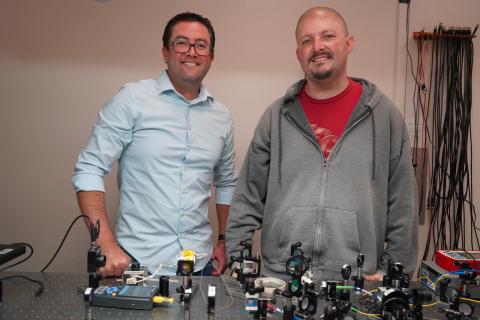
In a new study published in Machine Learning: Science and Technology, researchers Manon P. Bart, a recent Tulane PhD graduate, along with Nick Sparks and Ryan T. Glasser, introduce a method that dramatically improves how optical neural networks are trained, bringing this emerging technology closer to real-world use.
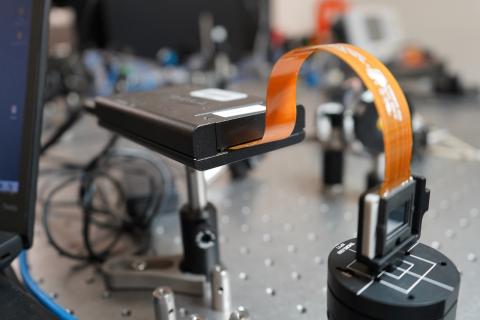
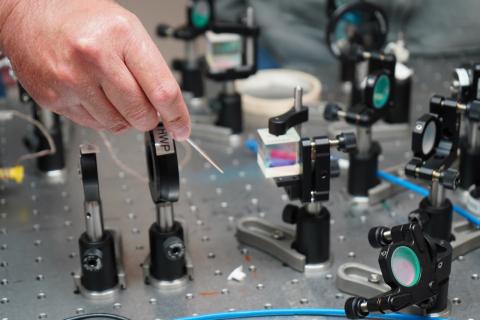
Optical neural networks process information by sending light through a series of structured layers, where the light is modified and redirected to perform computation. Because light travels quickly and operates in parallel, these systems have been suggested as a promising alternative to traditional, energy-intensive computing.
But there has been a major obstacle.
While optical systems can perform computations efficiently once trained, the training process itself has remained a major bottleneck.
“Light is the fastest thing in the universe, so it stands to reason it should also be the most efficient way to compute,” said Sparks. “Our work is about making that idea practical.”
Unlike conventional neural networks, where weights can be adjusted independently, optical systems are governed by the physics of light. Each adjustment to the system influences the entire output, making optimization slow and computationally demanding.
To address this, the Tulane-led team took a different approach. Instead of applying standard machine learning techniques directly, they developed a method that works with the underlying physics of optical systems.
Their approach uses the Fourier transform to represent light as a combination of plane waves. In this representation, the complex behavior of light propagation becomes much simpler, allowing gradients, a key component of training, to be computed far more efficiently.
“Because these are unconventional approaches to computing, not all machine learning techniques translate directly, so we have to think differently about how we encode, manipulate, and train these systems,” said Bart. “We draw on the fact that the Fourier transform naturally describes optical propagation, while also benefiting from the computational efficiency of fast Fourier transform algorithms. By combining these principles with backpropagation, we developed a physics-informed training approach that computes gradients much more efficiently,” Bart said.
By leveraging this framework, the method allows gradients across an entire layer to be computed simultaneously, rather than one parameter at a time.
“This work significantly speeds up the training process for optical systems,” said Glasser. “Our method computes all of the ‘weights’ in a given layer simultaneously, rather than sequentially, which leads to a substantial improvement over previously demonstrated approaches.”
The result is a major improvement in training efficiency. In benchmark tests, the method achieved high accuracy while reducing computational overhead and training time compared to existing techniques.
“The strength of optical analog systems lies in their ability to exploit the inherent properties of light, using passive components like lenses and reconfigurable devices such as spatial light modulators to manipulate phase,” Bart said. “These systems are effectively scale-invariant, meaning they can process information at both small and large scales while consuming nearly the same amount of power, which is not something conventional electronic hardware can do.”
“Reducing training time allows us to explore different architectures much more quickly, which is critical for advancing optical computing platforms,” she added.
Beyond performance gains, the work points toward a more sustainable future for artificial intelligence.
“There are two major advantages to optical computing: speed and power consumption,” said Glasser. “The speed of light represents the fastest possible way to perform computation. At the same time, the energy demands of modern AI systems are enormous. Training a large language model like GPT-3, for example, has been estimated to consume on the order of 10 gigawatt-hours, roughly the annual energy use of about 1,000 U.S. households. Optical approaches offer a path toward dramatically reducing that footprint.”
As AI systems continue to grow in scale, alternative computing approaches are becoming increasingly important.
“Optical computing offers a pathway to neural network and machine learning systems that operate at the speed of light while using far less energy than traditional electronic computers,” Glasser said.
The implications extend beyond classification tasks. The same approach can be applied to signal processing, image generation, and other applications that rely on complex linear transformations.