1,000 Day Plan
Space Science and Engineering
Space, Tulane, and NOLA
Tulane University brings scientists, engineers, students, and partners together to study space, develop technologies for exploration, and prepare the workforce that will advance a growing space economy.
Louisiana is becoming a launch state, and decisions made over the next several years will determine where the nation builds its space infrastructure and where it trains the space workforce. Tulane's School of Science and Engineering has been building toward this work for some time.
From spacecraft materials and satellite remote sensing to planetary science and human health in flight, the School of Science and Engineering is building on Tulane's history while creating new opportunities in New Orleans and across the Gulf South.

Academic Foundations
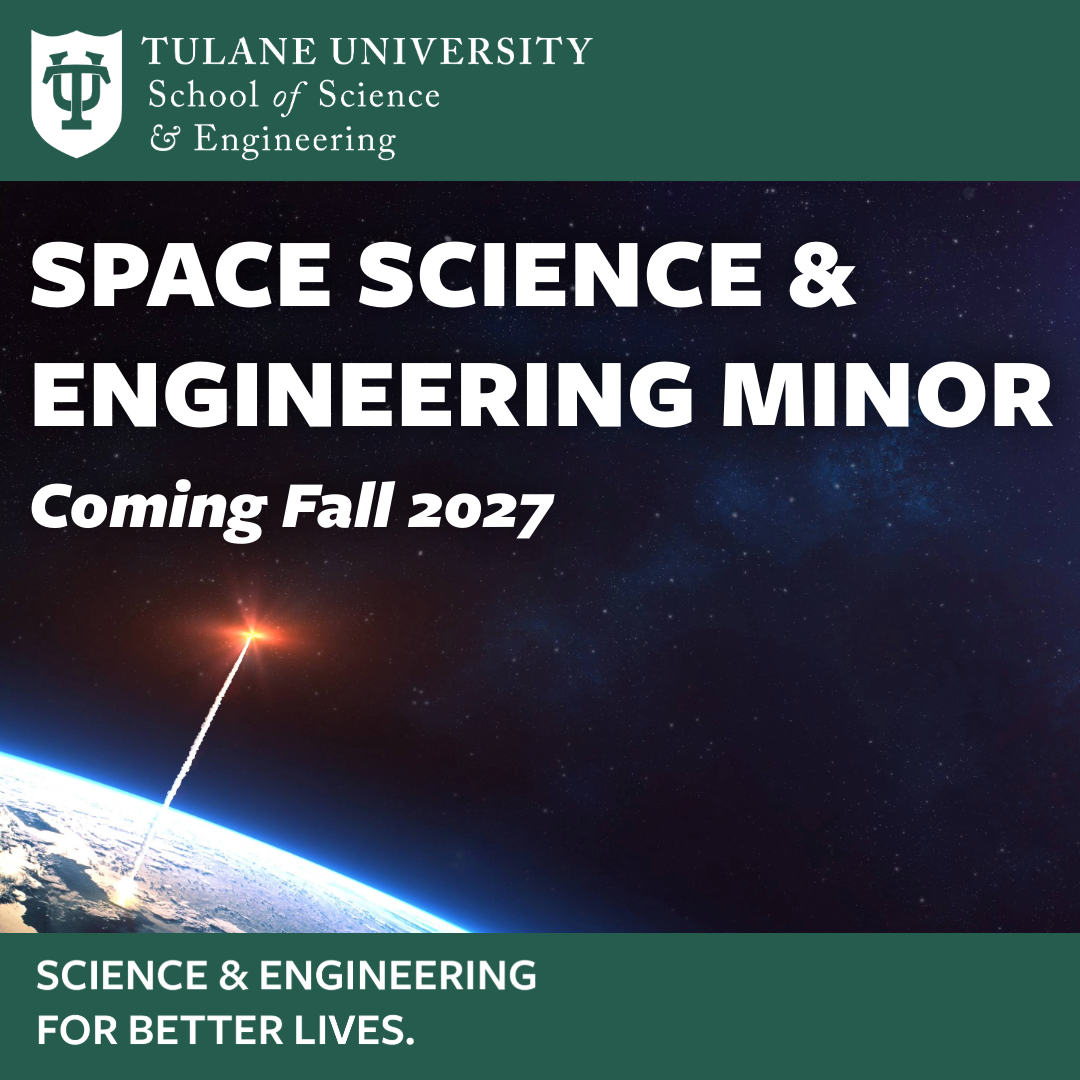
Space Science and Engineering Minor
SSE established an interdisciplinary Space Science and Engineering minor and announced it on September 1, 2026. It carries 16 credits, is open to undergraduates in any major, and becomes declarable in Fall 2027. The science core is Astrophysics and Dynamic Planets. The engineering core is one of Electric Circuits, Engineering Dynamics, or Materials Science and Engineering. Electives run through planetary observation, spacecraft systems, robotics, communications, materials, energy systems, remote sensing, human health and performance, simulation, and artificial intelligence. The faculty advisers are Cynthia Ebinger, Matthew Escarra, Kenneth McLaughlin, Mark Mondrinos, and Daniel Straus.
Engineering Degrees
Tulane now offers full degrees in mechanical, electrical, and civil engineering, along with a minor in artificial intelligence. Mechanical engineering trains students on aerospace structures, energy systems, robotics and additive manufacturing, and biomedical mechanics. Electrical engineering trains students on the avionics-class electronics inside launch vehicles, on grid resilience, and on biomedical devices. These are the degrees a launch and manufacturing economy hires first, and they are new enough that their curricula were designed with the NASA Michoud Assembly Facility and the Gulf aerospace cluster in view.
Space Science and Engineering Task Force
The Space Science and Engineering Task Force coordinates Tulane SSE's academic, research, and partnership efforts. Cynthia Ebinger, Marshall-Heape Chair in Earth and Environmental Sciences, chairs the group. Its members bring expertise from six departments.
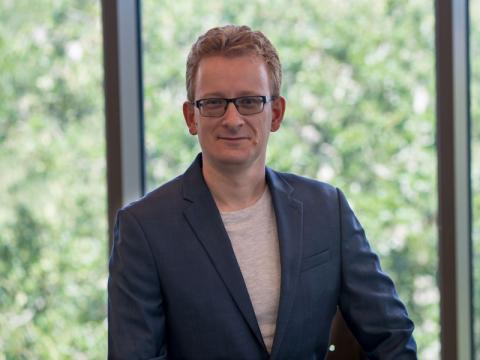
Associate Professor, Physics & Engineering Physics
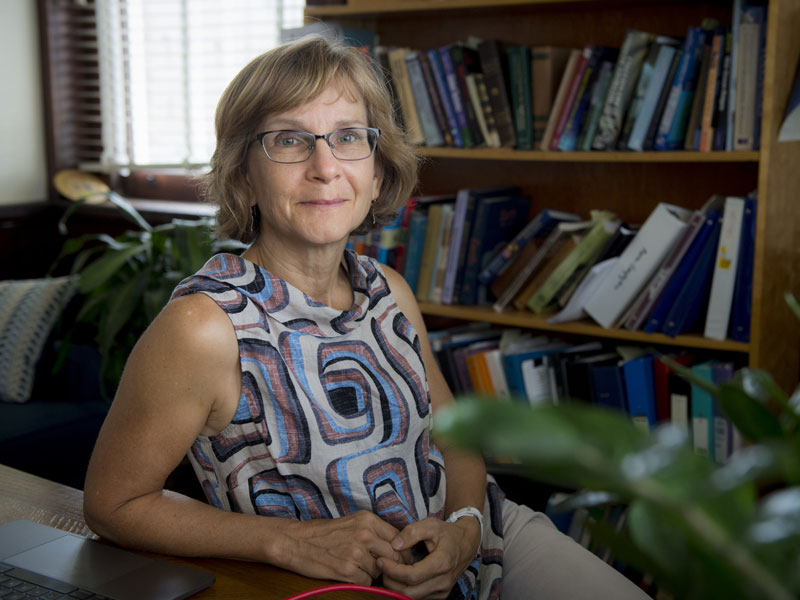
Marshall-Heape Chair and Professor, Earth and Environmental Sciences
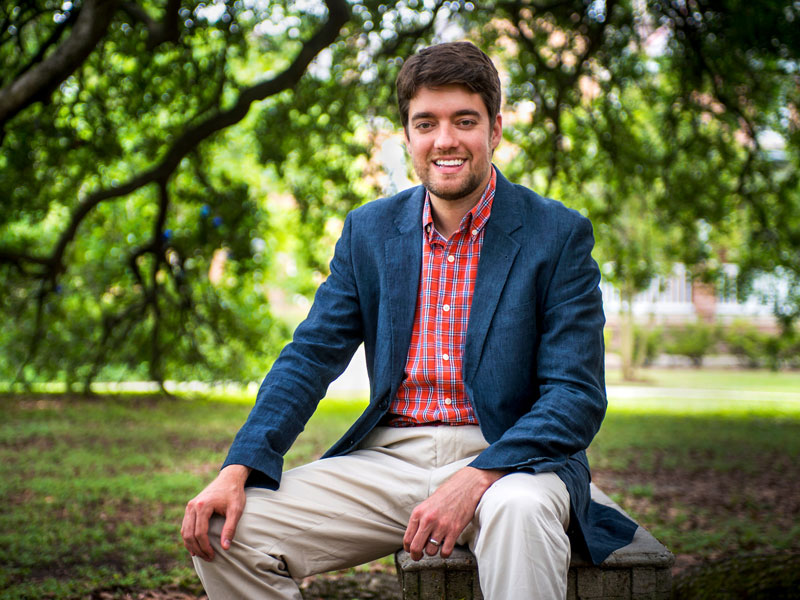
Professor, Physics and Engineering Physics
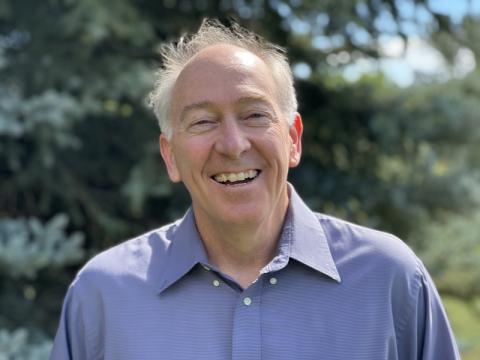
Phillips Chair and Professor, Mathematics
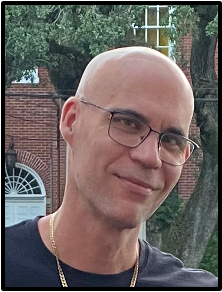
Assistant Professor, Biomedical Engineering
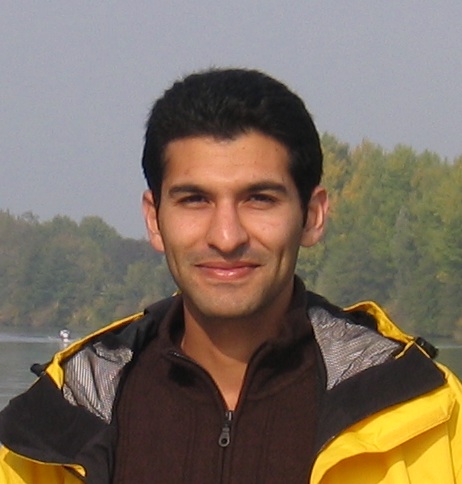
Associate Professor, Chemical and Biomolecular Engineering

Assistant Professor, Chemistry
Faculty Research
SSE holds twelve departments and programs in a single faculty: computer science, mathematics, chemistry, chemical and biomolecular engineering, biomedical engineering, physics and engineering physics, earth and environmental sciences, ecology and evolutionary biology, cell and molecular biology, neuroscience, psychology, and river-coastal science and engineering. SSE is the only school in the nation bringing together this breadth of disciplines in one faculty, and space engineering needs all of them, because propulsion chemistry, spacecraft materials, planetary science, autonomy and avionics, remote sensing, and human health in flight are one problem set and not six.
Published “High-Specific Power Flexible Photovoltaics from Large-Area MoS2 for Space Applications” in ACS Applied Energy Materials in 2025, in collaboration with NASA Glenn Research Center. High-specific-power flexible solar goes directly into spacecraft and orbital platforms.
A member of the National Academy of Sciences, returned to Tulane in August 2025 and is starting a study of the volatile organic compounds produced by mold aboard crewed spacecraft, an emerging concern for astronaut safety.
Works in quantum optics and quantum communication. His student, Manon Bart held a NASA internship working with Goddard Space Flight Center on ground-to-satellite and space-to-space quantum communication.
Publishes on cryogenic insulation for aerospace vehicles, including thermal conductivity of rigid foam insulation in Cryogenics in 2013 and spray-on foam insulation work presented at the Cryogenic Engineering Conference. He is the engineer regional media turn to on the problem of storing cryogenic propellants in Louisiana heat.
Holds the Michael A. Fitts Presidential Chair in Environmental Informatics and Artificial Intelligence in River-Coastal Science and Engineering and the ByWater Institute. He came to Tulane in January 2025 with more than $50 million in career grants and more than 250 publications. His current project applies geospatial foundation models to satellite remote sensing for disaster resilience.
Holds the Marshall-Heape Chair in Earth and Environmental Sciences, completed a postdoctoral fellowship at NASA Goddard Space Flight Center, served as a Jefferson Science Fellow at the U.S. Department of State, chairs the Space Science and Engineering Task Force, and directs Tulane's community program in the Student Spaceflight Experiments Program.
NASA has funded research at Tulane on core formation and element distribution in planetary interiors ($819,969, 2021 to 2026) and on sea level hotspots ($313,861, 2024 to 2028), among other awards made since 2019.
SSE funded six new space research projects through its start-up research program in 2026, to be presented publicly on September 22, 2026:
● Jiang Wei, two-dimensional superconductor single-photon detectors for quantum space
applications.
● Ibrahim Demir, geospatial foundation artificial intelligence for satellite remote sensing and
disaster resilience.
● Allan Ding, Zizhan Zheng, and Cynthia Ebinger, artificial intelligence for autonomous lunar
rover navigation and regolith extraction.
● Matthew Escarra, two-dimensional photovoltaics for space solar power.
● James Donahue, Janus metal dichalcogenides.
● Yanxu Zhang and Daniel Straus, ozone risk from satellite megaconstellation reentry.
Regional Engagement and Institutional History
Tulane’s proximity to NASA Michoud and the Stennis Space Center, alongside partnerships with companies like Boeing, Lockheed Martin, and SpaceX, positions the university to lead in space exploration. This initiative is advancing biomedical and biochemical systems for space, energy, and catalysis (for renewables and rocket fuel), and the development of advanced materials for spacecraft and robotics. Work in Resilient Habitats will complement this area, creating synergies that further strengthen Tulane’s leadership.
NASA's own Michoud Year in Review for 2024 names Tulane among the institutions whose students Michoud hosted for direct insight into advanced manufacturing. Michoud, in New Orleans East, builds the Space Launch System core stages for Boeing and the Orion pressure vessels for Lockheed Martin, and now hosts Vivace building the primary structure of the Starlab commercial space station. Tulane sits in the same city.
Tulane is a member institution of LaSPACE, classified as a research-intensive university in NASA's Space Grant annual performance documents.
Tulane built the Cunningham Observatory in 1941 around a reflecting telescope that had belonged to the astronomer William Henry Pickering, given to the university by his granddaughter Margaret Pickering Zemurray. Astronomy was an independent department at Tulane until 1972. A 16-inch computer-controlled telescope on the roof of Joseph Merrick Jones Hall has servedstudents and the public since 2001.
Tulane flew “Found in Space,” a low-cost star, sun, and moon tracker, on the High Altitude Student Platform launched from Fort Sumner, New Mexico, on September 15, 2008.
SSE is hosting the Space Science and Engineering Forum, “Explore Your Place in Space,” on Tuesday, September 22, 2026, in the Diboll Gallery. The keynote speaker is Tia Ferguson, a retired Senior Executive and Director of the Space Systems Department in the Engineering Directorate at NASA Marshall Space Flight Center.
The Pioneers of Space at Tulane

Harold A. Rosen was born in New Orleans in 1926 and earned his bachelor's degree in electrical engineering at Tulane in 1947. At Hughes Aircraft, he designed Syncom, and in July 1963, Syncom 2 became the first geosynchronous communications satellite. Every commercial satellite in geostationary orbit today descends from that design. Rosen received the National Medal of Technology in 1985 and the Draper Prize in 1995. The commercial satellite industry starts with a Tulane engineer from New Orleans.

Douglas G. Hurley graduated magna cum laude from Tulane with a bachelor of science in engineering in civil engineering in May 1988 and received his Marine Corps commission through Tulane's Naval ROTC. He flew as a pilot on STS-127 and on STS-135, the final Space Shuttle mission, and in May 2020 he commanded Demo-2, the first crewed flight of the Crew Dragon spacecraft. He received the Tulane Distinguished Alumni Award in 2015 and serves on the SSE Board of Advisors.
Students Who Have Flown, Won, and Competed
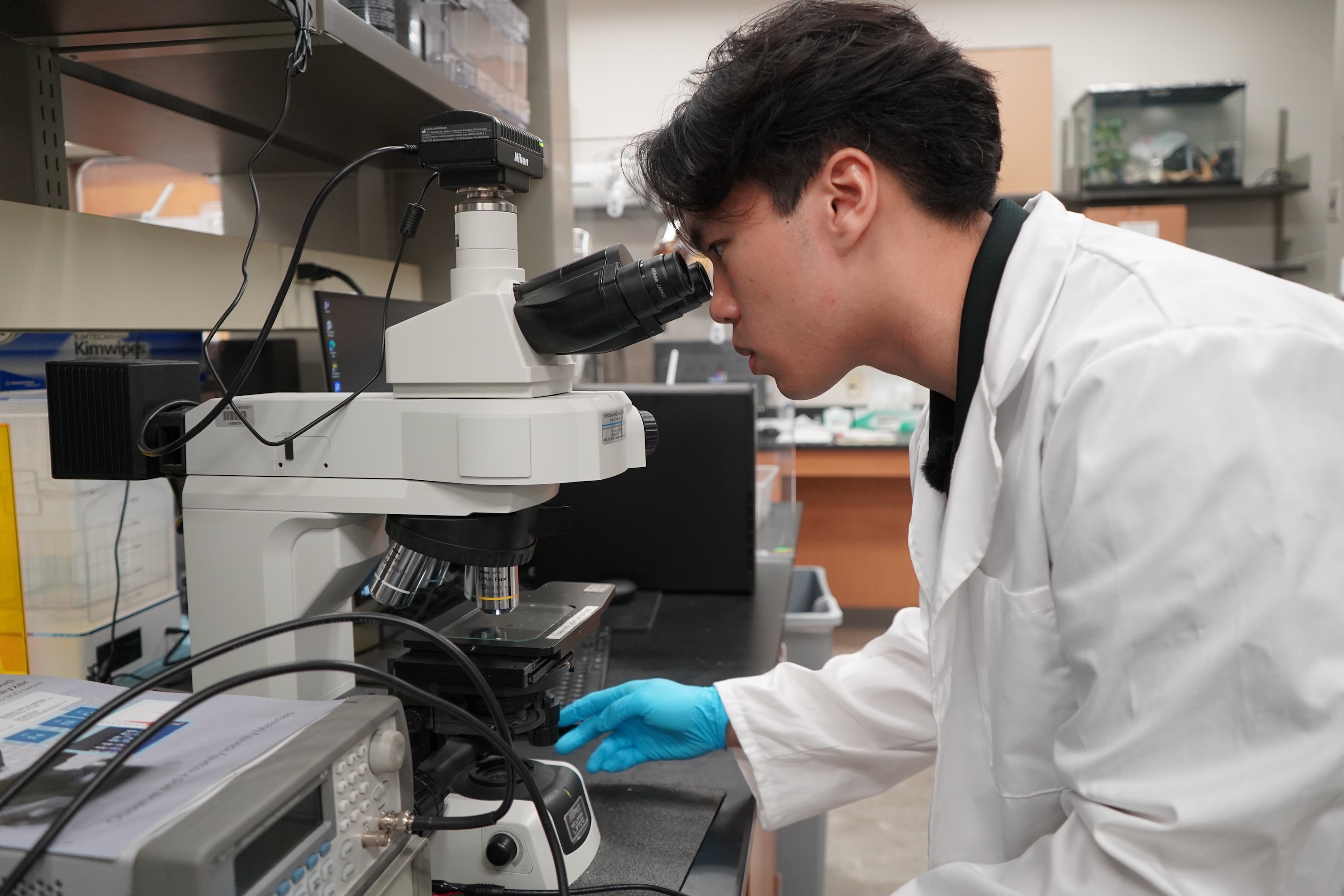
Student Spaceflight Experiments Program to study how coacervate droplets, known as protocells, behave in microgravity.
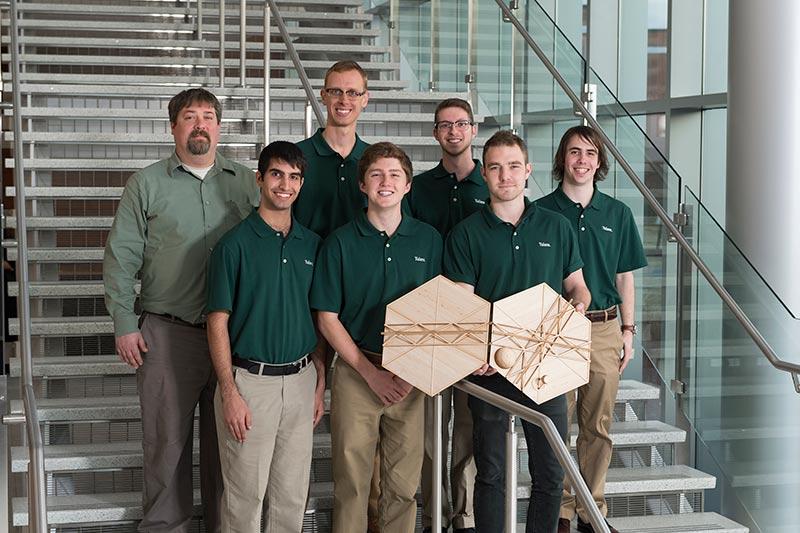
Tulane team wins NASA's BIG Idea Challenge at Langley Research Center.
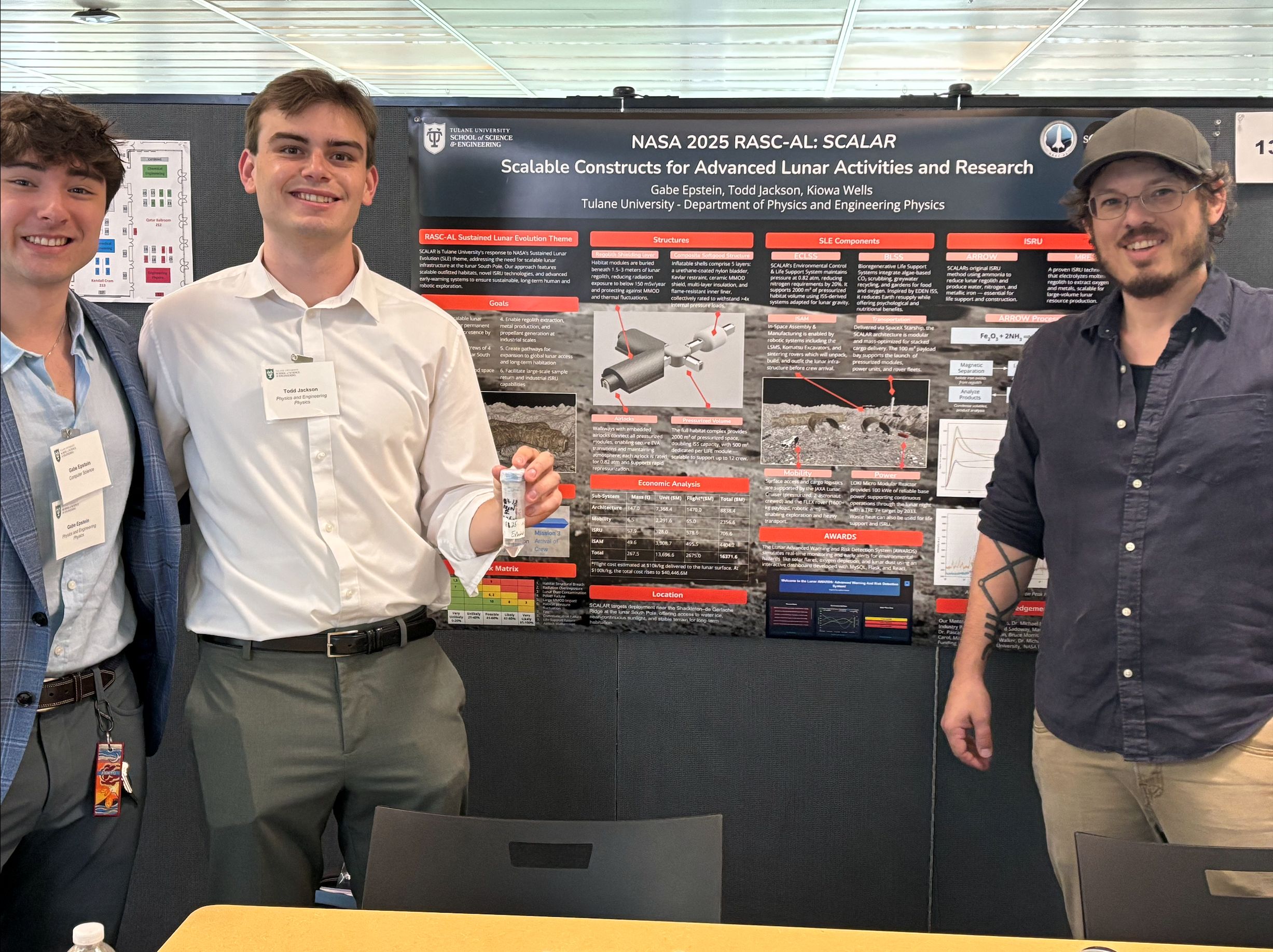
A Tulane team was one of fourteen finalists in NASA's Revolutionary Aerospace Systems Concepts Academic Linkage competition with SCALAR.
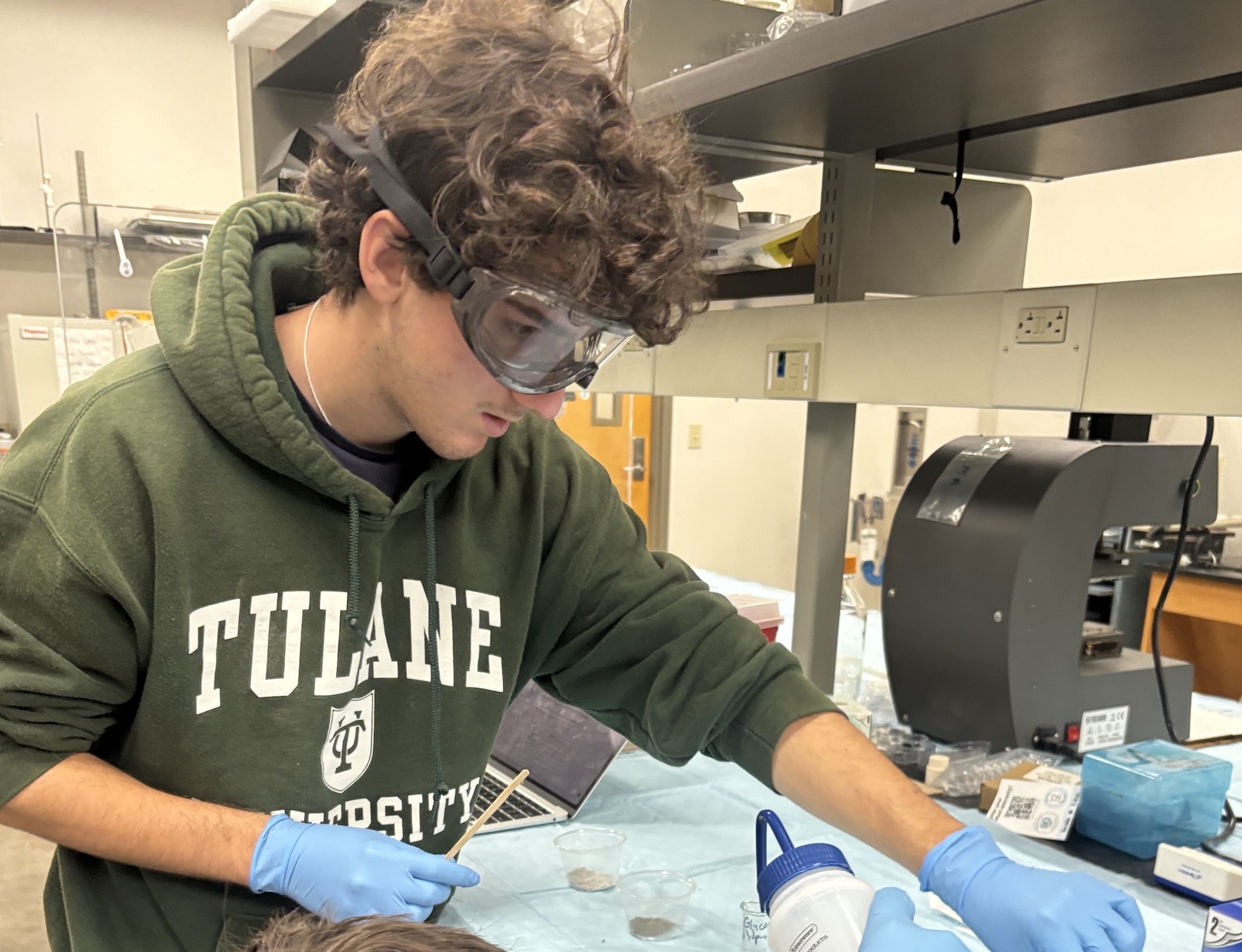
Tulane students developed a pozzolanic cement from lunar regolith simulant with the aim of cutting the mass launched from Earth for lunar construction by 70 to 80 percent.
Tulane students build a three-dimensional clinostat in the SSE Maker Space and propose an Aspergillus niger experiment for the International Space Station.
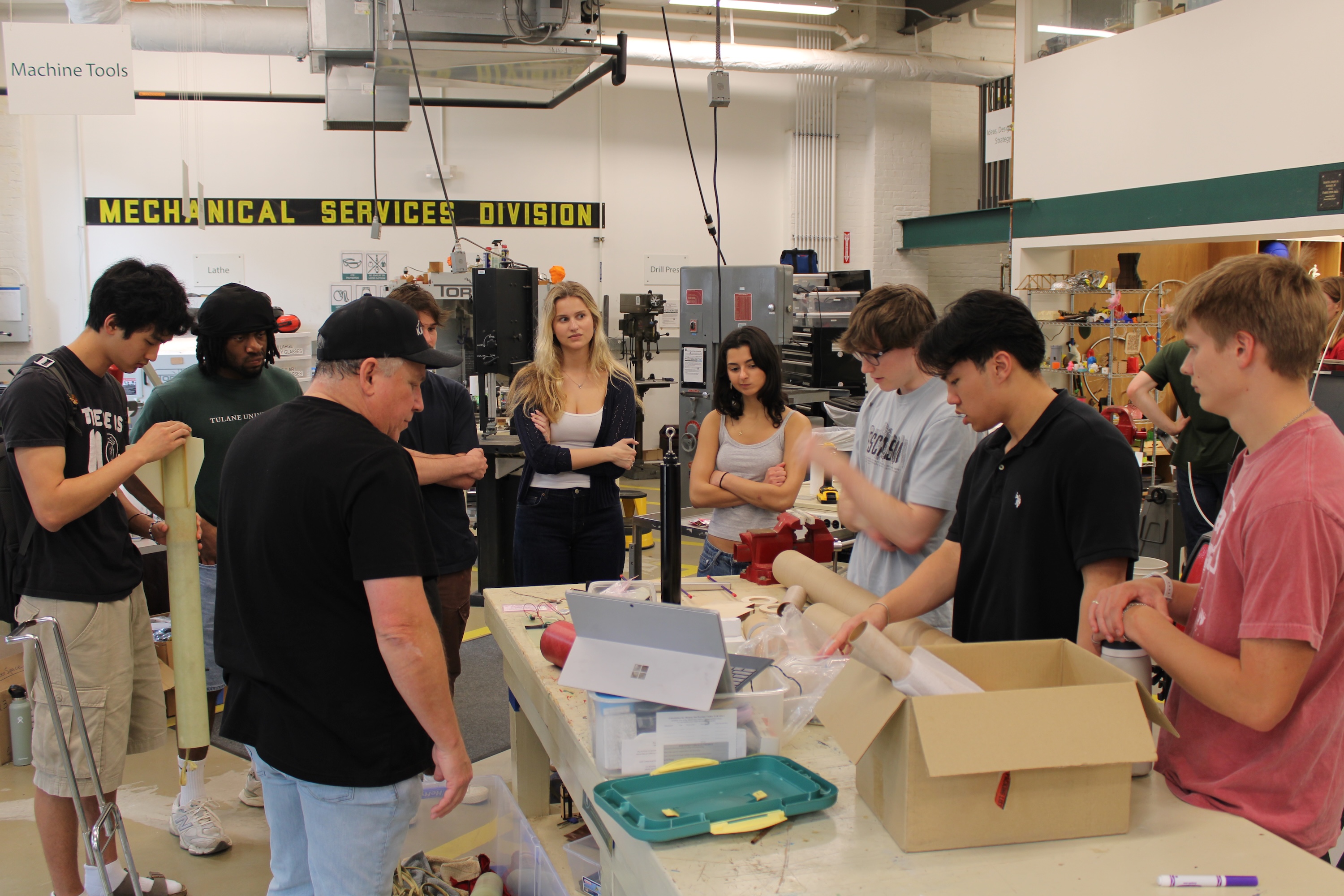
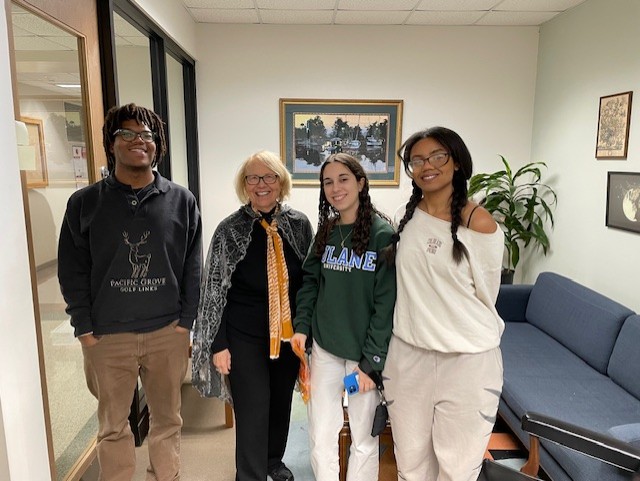
Two students are determined to prove that space is not just the final frontier, but a reachable one.

Tulane School of Medicine students toured NASA Michoud and Stennis Space Center, and one of them interned at NASA Johnson Space Center.
What Tulane Offers a Partner
Workforce. Mechanical, electrical, and civil engineering degrees now; the Space Science and Engineering minor from Fall 2027, and an artificial intelligence minor across all of it.
Research. Space photovoltaics with NASA Glenn Research Center, quantum communication, cryogenic systems, satellite remote sensing with artificial intelligence, advanced materials, planetary and Earth science, and space biology.
Human health in flight. Biomedical engineering, the School of Medicine, and a student aerospace medicine chapter with NASA experience already in place.
Location. An R1 research university in New Orleans, in the same city as NASA Michoud and within an hour of Stennis Space Center.
Readiness. SSE can contribute curriculum, faculty, and laboratory capacity to state and federal space workforce efforts, and can move on a timeline set by its partners.